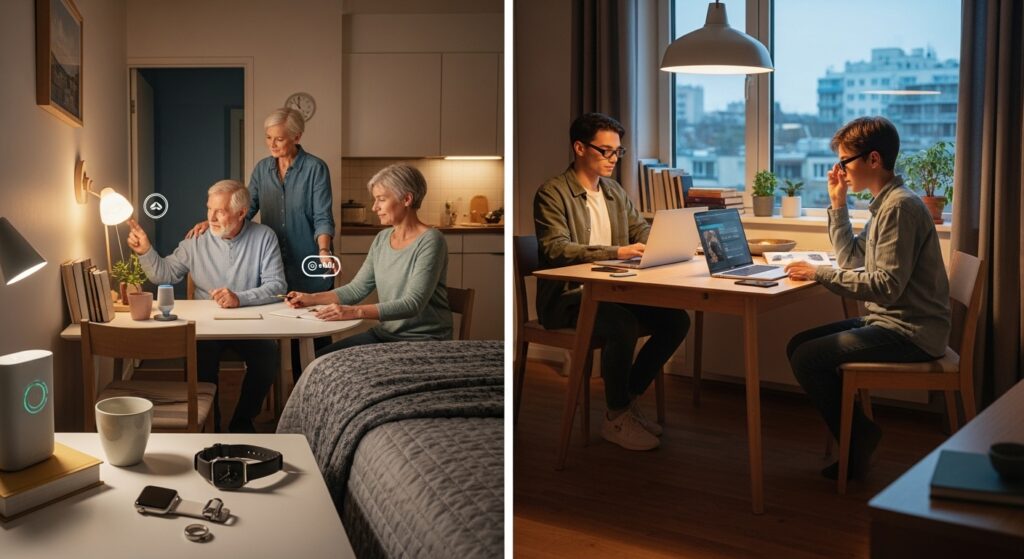

A new era of gadgets is emerging in which intelligence fades into the background, hardware becomes more personal, and convenience is judged less by novelty than by trust, endurance and usefulness.
The next generation of consumer technology is unlikely to arrive as a single breakthrough device. It will emerge as a quiet redesign of daily life, spreading across the objects people already carry, wear and speak to. The smartphone will remain central, but its dominance will be challenged less by a sudden replacement than by a growing ring of intelligent companions: glasses that can see and translate, earbuds that can interpret context, watches and rings that monitor health more continuously, and home devices that begin to act less like disconnected appliances and more like parts of a coordinated system.
For much of the last decade, consumer tech was defined by screens. Bigger screens, brighter screens, foldable screens and screens on nearly every surface. The next phase looks different. It will still involve displays, but the most important change will be a shift from interface-first design to assistance-first design. In other words, people will spend less time opening apps and more time issuing natural commands, receiving proactive suggestions, and letting devices handle routine tasks on their behalf.
Artificial intelligence is the force behind that shift, but not in the abstract way it has often been marketed. Consumers are not looking for a gadget that merely says it uses AI. They are looking for technology that saves time, reduces friction and works reliably. The winners of the next hardware cycle will be the companies that make intelligence feel practical rather than theatrical. That means better voice control that understands context, cameras that interpret the environment more accurately, software that can summarize, organize and respond across services, and devices that can do more of that work locally without constantly sending sensitive data to the cloud.
This move toward on-device intelligence will matter as much for privacy as for speed. Consumers have become more comfortable with smart assistants, but they remain wary of surveillance, hidden data collection and systems that feel intrusive. The next generation of consumer tech will therefore be shaped by a delicate bargain: people will share more data only if they see clear value and stronger safeguards. In that environment, privacy will no longer be a niche selling point. It will become part of the product itself, built into how devices process speech, biometric signals, location and personal routines.
Wearables are likely to be among the clearest examples of this transition. The smartwatch will continue to evolve, but the broader category will expand beyond the wrist. Rings, earbuds, patches and lightweight glasses are all contenders in a market that is becoming less about notifications and more about passive sensing. The promise is not simply to count steps or display messages. It is to build a continuous, low-friction layer of awareness around the body: how well a person slept, whether they are stressed, when they may be getting sick, how well they can hear, how clearly they can see, and whether a device can help them navigate the world more safely.
That is why the next generation of consumer tech may look more like health technology than entertainment technology. The boundaries between wellness, medical monitoring and everyday electronics are already blurring. The most successful devices will not try to turn every user into a quantified-self obsessive. Instead, they will work quietly in the background, surfacing only the insights that matter. A wearable that can detect an irregular pattern, warn of fatigue or support hearing and accessibility in real time is more likely to become indispensable than one that merely delivers another dashboard.
Smart glasses illustrate both the ambition and the difficulty of the new era. For years, the category promised a future that never quite arrived. The hardware was bulky, battery life was weak, and the social experience was awkward. But that may now be changing. As components shrink, microphones improve, and AI makes audio and visual interpretation more useful, glasses are becoming more plausible as an always-available layer of assistance. The breakthrough use case may not be immersive virtual worlds. It may be something simpler: translation during a conversation, navigation while walking, subtle prompts during work, or hands-free access to information in the middle of daily tasks.
Even so, consumer adoption will depend on restraint. The next successful glasses will not look like lab equipment. They will have to resemble ordinary eyewear, last all day, and give users strong control over cameras, recordings and notifications. In the next phase of consumer tech, design will matter not only aesthetically but socially. Products will need to fit into public life without making everyone nearby feel observed.
The home will change as well, though perhaps more slowly than many executives once predicted. Consumers do not want a home filled with gadgets that require separate apps, passwords and subscriptions just to turn on lights or adjust temperature. The next generation of smart home technology will be defined less by how many devices a household owns and more by whether those devices can work together simply. Interoperability, local responsiveness and reliability will become more important than flashy demos. A smart home that quietly saves energy, monitors air quality, assists older residents and coordinates lighting, security and appliances with minimal setup will feel more valuable than one packed with novelty.
This shift will also reshape the consumer tech business model. For years, the industry relied on annual upgrade cycles and the excitement of new hardware categories. That formula is weakening. Consumers are keeping devices longer, questioning subscription fatigue and demanding more value from each purchase. As a result, the next generation of consumer tech will likely emphasize durability, battery life, repairability and software longevity alongside performance. A product that lasts longer and improves through updates may win more loyalty than one designed mainly to impress at launch.
Battery technology, often overlooked in glossy product presentations, may become one of the defining battlegrounds. Smarter devices are only truly useful if they endure a full day, or several days, without anxiety. Consumers will care less about theoretical capabilities than about whether their glasses survive a commute, whether their AI laptop can work offline on a flight, and whether their wearable can monitor health continuously without becoming another object that needs constant charging. The future of consumer tech, in that sense, will be constrained by chemistry as much as by software.
There is also a broader cultural shift underway. The first wave of digital consumer technology asked people to adapt to machines. Users learned menus, settings, file systems and interfaces. The next wave will expect machines to adapt to people. Devices will need to understand speech patterns, habits, accessibility needs and emotional context. This will create enormous convenience, but it will also raise questions about dependence. If assistants become more capable, consumers may gain time while losing some autonomy, memory or patience for friction. The most responsible technology companies will be the ones that enhance human ability without making people feel managed by their own devices.
The next generation of consumer tech, then, will not be defined by a single object replacing the smartphone, nor by a fully virtual lifestyle. It will be defined by a more distributed, more intimate computing environment. Intelligence will live across many devices. Screens will matter less than context. Health, accessibility and trust will move closer to the center of product design. And the most important innovations may be the ones that barely announce themselves at all.
In the end, the future consumer device may not be the one that dazzles the most in a product keynote. It may be the one that disappears most gracefully into everyday life, helping people see, hear, learn, work and rest a little better, while asking for less attention in return.