
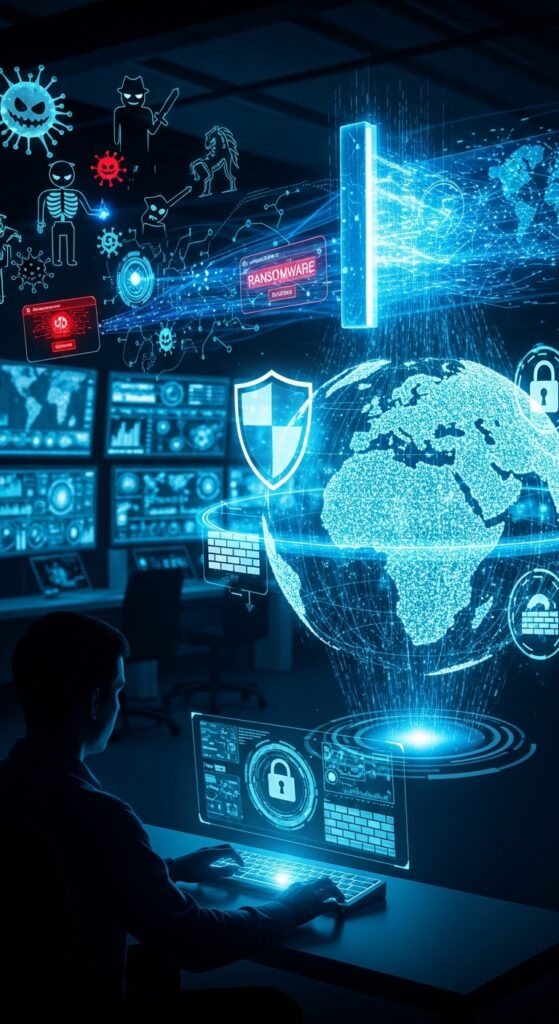
In the modern world, cybersecurity has become one of the most important concerns for individuals, businesses, and governments. As society becomes increasingly dependent on digital systems, the need to protect data, networks, and devices from cyber threats continues to grow. Nearly every aspect of life now relies on technology, from communication and banking to education, healthcare, transportation, and national defense. While these digital advancements have brought convenience and efficiency, they have also created new vulnerabilities. Cybersecurity, therefore, is no longer just a technical issue for IT professionals; it is a global challenge that affects everyone.
Cybersecurity refers to the practice of protecting computers, servers, mobile devices, networks, and information from unauthorized access, damage, theft, or disruption. Its goal is to ensure the confidentiality, integrity, and availability of data and systems. Confidentiality means that sensitive information is accessible only to authorized users. Integrity ensures that data remains accurate and unaltered. Availability means that systems and information are accessible when needed. These three principles form the foundation of cybersecurity and guide how organizations design their defenses.
The importance of cybersecurity has increased dramatically because of the rapid expansion of the internet and connected devices. Today, billions of people use smartphones, laptops, cloud services, and online platforms every day. Companies store huge amounts of personal and financial data in digital form, and governments depend on computer networks to manage public services and critical infrastructure. At the same time, cybercriminals have become more sophisticated, organized, and persistent. They use advanced tools and strategies to steal information, demand ransom, disrupt services, and exploit system weaknesses. As a result, cybersecurity has become essential for maintaining trust in the digital environment.
There are many different types of cyber threats. One of the most common is malware, a term used to describe malicious software designed to harm or exploit computer systems. Malware includes viruses, worms, trojans, spyware, and ransomware. A virus can attach itself to a legitimate file and spread when the file is opened. Worms can replicate and spread across networks without user action. Trojans disguise themselves as useful programs but contain harmful code. Spyware secretly collects information about a user’s activities, while ransomware locks files or systems and demands payment to restore access. These forms of malware can cause serious financial loss and operational disruption.
Another major cyber threat is phishing, a form of social engineering in which attackers trick people into revealing confidential information such as passwords, credit card numbers, or banking details. Phishing attacks often come through emails, text messages, or fake websites that appear legitimate. For example, a person may receive an email that seems to be from a bank, asking them to click a link and verify their account. If they do so, they may unknowingly provide their login credentials to criminals. Phishing is especially dangerous because it targets human behavior rather than technical systems. Even strong security tools can fail if users are deceived into giving away access.
Cyberattacks can also take the form of denial-of-service attacks, in which attackers flood a website or server with excessive traffic so that it becomes unavailable to normal users. A more powerful version, called a distributed denial-of-service attack, uses multiple infected devices to overwhelm a target simultaneously. Such attacks can damage business operations, interrupt services, and harm a company’s reputation. Online retailers, banks, media companies, and government agencies are all potential targets.
In addition to external threats, insider threats also pose a serious risk. These occur when employees, contractors, or other authorized users misuse their access to systems or data. Sometimes the harm is intentional, such as when an employee steals confidential information for personal gain or revenge. In other cases, it may be accidental, such as when someone clicks on a malicious link, uses a weak password, or sends sensitive data to the wrong recipient. Insider threats are particularly challenging because they come from people who already have some level of trust and access within the organization.
The consequences of cyberattacks can be severe. For individuals, a successful attack may lead to identity theft, financial loss, emotional stress, and loss of privacy. For businesses, cyber incidents can cause data breaches, service interruptions, legal penalties, customer distrust, and significant financial damage. In some cases, the cost of recovery can be so high that small businesses cannot survive. For governments and critical infrastructure providers, cyberattacks can threaten public safety and national security. Hospitals, power grids, water systems, and transportation networks are increasingly connected to digital systems, making them potential targets for disruption.
Because cyber threats are constantly evolving, cybersecurity requires a multi-layered approach. No single solution can provide complete protection. Instead, effective cybersecurity combines technology, policies, user awareness, and continuous monitoring. One of the most basic but important measures is the use of strong passwords. Weak passwords are easy for attackers to guess or crack. A strong password should be long, unique, and difficult to predict. It is also recommended to use different passwords for different accounts. Password managers can help users create and store strong passwords securely.
Another essential defense is multi-factor authentication. This method requires users to verify their identity using at least two forms of evidence, such as a password and a one-time code sent to a phone. Even if an attacker steals a password, they may still be unable to access the account without the second factor. Multi-factor authentication has become one of the most effective ways to reduce account compromise.
Keeping software updated is another critical cybersecurity practice. Software developers regularly release updates and patches to fix vulnerabilities that attackers might exploit. When users or organizations delay these updates, they leave systems exposed to known security flaws. Regular patch management is especially important for operating systems, browsers, antivirus software, and network devices. Many major cyber incidents have occurred because organizations failed to apply available security updates in time.
Firewalls and antivirus programs also play a key role in protecting systems. A firewall monitors and controls incoming and outgoing network traffic based on predefined security rules. It acts as a barrier between trusted internal networks and untrusted external sources, such as the internet. Antivirus and endpoint protection tools help detect, block, and remove malicious software from devices. However, these tools must be updated regularly to remain effective against new threats.
Data encryption is another important aspect of cybersecurity. Encryption transforms information into a coded format that can only be read by someone with the correct decryption key. This helps protect sensitive data both when it is stored and when it is being transmitted over networks. For example, encryption is commonly used in online banking, messaging applications, and e-commerce transactions. Even if data is intercepted, encryption makes it much harder for attackers to use it.
Organizations also need clear security policies and incident response plans. A security policy defines rules for how data and systems should be used, accessed, and protected. It may cover topics such as password requirements, acceptable device usage, data sharing, and employee responsibilities. An incident response plan outlines what to do when a cyberattack occurs. It usually includes steps for identifying the attack, containing the damage, recovering systems, and informing affected parties. Having a plan in place helps organizations respond quickly and reduce the impact of an incident.
Employee education and awareness are equally important. Since many cyberattacks begin with human error, training staff to recognize suspicious emails, avoid unsafe downloads, and follow security procedures can significantly reduce risk. Cybersecurity awareness should not be treated as a one-time activity. Because threats change over time, training must be ongoing and practical. Employees need to understand that cybersecurity is part of their everyday responsibilities, not just the job of the IT department.
In recent years, cloud computing has introduced both new opportunities and new security challenges. Cloud services allow organizations to store data and run applications on remote servers rather than on local systems. This provides flexibility, scalability, and cost savings. However, it also raises concerns about data privacy, shared responsibility, and access control. Misconfigured cloud settings have caused many data breaches. Therefore, organizations using cloud platforms must carefully manage permissions, encrypt sensitive data, and monitor activity to ensure security.
The rise of the Internet of Things has also complicated cybersecurity. Everyday objects such as smart cameras, home assistants, medical devices, and industrial sensors are now connected to the internet. While these devices improve convenience and efficiency, many of them have weak security features. Some use default passwords, lack regular updates, or collect large amounts of personal data. If compromised, they can be used for spying, data theft, or participation in large-scale attacks. Securing the Internet of Things requires manufacturers to build safer devices and users to configure them responsibly.
Artificial intelligence is playing an increasing role in cybersecurity as well. Security teams use AI to analyze large volumes of data, detect unusual behavior, and respond to threats more quickly. Machine learning systems can identify patterns that might indicate malware, fraud, or unauthorized access. However, attackers can also use AI to create more convincing phishing messages, automate attacks, and discover vulnerabilities faster. This creates a technological race between defenders and criminals. As AI continues to develop, cybersecurity strategies will need to adapt accordingly.
Governments around the world have recognized the strategic importance of cybersecurity. Many countries have created national cybersecurity strategies, cyber defense units, and legal frameworks for protecting data and responding to digital threats. International cooperation is also essential because cybercrime often crosses national borders. Attackers may operate in one country while targeting victims in another, making investigation and prosecution difficult. Cooperation between governments, private companies, law enforcement agencies, and international organizations is necessary to address these challenges effectively.
Cybersecurity also raises ethical and legal questions. How much monitoring should employers conduct to protect company systems? How should governments balance national security with citizens’ privacy rights? What responsibilities do technology companies have when vulnerabilities are discovered in their products? These questions do not have easy answers, but they show that cybersecurity is not only a technical field. It also involves law, policy, ethics, and human rights. The challenge is to build secure digital systems while respecting freedom, privacy, and fairness.
For students and young people, cybersecurity education is becoming increasingly important. As digital natives, many young people spend a large part of their lives online, using social media, cloud apps, and gaming platforms. However, being familiar with technology does not automatically mean being secure. Students need to learn how to protect their accounts, identify scams, manage privacy settings, and think critically about online information. Cybersecurity literacy should be part of modern education, just like reading, writing, and mathematics.
Looking to the future, cybersecurity will become even more important as technology continues to evolve. Emerging fields such as quantum computing, autonomous vehicles, smart cities, and advanced robotics will create new opportunities but also new risks. As more systems become interconnected, the potential impact of cyberattacks will grow. This means that cybersecurity must be treated as a long-term priority. Investment in research, workforce development, public awareness, and international cooperation will be essential.
At the same time, it is important to understand that perfect security does not exist. Every system has some level of risk. The goal of cybersecurity is not to eliminate all threats completely, which is impossible, but to reduce risks, strengthen resilience, and prepare for incidents. Organizations and individuals must remain alert, adaptable, and proactive. Cybersecurity is a continuous process rather than a one-time solution.
In conclusion, cybersecurity is one of the defining challenges of the digital age. It protects the systems and information that modern life depends on, from personal communications to national infrastructure. As cyber threats become more advanced, the need for strong cybersecurity practices becomes more urgent. Effective protection requires a combination of technology, awareness, policies, and cooperation. It also requires a cultural shift in which everyone understands their role in maintaining digital safety. In a world where so much of human activity takes place online, cybersecurity is not optional. It is a fundamental requirement for security, trust, and stability in the twenty-first century.
