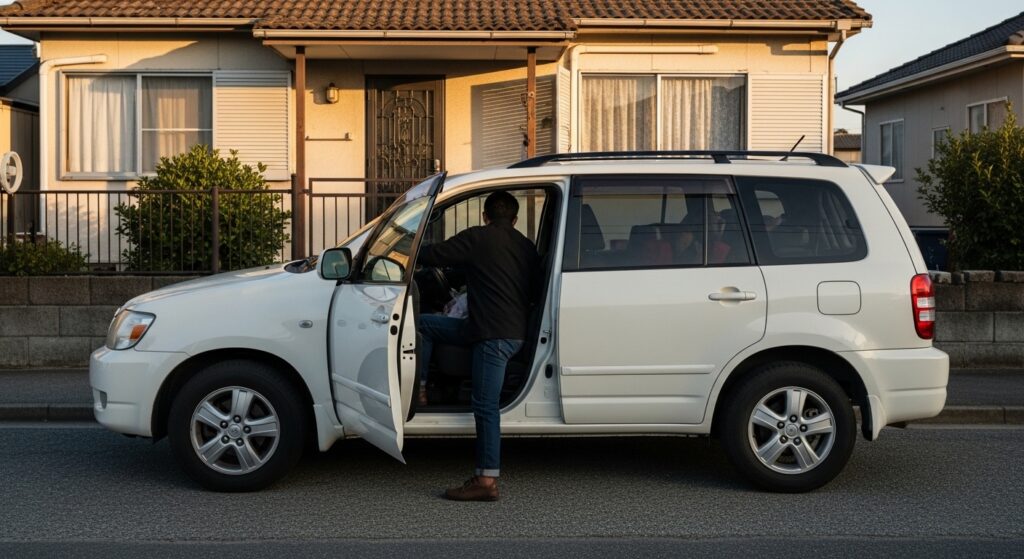
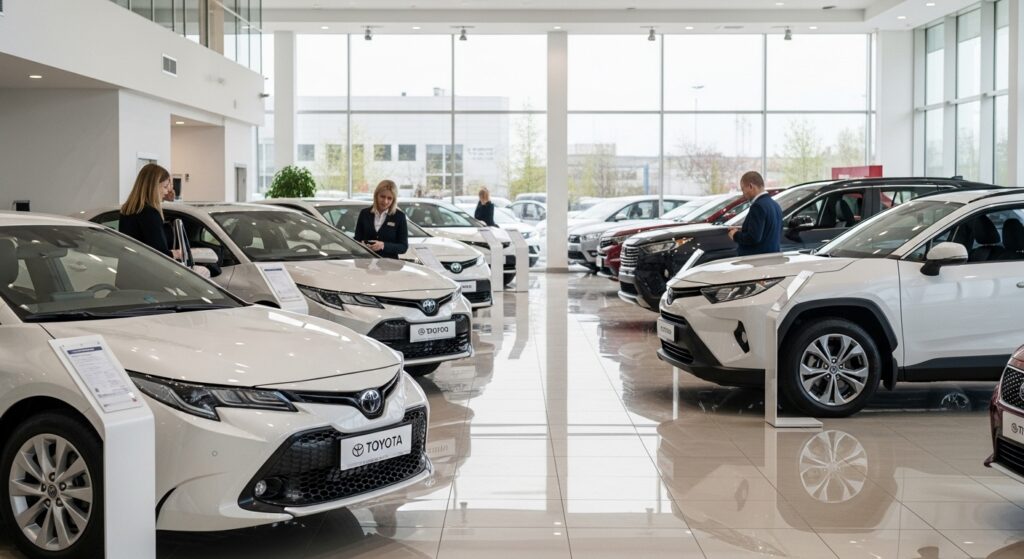
With a broad lineup, steady ownership costs and a reputation for durability that continues to hold up in major consumer surveys, Toyota remains one of the auto industry’s clearest symbols of practical confidence rather than automotive theater.
TOKYO — In an era when the car market is increasingly shaped by touchscreen spectacle, software promises and luxury branding, Toyota continues to occupy a more grounded position in the public imagination: the dependable choice, the brand people buy when they want something that starts every morning, ages slowly and does not turn ownership into a financial gamble.
That image, often summed up in Vietnam by the phrase “ăn chắc mặc bền,” has proved remarkably durable. Toyota is not always the boldest brand, the cheapest brand or the most exciting brand on paper. But it has become one of the most trusted. For millions of drivers, that matters more than dramatic design or bragging rights.
The case for Toyota has long rested on a simple proposition. Reliability reduces stress. Reliability protects resale value. Reliability lowers the odds that a family budget will be disrupted by unexpected repairs. In a market where the cost of owning almost any vehicle has risen — from insurance to financing to maintenance — that kind of predictability has become an even more valuable selling point.
Consumer Reports has again placed Toyota near the top of its reliability rankings, reinforcing a reputation the company has spent decades building. The significance of those rankings is not merely marketing. They reflect something consumers feel in everyday use: Toyota has built a brand around engineering discipline, conservative calibration and incremental improvement. It is often less interested in being first than in being proven.
That philosophy helps explain why Toyota’s appeal cuts across demographics and income levels. For first-time buyers, it offers reassurance. For families, it offers practicality. For older drivers, it offers familiarity and lower hassle. Even for wealthier consumers who could afford a premium badge, Toyota can still make sense as the rational purchase — a car chosen not to impress the street, but to simplify life.
This is one reason Toyota has maintained unusual breadth in its lineup. It is not dependent on a single body style or buyer profile. The company has products that stretch from compact sedans to large SUVs, from urban hybrids to pickup trucks and family minivans. A customer entering the brand can begin with a Corolla, move later to a Camry or RAV4, and eventually consider a Highlander, Sienna, Tacoma or Land Cruiser depending on need, region and budget. That range gives Toyota a structural advantage: it can keep customers inside the brand as their lives change.
The sedan category illustrates Toyota’s staying power particularly well. While many rivals have abandoned traditional passenger cars in favor of crossovers, Toyota has continued to treat sedans as serious volume products rather than legacy obligations. The Corolla remains a global symbol of straightforward value, while the Camry has long embodied the middle-class formula of comfort, efficiency and low drama. These are not vehicles built around fantasy. They are built around routine, and there is still a massive market for that.
Toyota’s strength in SUVs has further expanded its reach. The RAV4 has become one of the company’s most important models because it sits at the intersection of nearly every modern buying preference: elevated ride height, family practicality, fuel efficiency in hybrid form and a nameplate widely associated with dependability. Above it, Toyota offers larger SUVs for buyers who need more room or a more rugged image, while off-road-focused models preserve a distinct identity that reaches beyond pure commuting.
That diversity matters because the contemporary car market is fragmented. Some buyers want efficient city transport. Others want seven seats. Others want all-wheel drive, a hybrid powertrain or a vehicle that can absorb years of hard use. Toyota’s product strategy works because it rarely tries to force one answer onto every problem. It gives customers a menu of sensible answers.
The company’s hybrid credentials have also become central to its enduring appeal. Long before electrification became an industry-wide race, Toyota had already established itself as a pioneer through the Prius and then expanded hybrid systems across a much broader share of its lineup. That move now looks less like an early niche experiment and more like a long strategic head start. For many buyers, especially those not ready to commit fully to battery-electric vehicles, Toyota hybrids represent a middle path: lower fuel consumption and established technology without the anxiety some consumers still feel about charging infrastructure or long-term EV ownership habits.
That helps keep Toyota relevant in a transitional auto era. While some rivals have tried to define themselves around aggressive electric-vehicle narratives, Toyota has largely stayed loyal to a multi-pathway approach, mixing hybrids, plug-in hybrids, fuel-cell ambitions and battery EV development. Critics have sometimes portrayed that strategy as cautious to a fault. Supporters see it differently: as an extension of the same conservative pragmatism that built Toyota’s reliability brand in the first place.
Pragmatism also shapes the ownership-cost argument. Toyota vehicles are not universally cheap, and some popular models command strong prices precisely because demand is high and used values remain firm. But total ownership cost often feels easier to live with than at more premium brands. Parts and service networks are well established. Maintenance expectations are familiar. Repair horror stories exist, as they do with any manufacturer, but they are less central to the brand narrative than with many competitors. In the minds of consumers, Toyota’s value lies not only in what it costs to buy, but in how rarely it creates financial surprises.
That does not mean the brand is perfect. Toyota has sometimes been criticized for interiors that lag more stylish competitors, infotainment systems that historically felt less intuitive than the best in the segment, and driving experiences that prioritize ease over excitement. There are also market-specific caveats: some models are more compelling than others, and no large automaker is immune from recalls, supply disruptions or missteps. A reputation for dependability is not a guarantee of flawlessness.
Yet Toyota’s real strength may be that its limitations are widely understood and often accepted by buyers in advance. People generally do not approach Toyota expecting radical design, exotic performance or ultra-luxury finishes. They approach it expecting durability, ease of use and resale stability. When a brand consistently delivers what customers actually came for, its trust capital grows.
Safety has also become a bigger part of Toyota’s mainstream identity. The company has emphasized Toyota Safety Sense across much of its lineup, offering driver-assistance technologies that help make advanced safety features feel less exclusive to luxury vehicles. In the broader market, this matters because the definition of “value” has evolved. Buyers are no longer judging only engine reliability and fuel bills. They are also weighing crash technology, active safety support and how much standard equipment they receive before moving up the price ladder.
Toyota’s global scale reinforces all of this. It remains one of the world’s biggest automakers not simply because it sells in many markets, but because its basic formula travels well. Reliability means one thing to an urban commuter in Asia, another to a suburban family in North America, and another to a fleet buyer in the Middle East or Africa. But the underlying demand is similar: a vehicle that can tolerate routine use, imperfect roads, varying climates and years of ownership without becoming a burden. Few brands have translated that requirement into global trust as effectively as Toyota.
That trust has become even more meaningful at a time when many consumers feel uneasy about complexity in modern cars. Software-defined vehicles promise convenience, but they also raise fears about glitches, subscription creep and expensive out-of-warranty electronics. Against that backdrop, Toyota’s reputation for evolutionary rather than revolutionary engineering starts to look like a competitive advantage. There is comfort in a machine that feels designed to last longer than the product cycle of a smartphone.
The result is that Toyota occupies a rare position in the industry. It is large enough to be mainstream, disciplined enough to be credible, and familiar enough to feel safe. It may not dominate every conversation among enthusiasts, but it consistently appears in the conversations that matter most to ordinary buyers: Which car will hold up? Which one will be easy to maintain? Which brand is the least likely to make ownership miserable?
Those questions may sound unglamorous. But they are the questions that shape household decisions. In that respect, Toyota has built something more durable than trendiness. It has built a brand associated with peace of mind.
That is why Toyota continues to stand out as the “safe bet.” Not because it promises perfection, and not because every model is automatically the best in class, but because it has spent decades proving that consistency itself is a form of value. In a volatile auto market filled with novelty and noise, Toyota’s most powerful feature may still be the simplest one: people believe it will keep doing its job long after the excitement of the purchase has faded.