
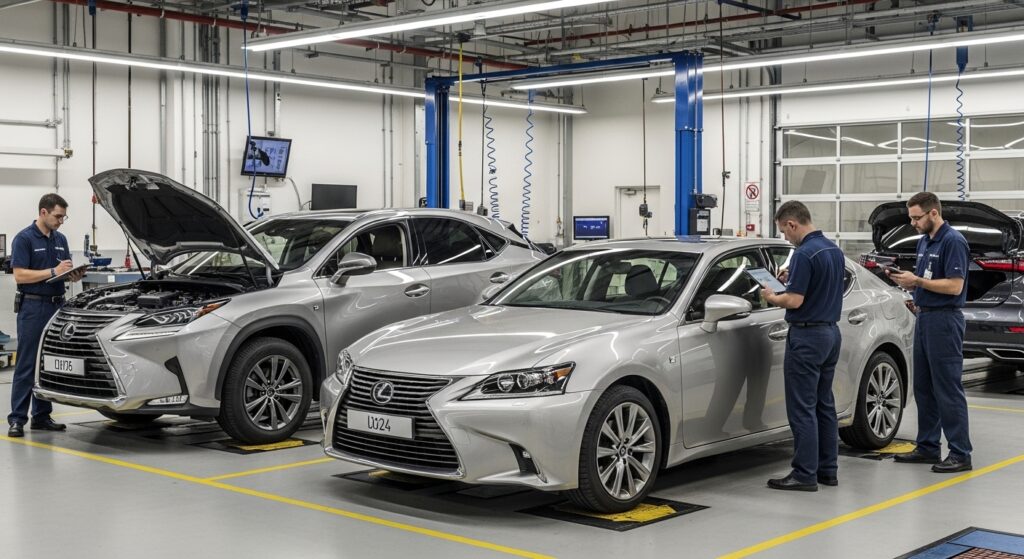
Even as the luxury auto market races toward bigger screens, more software and more complexity, Lexus continues to dominate the conversation around durability and dependability, reinforcing a reputation that many rivals still struggle to match.
In the modern car business, reliability has become one of the hardest virtues to maintain. Vehicles now carry more software, more driver-assistance systems, more connectivity features and more complicated powertrain choices than at any time in the industry’s history. For buyers, that has raised a basic but important question: which brands still build cars that simply hold up? Lexus remains one of the strongest answers.
The evidence in 2026 is clear, though it requires one important distinction. In Consumer Reports’ latest brand reliability ranking for new vehicles, Lexus did not finish first overall. Toyota led the list, followed by Subaru, with Lexus in third place. Yet that result does not weaken Lexus’ standing so much as sharpen its identity. It confirms that Lexus remains firmly in the top tier of the industry while continuing to stand out as the most credible reliability name in the luxury segment. Consumer Reports said Lexus, Subaru and Toyota again occupied the top of its reliability hierarchy, and described Lexus as a brand whose models consistently deliver average or better reliability. :contentReference[oaicite:1]{index=1}
That consistency matters more than a single headline rank. Reliability leadership is not only about finishing first in one survey cycle; it is about staying near the top year after year while competitors rise and fall with redesigns, software problems and platform transitions. On that measure, Lexus is unusually resilient. Consumer Reports noted that every Lexus model in its current ranking earned an average-or-better reliability rating, led by the IS sports sedan. It also highlighted the NX, NX Hybrid and UX as the three most reliable luxury small SUVs, while noting that the TX leads the luxury midsized three-row SUV category and the RZ posted the best predicted reliability among luxury electric SUVs. :contentReference[oaicite:2]{index=2}
If Consumer Reports shows Lexus as a durability heavyweight, J.D. Power’s newest long-term data goes further. In the 2026 U.S. Vehicle Dependability Study, Lexus ranked highest overall among all brands for the fourth consecutive year, posting 151 problems per 100 vehicles. In J.D. Power’s framework, a lower score is better, and the result placed Lexus ahead of Cadillac and Porsche among premium brands while also ahead of every mass-market marque measured in the study. That is especially notable because the industry’s average worsened to 204 PP100, the highest recorded level since the study was redesigned in 2022. :contentReference[oaicite:3]{index=3}
The broader context makes Lexus’ performance even more meaningful. J.D. Power said long-term dependability in 2026 was being dragged down by infotainment issues, weak owner perceptions of over-the-air updates and recurring exterior complaints. Premium vehicles in particular underperformed mass-market brands in seven of the study’s nine categories, and premium-segment problem levels rose sharply year over year. That Lexus still finished first overall suggests that its advantage is not merely historical reputation. It is surviving in precisely the part of the market where complexity has made consistency hardest to preserve. :contentReference[oaicite:4]{index=4}
There is also a model-level story behind the brand result. J.D. Power said Toyota Motor Corporation had the top overall model in the 2026 study, the Lexus IS, and collected the most model-level awards with eight. That matters because brand reputations in reliability are often built one vehicle at a time. Owners do not experience a corporate slogan; they experience a specific sedan, crossover or SUV in daily use over years. When the Lexus IS emerges as the top overall model in a major dependability study, it reinforces the idea that the company’s reputation is rooted in ownership experience, not marketing mythology. :contentReference[oaicite:5]{index=5}
Part of Lexus’ strength appears to come from a philosophy that is less glamorous than the industry’s current obsession with constant novelty. Consumer Reports pointed to the value of shared components and conservative, incremental changes in supporting reliability at the top of the rankings. That formula fits Lexus closely. As Toyota’s luxury arm, Lexus benefits from platforms, hybrid systems and engineering approaches that have often been proven before they are pushed into broad deployment. In an era when many automakers chase fast technological differentiation, Lexus has often preferred disciplined refinement. The payoff is visible in both owner surveys and long-term dependability data. :contentReference[oaicite:6]{index=6}
This helps explain why Lexus remains unusually strong even as luxury buyers demand more from their vehicles. Today’s premium customer expects not just comfort and craftsmanship, but also seamless smartphone integration, advanced interfaces, electrified powertrains and software-driven convenience. Those features can enhance ownership when they work, but they also create more opportunities for failure. J.D. Power identified Android Auto and Apple CarPlay connectivity, Bluetooth systems, wireless charging pads and app connectivity among the industry’s top trouble areas. In that environment, Lexus’ dependability edge becomes more impressive because it is being maintained despite the same technological pressures affecting everyone else. :contentReference[oaicite:7]{index=7}
Lexus’ hybrid strength is another part of the picture. Consumer Reports said hybrids continue to be more reliable than EVs and plug-in hybrids overall, and noted that the Lexus NX Hybrid scored near the top of its category. That plays into one of Lexus’ core strategic advantages. While some rivals have taken bolder but riskier leaps into highly complex EV and software ecosystems, Lexus and Toyota have spent years building credibility through hybrid systems that are familiar, mature and comparatively well understood. For buyers who want efficiency without becoming early adopters of more failure-prone technology, that matters. :contentReference[oaicite:8]{index=8}
None of this means Lexus is untouchable. Consumer Reports’ latest overall ranking shows that Toyota currently sits ahead of it in new-car reliability, and the luxury market remains under pressure from the same digitization and feature creep that have affected the rest of the industry. Lexus also faces a strategic balancing act: preserve its reputation for durability while adding enough design, performance and technology appeal to remain competitive against German and American luxury rivals that may take more risks. Reliability alone is a powerful selling point, but it is not the only one. :contentReference[oaicite:9]{index=9}
Still, in one crucial respect, Lexus occupies a rare position. It has managed to turn reliability from a supporting virtue into a central brand asset without making the vehicles feel purely utilitarian. Consumer Reports describes the marque as one of the few luxury automakers that combines technologically advanced designs with consistently great reliability. That combination is harder to achieve than it sounds. Many brands can deliver luxury. Many can deliver technology. Fewer can deliver both while also minimizing the ownership friction that erodes customer trust over time. :contentReference[oaicite:10]{index=10}
For consumers, this matters in practical terms more than abstract rankings ever could. Reliability affects repair bills, downtime, resale value, dealer visits and the quiet daily confidence that a vehicle will simply do what it is supposed to do. Dependability studies often sound dry, but they measure the lived texture of ownership. A car that starts trouble-free, integrates cleanly with devices, avoids recurring faults and ages predictably is not just better on paper. It is easier to own. That is where Lexus continues to win. :contentReference[oaicite:11]{index=11}
In a market increasingly defined by technological ambition, Lexus has become a reminder that restraint can be competitive. The brand does not always move first. It does not always make the loudest claim. But year after year, it remains near or at the top where many owners care most: the likelihood that the vehicle will hold together. Consumer Reports’ latest data show Lexus still entrenched among the most reliable brands in America, while J.D. Power’s 2026 study places it first overall for long-term dependability yet again. Taken together, those results do not just confirm a strong year. They confirm an enduring identity.
That identity may be one of the most valuable things Lexus has built. In an industry where prestige can be bought through design and performance can be engineered through horsepower, trust is slower to earn and easier to lose. Lexus has spent decades accumulating it. The 2026 data suggest it still has more of it than almost anyone else.