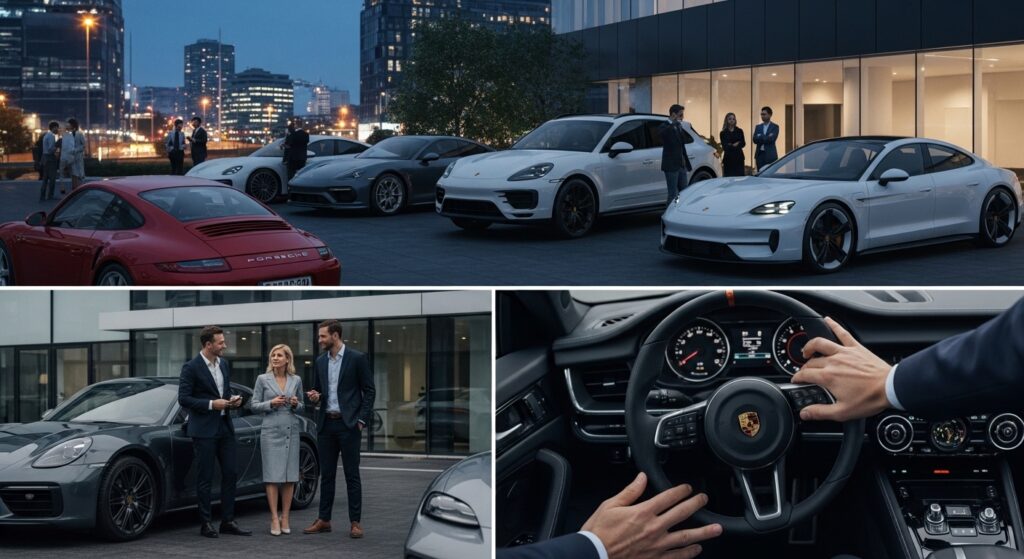
If buyers rank steering precision, build quality and brand prestige above almost everything else, Porsche continues to occupy a rare position in the premium market: a manufacturer that sells luxury not as softness or ornament, but as engineering confidence.
In the global luxury-car business, many brands can offer speed. Many can offer leather, digital screens and carefully lit showrooms. Fewer can consistently combine performance credibility, tactile quality and social cachet into a product line that feels coherent from top to bottom. That is why Porsche continues to hold such unusual power in the premium segment. It is not merely a luxury brand, nor simply a sports-car maker with an upscale badge. It is one of the few automotive names that still carries the promise that the driving experience itself will justify the price.
That promise is central to Porsche’s appeal. For decades, the company has built its reputation not only on straight-line performance figures or brand mythology, but on how its cars feel at speed and in the hand: steering response, brake modulation, chassis balance, seat position, visibility, pedal placement and the sense that the machine has been tuned by people who still care how it communicates. In an era when many premium vehicles are becoming heavier, quieter and more software-mediated, Porsche has preserved a rare identity. Its cars often feel engineered first as drivers’ tools and only then as luxury products. For many buyers, that order matters.
It also helps explain why Porsche continues to perform well in quality and owner-satisfaction studies, even in a market where consumers increasingly complain about software complexity and digital glitches. J.D. Power’s 2025 U.S. Vehicle Dependability Study ranked Porsche third among premium brands, behind Lexus and Cadillac, placing it firmly in the upper tier of long-term ownership performance among luxury marques. That result is significant not because Porsche led the study outright — it did not — but because it reinforces the brand’s ability to remain competitive on dependability while building vehicles that are generally more performance-focused than many of its premium rivals.
The distinction is important. Buyers often assume that the more emotionally engaging a car is, the more likely it is to be compromised in daily ownership. Porsche’s brand strength has long rested on challenging that assumption. It sells excitement, but increasingly with the expectation that the car will also function as a credible long-term possession rather than a temperamental indulgence. In luxury markets, that is a powerful combination. Prestige is attractive; prestige plus confidence is stronger.
Porsche’s standing in J.D. Power’s 2025 quality awards adds another layer to that image. In the company’s 2025 quality ratings, which focus on problems experienced during the first 90 days of ownership, the Porsche 911 ranked highest in the Premium Sporty Car segment. For a model as symbolically important as the 911, that matters beyond one award category. The 911 is not just another vehicle in Porsche’s portfolio. It is the center of gravity for the brand’s identity — the machine through which Porsche’s claims about engineering, performance and heritage are judged most harshly. When that car leads its segment on initial quality, it strengthens Porsche’s broader argument that performance and execution do not have to come at the expense of ownership refinement.
There is also the matter of emotional appeal, which remains one of Porsche’s strongest differentiators. In the 2025 J.D. Power U.S. APEAL Study, Porsche ranked first in the premium segment for the second consecutive year, while the 911 again took the top spot in the Premium Sporty Car category. That study measures emotional attachment and excitement rather than long-term dependability, but for Porsche, the result is especially revealing. It suggests that the brand is not only satisfying owners in technical categories. It is sustaining the harder-to-quantify dimension that luxury performance brands depend on: the feeling that the car continues to feel special after the transaction is over.
That feeling is no small part of Porsche’s market position. Luxury buyers are often purchasing more than mobility. They are buying reassurance, identity and an experience that begins before the engine starts. Porsche has managed to translate that into a brand language that feels unusually stable. A Porsche signals affluence, but usually in a way that is read as informed rather than merely extravagant. It implies taste shaped by machinery and design, not just price. For some buyers, that distinction is exactly the point. The car does not simply say money; it says discernment.
This is one reason Porsche occupies such a strong place in discussions of “best premium brand” even when competitors may surpass it in isolated categories. Mercedes-Benz can emphasize luxury tradition. BMW can argue breadth and driver engagement. Lexus can point to dependability leadership. Ferrari can claim emotional intensity at a higher stratum of exclusivity. But Porsche’s strength lies in how little compromise it appears to demand between categories. It offers prestige without losing engineering seriousness, luxury without becoming inert, and performance without entirely surrendering daily usability. That balance is difficult to replicate.
The 911 remains the clearest expression of that formula, but Porsche’s wider lineup has helped turn the brand from an icon into a durable business. SUVs such as the Cayenne and Macan brought Porsche to buyers who wanted family practicality without giving up the badge’s performance aura. The Panamera extended the formula into executive-car territory. The Taycan pushed Porsche into the electric era while preserving much of the visual and dynamic identity that existing customers expect. This broader lineup matters because it allows Porsche to sell a way of thinking about premium mobility, not just one legendary sports car.
Still, the halo of the 911 remains essential. It is the proof point that legitimizes everything else. A luxury brand can broaden its range only so far before buyers begin to question whether the original promise still holds. Porsche’s advantage is that the 911 continues to sustain that promise at a very high level. Awards for quality, appeal and performance are not merely trophies in this context. They are part of a wider credibility system that tells buyers the core of the brand is still intact.
That credibility also rests on interior execution, an area where Porsche has historically performed better than many brands that chase drama at the expense of tactile quality. When people describe Porsche’s “quality,” they are often referring to more than reliability statistics. They mean the weight of a switch, the solidity of trim, the alignment of panels, the way a seat supports the body over time, and the sense that materials have been chosen to endure rather than merely impress during a showroom visit. In the premium market, this kind of finish is not always easy to maintain as cabins become more digital. Porsche’s continued strength lies in making modern interiors feel expensive without becoming flimsy or over-styled.
Of course, Porsche is not perfect, and any serious assessment should resist turning the brand into a myth. It does not top every dependability chart. Its vehicles are expensive to buy and maintain. Options pricing can be punishing. As with much of the industry, software and digital interfaces remain pressure points. And in some segments, rivals may offer more comfort, more technology for the money or better pure value. But buyers who choose Porsche are often not trying to optimize one category. They are choosing a total package in which driving character carries unusually high weight.
That is why Porsche remains so prominent whenever people talk about the “top” premium brands. It is not simply because the badge is admired. Many badges are admired. It is because Porsche still manages to make the product feel worthy of the admiration. The brand’s strongest case has never rested on marketing alone. It rests on the recurring impression, confirmed by owners, critics and industry studies alike, that Porsche has preserved something many luxury marques struggle to hold onto as they scale: a sense of purpose.
If the priority is softest ride, lowest cost of ownership or the most gadget-heavy cabin, there are other strong arguments elsewhere. But if the brief is more specific — driving experience first, excellent execution, and unmistakable prestige — Porsche remains very close to the front of the line. In many corners of the premium market, it is still the standard against which others are measured.