
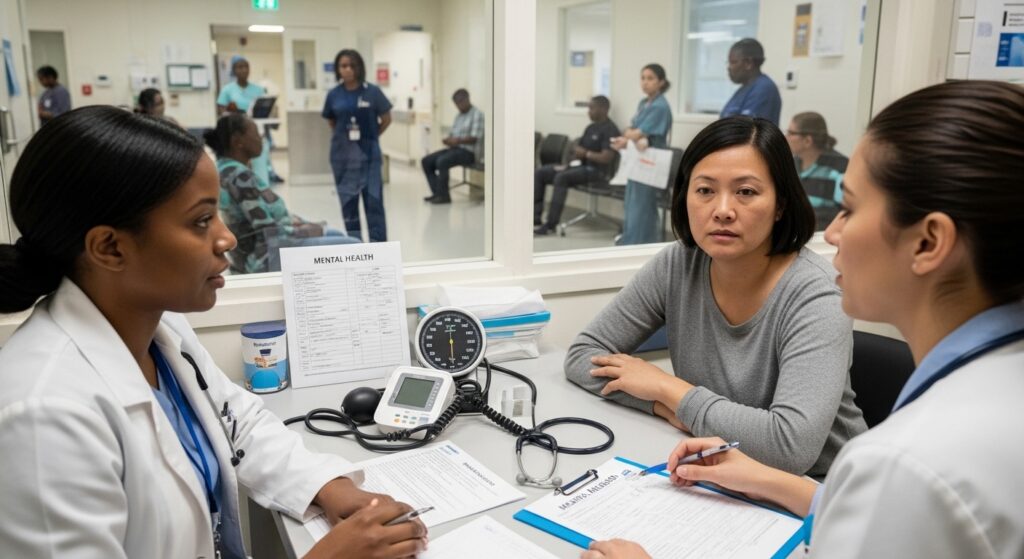
From hospitals and schools to offices and public policy, mental health is increasingly being treated not as a secondary concern, but as an essential part of overall health that demands equal attention, investment and protection.
For much of modern history, healthcare systems treated the body and the mind as if they belonged to different worlds. Broken bones, infections, heart disease and cancer were seen as concrete medical concerns, measurable and urgent. Anxiety, depression, trauma and emotional distress were often pushed to the margins, framed as private weakness, family burden or social discomfort rather than central public health issues. That separation is now narrowing. Across governments, workplaces and communities, mental health is being recognized with new seriousness, and increasingly, it is being placed on the same level as physical health.
The shift is not only cultural. It is institutional. The U.S. Centers for Disease Control and Prevention states plainly that mental and physical health are equally important components of overall health, and that each is closely linked to the other. That language reflects a broader public health understanding: emotional well-being affects sleep, immunity, chronic disease management, cardiovascular risk and quality of life, just as physical illness can shape mood, cognition and psychological resilience. Mental health is no longer being described as an optional dimension of wellness. It is being defined as health itself. :contentReference[oaicite:1]{index=1}
This matters because the burden is enormous. According to the World Health Organization, more than one billion people are living with mental health conditions worldwide, while major gaps in resources, workforce and care quality leave most of them without adequate support. WHO’s 2025 reporting and policy guidance describe a system that remains chronically underfunded even as demand rises and governments acknowledge the scale of the problem more openly. The message is increasingly difficult to ignore: mental ill health is not peripheral. It is one of the central health challenges of modern life. :contentReference[oaicite:2]{index=2}
Part of the reason mental health has moved closer to the center of public debate is that the old hierarchy has become harder to defend. The separation between mental and physical health was never medically tidy. Depression is linked with increased risk of chronic conditions such as heart disease, stroke and diabetes, according to the CDC. Chronic pain, disability and serious illness, in turn, can worsen mental distress or trigger it. Someone struggling emotionally may delay treatment, eat poorly, sleep badly or find it harder to maintain medications and appointments. Someone facing long-term physical disease may experience fear, grief and exhaustion that shape outcomes just as surely as a lab result does. To treat one without the other is often to treat neither fully. :contentReference[oaicite:3]{index=3}
That recognition is changing health policy language. In March 2025, WHO released new guidance calling for countries to reform and strengthen mental health policies and systems, stressing that services remain underfunded and access remains inadequate in many places. Later that year, WHO also issued guidance promoting a “mental health in all policies” approach, urging governments to consider mental health not only inside hospitals and clinics, but across education, employment, housing, social protection and crisis response. This is a significant shift. It suggests that mental health is no longer viewed simply as the responsibility of specialists. It is becoming a whole-of-society policy issue, much like vaccination, nutrition or chronic disease prevention. :contentReference[oaicite:4]{index=4}
The workplace is one of the clearest arenas where this change can be seen. For years, physical safety in employment was treated as a legitimate management obligation, while mental strain was often dismissed as a personal problem. That distinction is now under pressure. OECD analysis notes that mental ill health can lead to poor work performance, high sickness absence and reduced labor market participation, and that effective responses require integrated services across health, employment, education and social sectors. At the same time, the CDC has emphasized organizational changes that can support worker mental health and prevent burnout. The implication is clear: protecting employees now means more than preventing accidents or providing insurance. It also means addressing overload, isolation, insecurity and unhealthy workplace culture. :contentReference[oaicite:5]{index=5}
Schools are also becoming central to this rebalancing. Young people today are growing up in environments shaped by academic pressure, digital overstimulation, social comparison and, in many cases, lingering disruption from recent years of crisis and instability. Public health agencies increasingly frame student well-being not as a soft extra, but as a condition for learning itself. A child who is anxious, depressed, traumatized or chronically overwhelmed is not simply facing an emotional problem separate from education. That child is facing a barrier to concentration, memory, attendance, confidence and long-term development. The logic is increasingly similar to physical health in schools: just as vision, nutrition and vaccination matter for learning, so do emotional regulation, social support and access to care. :contentReference[oaicite:6]{index=6}
Healthcare systems themselves are being pushed to adapt. In many countries, mental health services have historically been fragmented, stigmatized or geographically scarce. Specialist care is often hard to access, waiting times are long, and primary care providers may lack support, training or referral pathways. WHO’s recent work highlights persistent shortages in workforce and service capacity, while its long-running mhGAP effort continues to focus on scaling up care, especially in low- and middle-income countries. The broader direction is toward integration: mental health screening in primary care, community-based services rather than institutional isolation, and a model in which emotional well-being is addressed alongside routine medical treatment rather than after everything else fails. :contentReference[oaicite:7]{index=7}
This does not mean the goal has been achieved. In many places, parity remains more aspiration than reality. Physical symptoms still tend to command faster recognition and more reliable reimbursement. Stigma has not vanished. Some employers speak the language of mental well-being while maintaining workloads and expectations that undermine it. Schools may acknowledge student distress without having counselors, training or referral systems to respond adequately. Governments may launch campaigns while devoting only limited funding to actual services. The gap between public rhetoric and lived experience remains wide.
Still, the direction of travel is unmistakable. Mental health has become harder to trivialize because its effects are now visible across systems that societies care deeply about: healthcare expenditure, workforce participation, school performance, social cohesion and long-term disability. OECD work on both health and labor underscores that mental ill health carries broad social and economic consequences, while WHO’s latest data show that the unmet need is global and substantial. In policy terms, this makes mental health not only a moral issue but also a pragmatic one. Societies can no longer afford to treat it as secondary. :contentReference[oaicite:8]{index=8}
There is also a human reason the shift has gained traction. More people now speak publicly about therapy, grief, burnout, loneliness, trauma and the emotional effects of instability. Athletes, executives, teachers, parents and students have all contributed to a wider recognition that mental distress does not belong to a narrow group. It is part of ordinary life, and sometimes part of illness, recovery and work itself. That greater visibility has helped recast mental health from something hidden and exceptional into something universal and continuous. Everyone has mental health, just as everyone has physical health. Both can strengthen, decline, recover or require care.
The most meaningful version of parity, then, is not symbolic. It is operational. It means a patient with chest pain and panic is treated as a whole person. It means a workplace that measures health not only by injury rates but by whether people can function without chronic psychological strain. It means insurance, policy and public messaging that do not relegate mental care to the margins. It means schools that understand emotional stability as part of educational success. It means governments that see housing, poverty, violence and social exclusion as mental health issues as much as economic ones.
To place mental health on the same level as physical health is not to diminish the body. It is to stop pretending the mind can be separated from it. The old model was based on division: one set of diseases counted as real, urgent and public, while the other was too often deferred, moralized or ignored. The emerging model is more honest. It recognizes that health is not complete when the body is treated but the person is not.
That recognition is still uneven, and resources still lag far behind need. But the conceptual shift is already significant. Mental health is no longer merely being appended to health conversations as an afterthought. It is moving toward the center of them. In a century defined by chronic stress, rapid social change, digital overload and persistent inequality, that may prove one of the most important corrections modern health systems can make. Equal priority is not a slogan. It is the standard that reality now demands.