What began as a faster mobile standard is becoming something broader: a new layer of digital infrastructure that is reshaping office routines, remote collaboration, industrial operations and the way people stay in touch across daily life.
For years, 5G was marketed mainly in terms of speed. Wireless carriers promised faster downloads, smoother streaming and a more responsive mobile internet experience. Those gains were real, but they never captured the full significance of the technology. The deeper story is now emerging more clearly. As 5G networks mature, they are changing not only how quickly people consume content, but how they work, communicate and organize daily life around constant, portable connectivity.
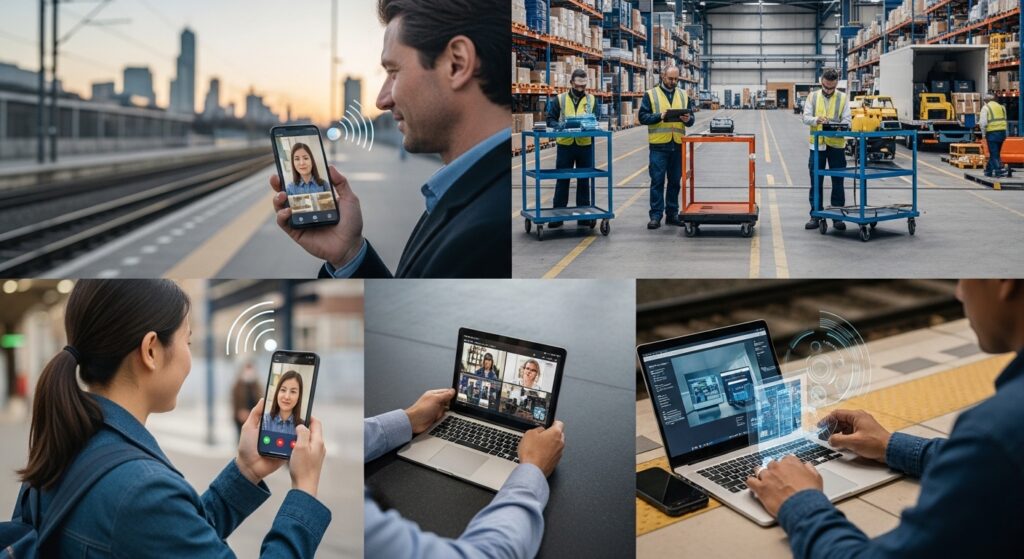
That shift matters because the modern economy no longer treats connectivity as a convenience. It treats it as infrastructure. A video call with a client, a cloud-based design review, a live translation feature during a virtual meeting, a field technician uploading diagnostics from a remote site, a warehouse tracking equipment in real time, or a family checking in across cities and countries all depend on networks that can move large amounts of data with minimal delay. In that environment, 5G is proving important not simply because it is faster than 4G, but because it is better suited to a world in which work and communication increasingly happen everywhere at once.
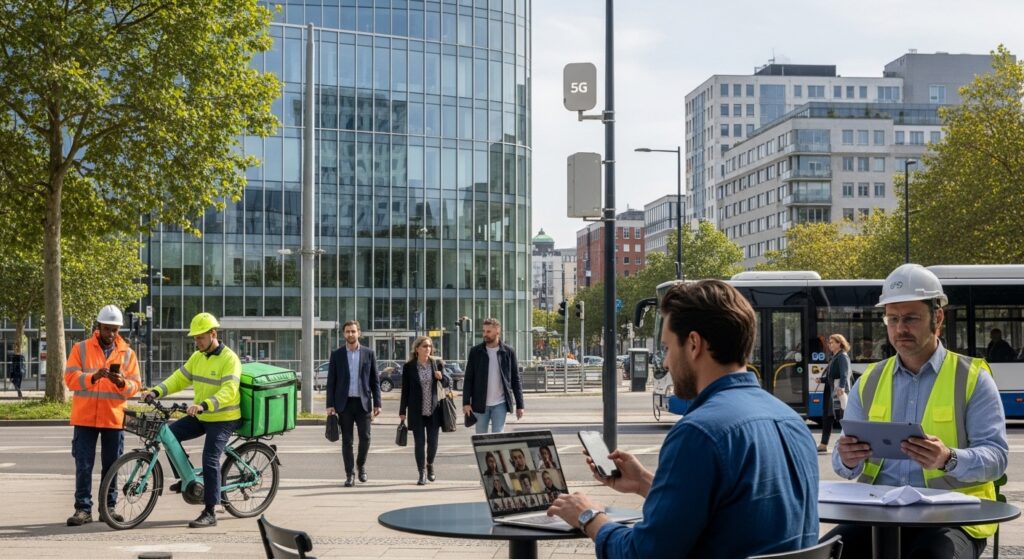
The workplace is one of the clearest examples. Hybrid work did not disappear when pandemic restrictions faded. It became part of the operating model for many companies, especially in sectors such as technology, consulting, media, logistics and sales. Employees now move between offices, homes, trains, airports, client sites and shared workspaces while expecting uninterrupted access to meetings, files, apps and collaboration platforms. A network that can better support video, cloud access and mobile multitasking helps make that mobility feel routine rather than fragile.
This matters especially for workers whose jobs were never fully desk-bound to begin with. Contractors, delivery teams, nurses, inspectors, emergency responders, utility crews and sales representatives often rely on mobile devices as their primary connection to scheduling, records, navigation and communication. For them, stronger mobile performance can mean less downtime, fewer failed uploads, better access to live video support and more reliable digital workflows in the field. In practical terms, 5G helps extend the functional office beyond the office itself.
The technology is also changing the home-work boundary in a less obvious way through fixed wireless access. Instead of relying entirely on cable or fiber, some households and small businesses now use 5G-based home internet as a primary broadband connection. That can be especially important in suburban, rural or underserved areas where wired broadband is limited, expensive or slow to deploy. For remote workers, that alternative can mean the difference between a patchy connection that undermines meetings and a more stable setup that supports full participation in digital work.
Yet 5G’s influence is not only about individual mobility. It is also beginning to matter inside factories, ports, warehouses, campuses and hospitals. In those environments, the key appeal is not just consumer speed but the ability to connect many devices, sensors and machines with greater reliability and lower latency. Private 5G networks and more advanced standalone 5G systems are attracting attention from enterprises that want tighter control over operations, more resilient communications and better support for automation, AI tools and industrial monitoring. In this sense, 5G is becoming part of the backbone for a more data-rich physical economy.
That industrial dimension may seem far removed from everyday life, but the effects reach consumers and workers alike. When logistics systems communicate more efficiently, inventory can be tracked more accurately. When maintenance teams can inspect equipment using high-quality mobile video and edge computing, repairs can happen faster. When hospitals or emergency services can prioritize mission-critical traffic, communications can become more dependable in high-pressure settings. The result is not a single dramatic transformation but an accumulation of smaller improvements that make connected systems more responsive and portable.
For ordinary users, one of the most visible changes is the growing expectation that rich communication should work instantly and almost anywhere. Messaging is no longer just text. It includes live video, voice notes, high-resolution media, collaborative documents, location sharing and real-time reactions across multiple apps. Social connection now depends on the ability to switch fluidly between communication modes without thinking much about the network underneath. 5G supports that shift by making more bandwidth-intensive interaction feel increasingly normal on mobile devices.
This has cultural consequences as well as technical ones. Families separated by migration, study or work can stay visually present in each other’s lives through frequent video calls. Friend groups can maintain constant ambient contact through messaging, clips and live streams. Creators and freelancers can produce, upload and distribute content on the move, narrowing the gap between being connected and being productive. The smartphone becomes less a backup screen and more a full participation device for work, media and relationships.
Still, the change is uneven. The public conversation about 5G often assumed that a new network label would automatically produce a universal leap forward. In reality, performance varies widely by country, carrier, spectrum mix, device type and whether operators have deployed more advanced standalone architecture. Urban users often see the benefits first, while rural buildouts can take longer. Indoor coverage remains inconsistent in some places. And many of the most transformative business features, such as tailored quality-of-service or network slicing, depend on more mature deployments than basic consumer 5G branding alone.
Cost is another issue. Newer phones, premium data plans and enterprise-grade services can widen digital divides rather than close them. A worker with a recent handset, generous data allowance and strong urban coverage experiences 5G differently from someone with an older device or limited service options. The same is true for small firms and public institutions deciding whether advanced wireless capabilities justify the investment. Like many infrastructure upgrades, 5G can expand opportunity while also exposing inequalities in who gets reliable access first.
There are also broader questions about energy use, equipment security, spectrum policy and the balance between convenience and surveillance. More connected devices generate more data, and more data can improve services while also deepening concerns about privacy and control. Employers may gain better operational visibility, but workers may worry about monitoring. Cities may gain smarter infrastructure, but citizens may question how information is collected and used. The growth of high-capacity wireless networks does not settle these debates. It intensifies them.
Even so, the broad direction is becoming harder to ignore. 5G is no longer just a promise attached to smartphone advertising. It is increasingly a practical layer in how people join meetings from cars and kitchens, run businesses from mobile devices, substitute wireless broadband for fixed lines, manage industrial systems, and remain socially present across distance. The most important effect may be psychological as much as technical: people are beginning to assume that meaningful work and meaningful connection should be possible from almost anywhere.
That assumption will shape the next phase of digital life. As 5G standalone networks expand, cloud applications become more demanding, and AI tools require more responsive connectivity, the network will matter even more to how organizations function and how relationships are maintained. The office will continue to spread beyond a single building. Communication will continue to blend text, video, media and live collaboration. And the boundary between being online and being available will grow thinner still.
In that sense, 5G is changing the way people work and connect not through one revolutionary moment, but through thousands of ordinary moments made smoother, faster and more mobile. Its real impact lies in making high-quality connectivity feel less like a destination people go to and more like a condition that follows them wherever they are.