As connected locks, speakers, cameras and thermostats move deeper into everyday life, the modern smart home is delivering real convenience while forcing households to confront how much intimacy they are willing to hand over to technology companies.
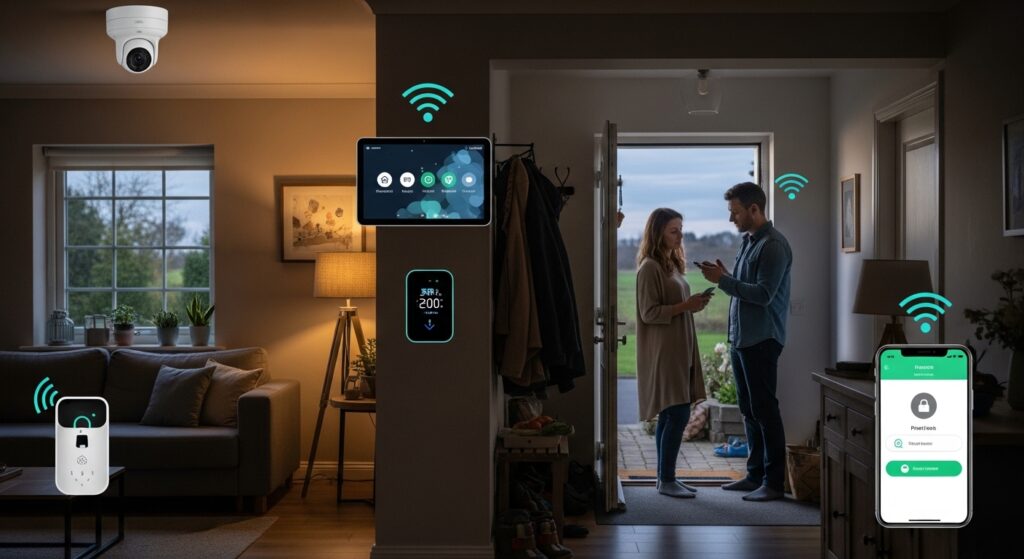
The smart home was once marketed as a futuristic luxury, a vision of automated lights, self-adjusting thermostats and voice-controlled appliances that seemed designed more for trade shows than daily life. That has changed. In many households, the smart home is no longer an aspirational concept but a patchwork reality already in place: a video doorbell by the front entrance, a smart speaker in the kitchen, connected bulbs in the living room, a thermostat that learns routines, and a phone app that can lock doors or check camera feeds from miles away. What began as novelty has become habit.
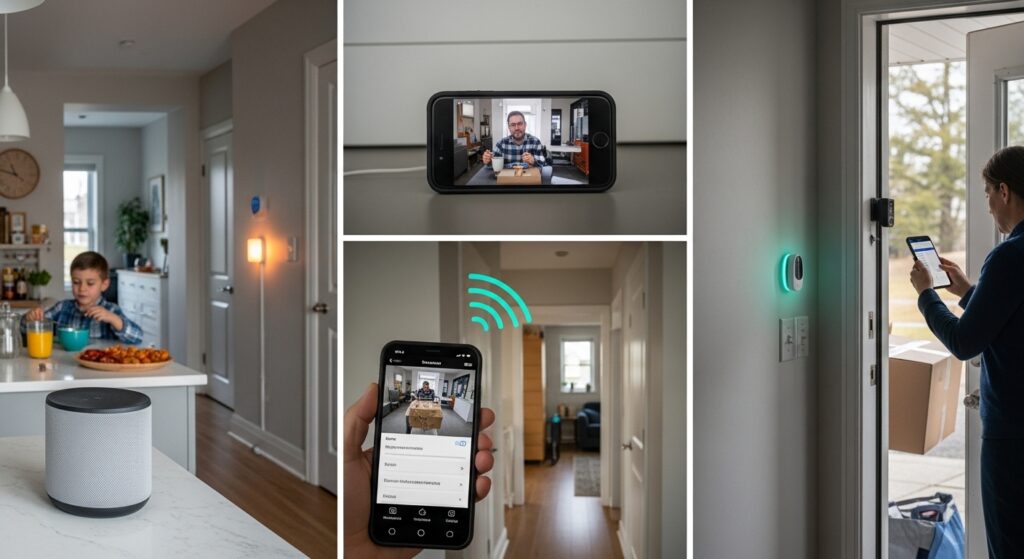
The appeal is easy to understand. Smart-home devices promise control, efficiency and reassurance. Parents can check whether children arrived home. Travelers can turn lights on remotely. Renters can monitor deliveries. Homeowners can reduce heating or cooling waste with app-based climate control. Elderly relatives can be supported through motion sensors, fall alerts or voice assistants that simplify daily tasks. For many consumers, smart devices solve small, recurring problems in a way that feels immediate and tangible. The attraction is not abstract innovation. It is friction removed from ordinary life.
That practical convenience helps explain why the category has expanded so quickly. The technology has also become easier to buy and install. Devices that once required professional setup now arrive with QR codes, polished apps and simplified onboarding. The industry’s push toward interoperability standards has further strengthened the pitch. A growing number of devices are designed to work across ecosystems rather than being confined to a single brand. For consumers, that means less fear of buying the wrong bulb, lock or sensor and discovering it will not talk to the rest of the house. The smart home, in other words, is becoming less technical and more domestic.
Yet that ease masks a deeper shift. A home filled with connected devices is not simply more automated. It is more observable. Smart speakers can process voice commands. Doorbell cameras can record visitors, delivery workers and neighbors passing on the street. Motion sensors can infer when someone is awake, asleep, away or moving from room to room. Smart TVs, appliances and plugs can generate data about viewing habits, routines and energy use. When these products operate together, they create a remarkably intimate portrait of household life.
This is where the central promise of the smart home begins to blur into its central risk. Convenience often depends on collection. The more a device knows, the more seamless it can appear. A thermostat that “learns” behavior is learning behavior. A voice assistant that responds naturally may also be storing or processing commands. A security camera that offers reassurance may also create a permanent archive of domestic life. The smart home’s efficiency is built on awareness, and awareness in connected systems usually means data.
For privacy advocates and cybersecurity experts, that raises two overlapping concerns. The first is how much information companies collect, retain, share or monetize. The second is how well those companies protect it. Consumers may worry about targeted advertising, but the more immediate fear is often exposure: hacked cameras, compromised accounts, weak default settings, or poorly secured devices sitting on a home network. A front door lock that can be controlled remotely is useful, but it also alters the consequences of a security failure. In a smart home, digital vulnerability can become physical vulnerability.
That concern is not theoretical. Connected-home products have repeatedly been drawn into controversies over surveillance, weak protections and unclear data practices. Even when companies improve policies after public scrutiny or regulatory action, the underlying lesson remains the same: when devices are embedded in bedrooms, hallways, nurseries and kitchens, the margin for error is unusually small. Consumers are not simply trusting a gadget. They are trusting an invisible system of software updates, cloud storage, permissions, contractors, third-party integrations and corporate policies that may change over time.
The problem is compounded by the way smart homes are actually assembled. Few households build a connected home from one manufacturer alone. More often, they accumulate devices over years, mixing brands, price points and generations of hardware. A premium lock may sit beside a budget indoor camera, an aging router and a smart speaker from another ecosystem. This patchwork can make homes more flexible, but also more fragile. Security is only as strong as the weakest component, and many consumers are not equipped to evaluate which component that might be.
There is also a gap between what buyers think they are purchasing and what they are really accepting. A customer may believe they bought a doorbell or a thermostat. In practice, they may have entered an ongoing relationship with an app, an account system, a subscription model and a software-maintenance cycle. The device on the wall is only one piece of the product. If updates stop, if servers are shut down, if a company changes its privacy policy, or if key features move behind a paywall, the meaning of ownership changes. The smart home can feel less like buying appliances and more like leasing access to a service layer built on top of domestic space.
Still, it would be too simplistic to frame the rise of smart homes as a story of naïve consumers wandering into digital surveillance. Many households are making rational trade-offs. A video doorbell may offer real protection in neighborhoods where package theft is common. Smart smoke and water-leak detectors can prevent devastating losses. Connected thermostats can lower utility bills. Accessibility features can help disabled or elderly residents live more independently. For busy families, automation can remove daily friction in ways that feel not only convenient but necessary. Privacy matters, but so does practicality, and most consumers live in the tension between the two.
That tension is likely to define the next phase of the market. The question is no longer whether smart homes will spread further. They almost certainly will. The more important question is whether the industry can normalize stronger safeguards before trust erodes. Regulators and standards bodies are trying to push in that direction, with cybersecurity baselines, labeling efforts and technical standards intended to improve security and interoperability. These steps matter because consumers rarely read dense privacy policies or conduct technical audits before buying a smart plug or baby monitor. In practice, they rely on signals: reputation, simplicity, labels and default settings.
That means the burden cannot rest solely on the consumer. Telling users to create stronger passwords and enable two-factor authentication is sensible, but insufficient. Security that depends on unusually attentive behavior will fail at scale. The smart-home industry’s real test is whether it can make privacy and security part of the default experience rather than an advanced option buried in menus. Devices should ship with protections enabled, data collection minimized, update commitments clear and permissions understandable. Consumers should not need expert knowledge to secure a nursery camera or a front-door lock.
There is also a cultural dimension to the debate. The home has traditionally been treated as the most private of spaces, the place where people can retreat from public scrutiny. Smart-home technology complicates that assumption by bringing networked microphones, cameras and sensors into precisely that environment. This does not mean connected devices are inherently incompatible with privacy. It means the home is no longer private by architecture alone. Privacy increasingly depends on design choices made by companies and settings chosen by users.
In the end, the rise of smart homes is not best understood as a choice between comfort and danger. It is a negotiation over control. Consumers want the benefits of automation without surrendering the intimacy of domestic life. They want homes that are responsive, efficient and secure, but not homes that quietly report on them. The industry has proved that convenience can sell. It has not fully proved that trust can scale at the same speed.
For now, smart homes remain both a genuine technological advance and a revealing test of modern digital life. They show how readily people will adopt connected systems when the benefits are concrete. They also show how quickly the boundaries of privacy can shift when convenience is packaged as care, efficiency or safety. The smart home is rising because it solves real problems. Whether it becomes a lasting improvement to domestic life, or a cautionary tale about surveillance by design, will depend on how seriously the industry treats the private world it has been invited into.