
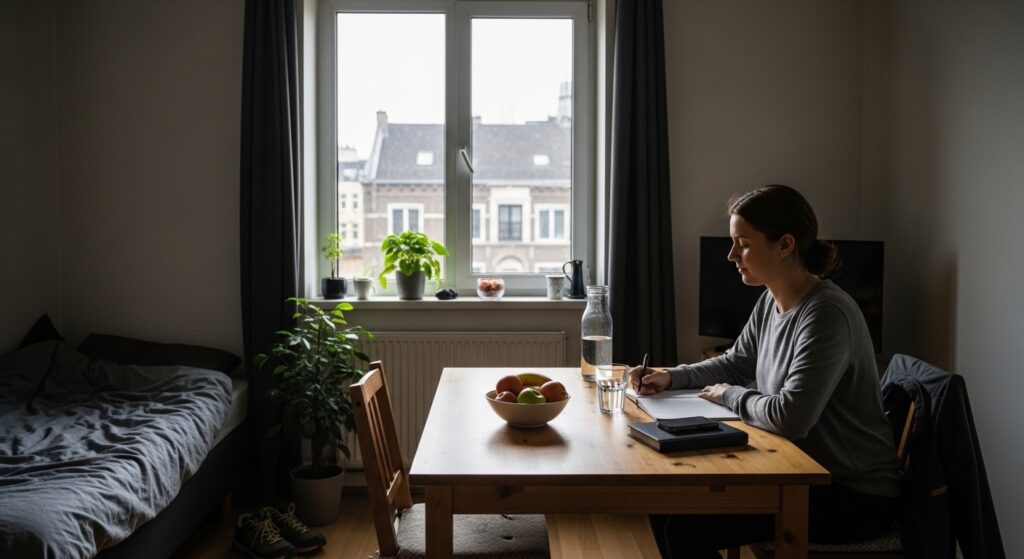
A growing number of people are embracing minimalist living not as a design trend, but as a practical way to improve physical health, mental clarity and daily balance by focusing only on what is truly necessary.
For years, the idea of a healthy lifestyle was often presented in narrow terms: eat well, exercise regularly, sleep enough and reduce harmful habits. Those pillars still matter, and they remain fundamental. But in modern life, health is shaped by more than nutrition plans and workout schedules. It is also influenced by noise, clutter, overstimulation, financial pressure, time fragmentation and the emotional weight of excess. That is why minimalist living has gained renewed relevance. It offers not just a cleaner home, but a different way of organizing life itself.
At its core, minimalist living is often misunderstood. It does not necessarily mean owning almost nothing, living in an empty room or rejecting comfort. Nor does it require strict aesthetic rules or a polished, monochrome interior. The deeper principle is simpler and more durable: reduce what is unnecessary in order to protect what matters. That can apply to possessions, commitments, digital habits, spending patterns, social obligations and even the pace of everyday thought. In that sense, minimalism is less about style than about selection.
The connection between minimalism and a healthy lifestyle begins with the environment people live in. Homes filled with too many objects often create more than physical inconvenience. They generate visual stress, decision fatigue and a sense of unfinished work. Every crowded shelf, overloaded closet or chaotic countertop quietly demands attention. The result is often subtle but real: a mind that finds it harder to rest because the environment keeps signaling disorder. A simpler living space, by contrast, can support calm and routine. It becomes easier to clean, easier to maintain and easier to move through without friction. That reduction in daily mental burden can have genuine health value.
Mental well-being is where minimalist living often shows its strongest appeal. Modern life overwhelms people with input. Messages arrive constantly. Social media encourages comparison. Advertising turns desire into habit. Work spills into private hours. Many people live not only among too many things, but inside too many demands. Minimalism pushes back by asking a difficult but clarifying question: what is actually necessary? Once that question becomes part of daily life, it can change more than consumption. It can reshape priorities.
For some, that means saying no to impulse purchases that bring momentary satisfaction but lasting clutter. For others, it means declining social or professional obligations that fill the schedule without adding real meaning. In both cases, the effect is similar. Less accumulation can mean less pressure. Fewer unnecessary choices can mean more emotional energy for relationships, rest, movement and attention. The healthier lifestyle that emerges is not built only on discipline. It is built on relief.
Physical health also benefits indirectly from minimalist habits. People who simplify their routines often find it easier to maintain healthy behaviors because there is less chaos competing with them. A clear kitchen encourages regular cooking. A less crowded bedroom can support better sleep hygiene. A simplified schedule makes room for walking, stretching, exercise or meal preparation instead of forcing everything into rushed margins. Minimalism, in this sense, does not replace healthy habits. It creates conditions in which those habits are more likely to survive.
The financial dimension is equally important. A lifestyle centered on constant buying can create long-term anxiety, especially when spending is driven more by aspiration than need. Minimalism interrupts that cycle. When people purchase less, keep what lasts and focus on utility rather than accumulation, they often reduce the background stress tied to consumption. Financial breathing room may not sound like a health topic at first, but it affects sleep, relationships, emotional stability and the ability to make better choices. A person under constant economic pressure is less likely to experience daily life as healthy, no matter how well they eat.
Minimalist living also changes the meaning of food and fitness. In a cluttered lifestyle, health itself can become another crowded project: too many supplements, too many apps, too many contradictory routines, too much performance around “wellness.” Minimalism offers a quieter alternative. Instead of turning health into endless optimization, it favors basics that are sustainable: simple home-cooked meals, regular water intake, consistent sleep, walking, body movement and recovery. That approach may appear less dramatic than trend-driven wellness culture, but it is often more realistic and more durable.
There is also a social side to minimalism that is often overlooked. People who simplify their lives frequently become more aware of where their attention goes. A life with fewer distractions can create more room for conversation, reading, family meals, time outdoors and ordinary presence. In this way, minimalist living supports not only private calm but stronger human connection. Health is not just the condition of the body. It is also shaped by whether a person feels grounded, connected and able to be present in daily experience.
Digital minimalism has become one of the most powerful expressions of this shift. For many people, physical clutter is no longer the only problem. Phones, notifications, streaming platforms and endless scrolling create another kind of excess—one that lives inside the mind rather than the room. Reducing screen time, turning off nonessential alerts, limiting social media and creating phone-free parts of the day can restore attention in ways that feel surprisingly physical. Sleep improves. Stress softens. Concentration returns. Meals feel more real. Walks become quieter. The body often responds positively when the mind is no longer being pulled in ten directions at once.
Still, minimalist living is not without contradictions. It can be turned into another consumer identity, sold through expensive “simple” products, luxury storage solutions or idealized images of perfection. In that form, minimalism risks becoming just another pressure. A healthy minimalist life does not require visual purity or moral superiority. It requires honesty. What is too much for one person may not be too much for another. A family with children, an artist, a frequent traveler and an older adult living alone will all define “necessary” differently. True minimalism is not about uniformity. It is about alignment between what a person owns, does and values.
This is why the philosophy resonates most when it stays practical. A person does not need to empty an entire house to live more lightly. The process can begin with one drawer, one room, one spending habit or one hour reclaimed from the phone. The point is not sudden transformation. It is gradual reduction of friction. Each removed burden—physical, emotional, digital or financial—makes healthy living a little more accessible.
In many ways, minimalist living reflects a deeper cultural shift. After years of excess stimulation, many people are no longer convinced that more is better. More products do not guarantee comfort. More commitments do not guarantee meaning. More information does not guarantee clarity. More connectivity does not guarantee closeness. The appeal of minimalism lies in the opposite possibility: that life may become healthier when it contains fewer but more intentional things.
That principle applies powerfully to lifestyle itself. A healthy life is often imagined as a perfectly managed one, filled with ideal meals, efficient workouts, productivity systems and polished routines. But such perfection can become exhausting. Minimalism offers another vision: a life that is healthy because it is livable. A kitchen with basic nourishing foods. A home that can be tidied without stress. A schedule with room to breathe. A wardrobe that simplifies mornings. A mind less crowded by impulse and comparison. A body supported by consistency instead of pressure.
The emotional value of that shift should not be underestimated. Many people are tired not only because they do too much, but because they carry too much—too many possessions, too many expectations, too many digital interruptions, too many unnecessary decisions. To live minimally is to remove some of that weight. And when weight is removed, health often becomes easier to reach.
Minimalist living, then, is not the opposite of a healthy lifestyle. It may be one of its most practical forms. By focusing on what is truly necessary, people often create more space for sleep, movement, peace, financial stability, better food, stronger relationships and a calmer mind. The result is not an empty life. It is a life with more room for what matters.
In an age defined by overload, that may be the most realistic form of wellness available: not adding more strategies, more products or more goals, but choosing less with greater intention. Minimalism does not promise perfection. It offers something more useful — a way to live with fewer burdens and, often, with better health.