
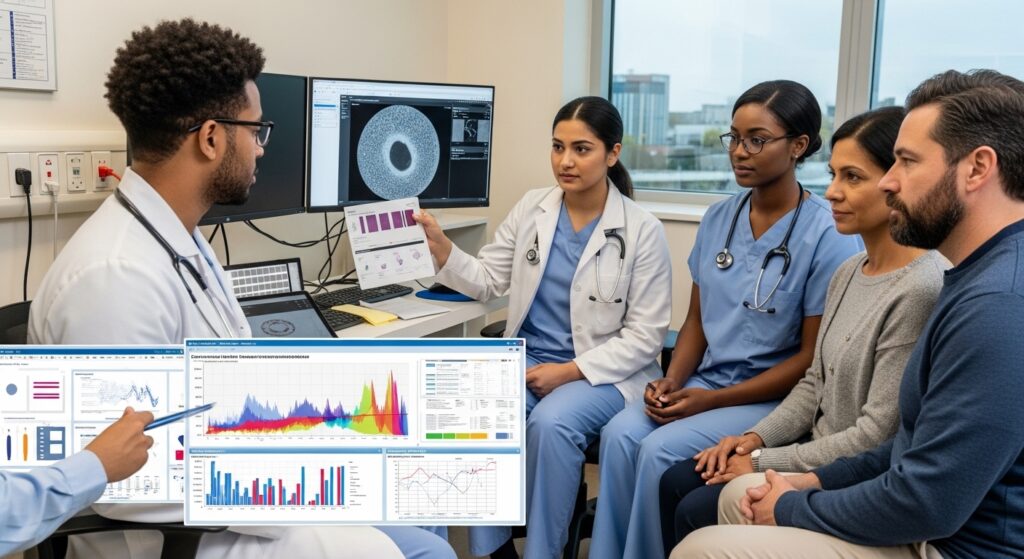
From cancer care and rare diseases to drug dosing and prevention strategies, medicine is moving away from the old one-size-fits-all model and toward treatments tailored to the biology, risk profile and circumstances of each patient.
The shift has been building for years, but it is now becoming much harder to dismiss as a specialist trend confined to elite laboratories or a handful of advanced cancer centers. Personalized medicine — often called precision medicine — is increasingly influencing how doctors diagnose disease, choose therapies, monitor response and think about prevention. The basic promise is simple: instead of treating patients as statistical averages, health systems are trying to match interventions more closely to the differences that matter, including genetics, tumor biology, environment, lifestyle and prior response to treatment.
That promise has moved from theory into routine practice in some fields. Oncology remains the clearest example. A growing share of modern cancer care depends not just on identifying where a tumor is located, but on understanding the molecular alterations driving it. Doctors increasingly use genomic profiling and biomarker testing to decide whether a patient is likely to benefit from a targeted therapy, an immunotherapy or a standard regimen. In that sense, the cancer patient is no longer treated only according to the organ involved, but according to the biological behavior of the tumor itself.
This is one reason personalized medicine is changing the structure of care rather than merely adding another layer of testing. The diagnostic step is becoming inseparable from the treatment decision. A biopsy may now lead to sequencing. Sequencing may identify a mutation. That mutation may determine eligibility for a specific drug, or show that a likely treatment would be ineffective or unnecessarily toxic. In the older model, a physician might begin with the standard therapy for most patients with the same diagnosis. In the newer model, the first question is increasingly: which patient, exactly, is this?
The rise of companion diagnostics has been central to that change. These tests are designed to identify which patients are most likely to benefit from a particular medicine, or face special risks from it. They are especially important in oncology, but their logic reaches beyond cancer. Pharmacogenomics, for example, is expanding the idea that a patient’s genes can affect how drugs are metabolized, how well they work and how likely they are to cause harm. In time, that could make drug prescribing more individual from the beginning, not only after side effects or treatment failure appear.
For patients, the appeal is obvious. Personalized treatment holds out the possibility of better outcomes with less trial and error. It may help avoid therapies that are unlikely to work, reduce exposure to avoidable toxicity and shorten the path to an effective intervention. For doctors and hospitals, it offers a way to make care more rational, matching scarce and often expensive therapies to those most likely to benefit. For policymakers, it raises the possibility that better targeting could improve both outcomes and efficiency, though only if the systems around testing, regulation and reimbursement are strong enough to support it.
The new model is not limited to cancer. Rare diseases are another major driver. Many rare conditions have a genetic basis, and for families who have spent years moving from clinic to clinic without a diagnosis, genomic sequencing can be transformative. It can end the “diagnostic odyssey,” clarify prognosis and in some cases open the door to targeted treatment, gene therapy or more informed family planning. Even where a cure does not exist, a precise diagnosis can still change care by preventing unnecessary procedures and connecting patients to the right specialists or trials.
This is also where personalized medicine begins to overlap with a broader data revolution in health care. Sequencing is only one piece of the story. The sharper movement now is toward combining many kinds of information: clinical records, pathology, imaging, biomarkers, family history, real-world outcomes and, increasingly, digital and computational tools that can detect patterns too complex for traditional methods alone. Medicine is becoming more individualized not only because scientists can read the genome more cheaply, but because health systems are gradually learning how to combine biological and clinical data into actionable decisions.
Still, the turn toward personalized care is not a clean story of progress. Its biggest challenge is not scientific excitement but unequal access. The tests, data infrastructure and specialist expertise required for precision medicine are not distributed evenly, either between countries or within them. Major academic centers may offer broad molecular profiling and multidisciplinary review, while rural clinics or underfunded hospitals may struggle to provide even basic access. A treatment model that looks transformative in a wealthy urban setting can look distant or unaffordable elsewhere.
Cost remains the central pressure point. Personalized medicine is often described as a smarter way to spend because it can avoid ineffective care. That may be true in some settings, but the upfront investments are substantial. Sequencing platforms, laboratory quality systems, bioinformatics, trained personnel, data governance and reimbursement pathways all require money and policy coordination. Some of the therapies linked to personalized treatment — including certain cell and gene therapies — are among the most expensive interventions in medicine. The result is a paradox at the heart of the field: precision can improve efficiency, but only if health systems can first afford to become precise.
There are also difficult ethical questions. Personalized medicine depends on collecting and interpreting very large amounts of sensitive data, including genomic information that does not belong only to one individual in the ordinary sense, because it may also reveal facts about relatives and communities. That raises concerns around privacy, consent, data sharing, commercial use and discrimination. Trust becomes essential. Patients may welcome more tailored care, but only if they believe their information will be governed responsibly and used fairly.
Another risk is overpromising. Personalized medicine is often presented in language that suggests every patient will receive a uniquely optimized treatment plan. The reality is more restrained. In many areas, medicine is not yet truly individualized; it is stratified. Patients are grouped into narrower categories based on biomarkers, mutations or response patterns, and care is tailored at that level. That is still a major advance over one-size-fits-all medicine, but it is not the same as custom-built treatment for every person in every condition.
Even so, the direction of travel is unmistakable. Regulators are adapting. Researchers are building larger and more diverse datasets. Drug developers are designing therapies alongside diagnostics. Hospitals are reorganizing around molecular tumor boards, genomic services and integrated data pathways. Public-health agencies are also beginning to look at personalized medicine not only as a matter of specialist care, but as part of a wider strategy that could influence prevention, screening and population health.
The harder question is whether this transformation can be made equitable. Personalized medicine will not fulfill its promise if it remains concentrated in wealthy countries, private systems or premium hospitals. Its success will depend not only on scientific breakthroughs, but on whether governments can build rules, reimbursement systems and public trust strong enough to extend those breakthroughs beyond the best-resourced patients.
For now, medicine is clearly moving in a new direction. The old model of treating the average patient is losing ground to an approach that asks deeper biological questions before acting. That shift is already changing cancer care, rare-disease diagnosis and drug selection. Over time, it could also change the culture of medicine itself, making treatment less about standard pathways and more about the particular patient in front of the clinician. Personalized medicine is not eliminating uncertainty. But it is steadily narrowing the distance between what doctors know about disease and how precisely they can respond.