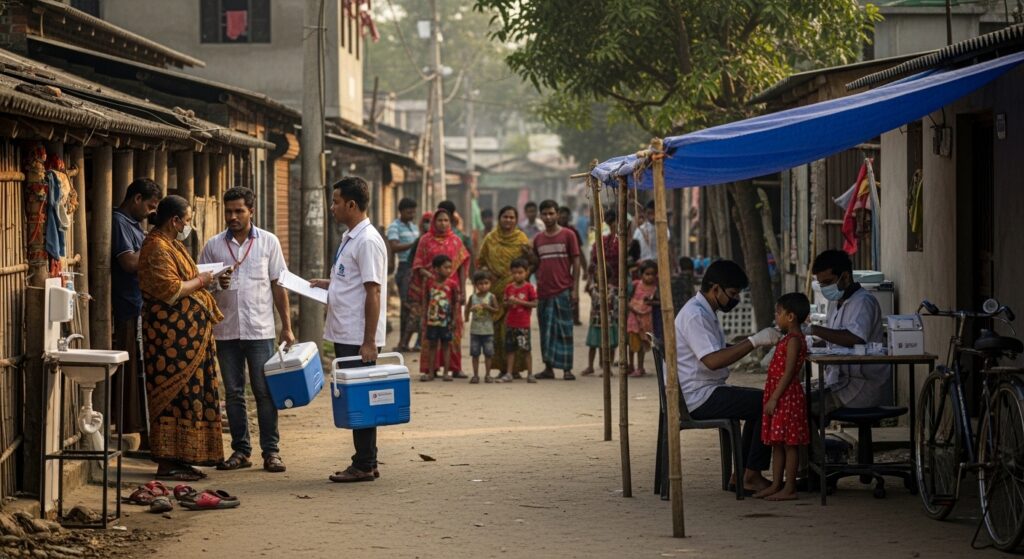
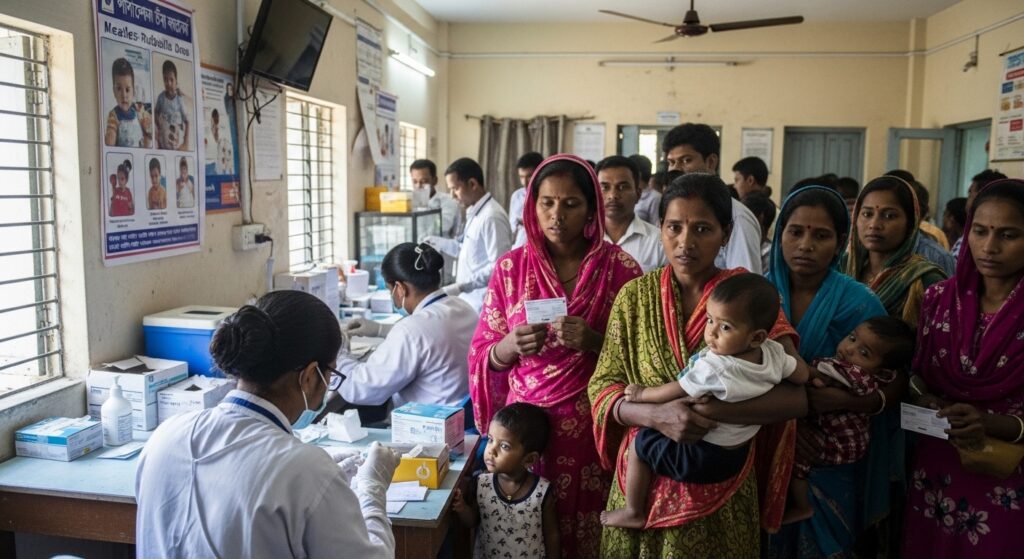
An emergency immunization campaign targeting children from 6 months to 5 years old is underway across high-risk areas of Bangladesh, as health authorities and international agencies race to contain a measles outbreak that has turned into one of the country’s gravest child-health emergencies in recent years.
Bangladesh has begun an urgent measles-rubella vaccination campaign after a fast-moving outbreak killed more than 100 children in less than a month, exposing dangerous gaps in routine immunization and placing renewed pressure on a health system already strained by inequality, uneven access and public mistrust. The campaign, launched with support from UNICEF, the World Health Organization and Gavi, is initially focused on 18 high-risk districts, where officials say the youngest and most vulnerable children face the greatest danger.
The scale and speed of the outbreak have shocked health workers and alarmed families across the country. Measles is one of the most contagious diseases in the world, but it is also vaccine-preventable. That is what makes outbreaks like this especially devastating: they often reveal not only the force of the virus itself, but the hidden weaknesses in the public-health systems meant to stop it. In Bangladesh, the current emergency has done exactly that. It has forced the government into rapid action while raising difficult questions about why immunity gaps were allowed to widen in the first place.
At first glance, Bangladesh does not fit the profile of a country that should be caught so exposed. For decades, it has been cited as a public-health success story in South Asia, making major gains in child survival, maternal health and routine immunization. Vaccination coverage rose dramatically over time, and many diseases once associated with large-scale childhood death became more manageable. Yet immunization systems do not fail only through collapse. They can also weaken gradually, district by district, family by family, through missed doses, supply interruptions, uneven outreach and the accumulation of children who remain unprotected.
That appears to be what happened here. Health officials and international partners have pointed to immunity gaps among zero-dose and under-vaccinated children, while infants under the age for routine vaccination have emerged as an especially vulnerable group. In outbreaks of highly contagious disease, those small weaknesses can become large very quickly. Measles does not require a broad opening to spread. It requires only enough susceptible children in close contact and enough delay in response for the virus to move faster than protection.
The emergency campaign is therefore about more than delivering shots. It is an attempt to close a widening breach before the outbreak grows even more lethal. By focusing first on children between 6 months and 5 years old, authorities are trying to reach the age group most at risk of severe complications, hospitalization and death. The decision to target 18 high-risk areas reflects a strategy common in fast-moving outbreaks: move first where the danger is greatest, then expand outward before transmission gains further momentum.
But even that strategy carries its own message. When a vaccination campaign begins in the midst of rising deaths, it is both a preventive act and a sign that prevention came too late for many families already affected. For parents whose children have died, the campaign arrives not as reassurance, but as an acknowledgment of what was not protected in time. Public-health action in such moments must do two things at once: stop the immediate emergency and rebuild confidence that the system can still be trusted.
That trust is likely to be one of Bangladesh’s biggest challenges in the weeks ahead. In many outbreaks, fear creates two parallel crises. The first is medical: the spread of disease. The second is behavioral: confusion, rumor and delayed treatment. Reports from the current outbreak suggest that some parents have turned to local medicine sellers rather than formal healthcare when children developed symptoms. That pattern is not unusual in places where cost, distance, crowding or previous bad experiences make hospitals feel inaccessible. Yet it can be deadly when dealing with measles, especially in very young children who can deteriorate quickly from dehydration, pneumonia or other complications.
The outbreak has also underscored a broader lesson that public-health experts have repeated for years: vaccination systems are not static achievements. They are living infrastructures that need constant maintenance. A country may achieve high national coverage on paper while still leaving pockets of vulnerability untouched. Those pockets matter. Infectious diseases do not spread according to national averages; they spread through local realities. If one district has stronger outreach than another, if one community has better transport than another, if one clinic has stable supply while another does not, the map of immunity becomes uneven. Measles exploits exactly that unevenness.
For Bangladesh, the political dimension cannot be ignored either. Public-health systems are deeply affected by governance, supply chains and administrative continuity. Any period of disruption can have consequences that appear months later in clinics and villages, especially when it affects vaccine procurement, storage, distribution or local confidence in state services. When officials now speak of strengthening immunization again, they are implicitly acknowledging that the present crisis was not produced by biology alone. It was also shaped by policy, management and the ability of institutions to keep routine protections functioning.
International agencies have moved quickly to support the response, but the campaign’s success will depend heavily on the last mile: whether vaccinators can reach children in remote areas, whether parents are informed in time, whether cold-chain systems hold, and whether the urgency of this moment translates into sustained follow-through. Emergency drives can reduce immediate risk, but they do not solve the deeper problem if the children reached today are replaced tomorrow by another cohort that misses routine doses.
There is also a hard emotional truth at the center of the story. Measles deaths in the modern era often feel especially intolerable because they are so preventable. They are not accidents in the usual sense. They are losses that arise when a known disease meets an avoidable immunity gap. For health workers, that can be one of the most demoralizing aspects of an outbreak. The treatment of sick children is urgent and exhausting, but the knowledge that many cases could have been prevented adds a layer of moral frustration. Each death becomes not only a tragedy, but also a warning.
The current campaign may still prevent many more such warnings from becoming funerals. If the high-risk districts are covered quickly, if families respond, and if expansion to additional districts proceeds without delay, Bangladesh may yet contain the outbreak before it becomes a wider national calamity. But the numbers already reported suggest that the country is past the point where this can be treated as a localized disturbance. It is a significant child-health emergency, one that touches questions of equity, access, governance and public communication as much as medicine.
What happens next will matter beyond Bangladesh. Around the world, health agencies have warned that measles is resurging where vaccination coverage has slipped, whether because of conflict, mistrust, disruption, migration or simple neglect. Bangladesh’s outbreak is therefore both national and global in meaning. It shows how quickly a preventable disease can return when protection becomes uneven, and how rapidly public-health progress can be tested when systems lose resilience.
For families in the 18 targeted areas, however, the crisis is not abstract. It is immediate and deeply personal. It is measured in fever, rash, breathlessness, hospital beds and the fear that a child’s condition may worsen by nightfall. The vaccination campaign offers something essential in that setting: not certainty, but intervention. It gives health authorities a chance to break chains of transmission, shield younger children and slow the spread before more households are pulled into mourning.
Whether the campaign ultimately succeeds will depend on speed, reach and credibility. Speed matters because measles moves fast. Reach matters because partial protection can leave dangerous gaps intact. Credibility matters because vaccines save lives only when families trust and accept them. Bangladesh now needs all three. It needs a campaign that is not only announced, but delivered; not only targeted, but completed; not only urgent, but sustained.
The immediate goal is to stop deaths. The larger goal is to restore the routine immunization shield that should have prevented such a deadly outbreak from taking hold at all. If the emergency campaign can achieve both, it may yet become more than a crisis response. It may become the starting point for rebuilding confidence in one of the most basic obligations of public health: protecting children from diseases the world already knows how to prevent.
For now, though, the country remains in a race against time. Bangladesh has launched its emergency vaccination drive under the shadow of profound loss. The measure of success will not be the announcement itself, but how many lives it saves in the days and weeks ahead.