From search boxes and schoolwork to hospitals, offices and scams, artificial intelligence is becoming less of a distant technology and more of a daily presence in American life.
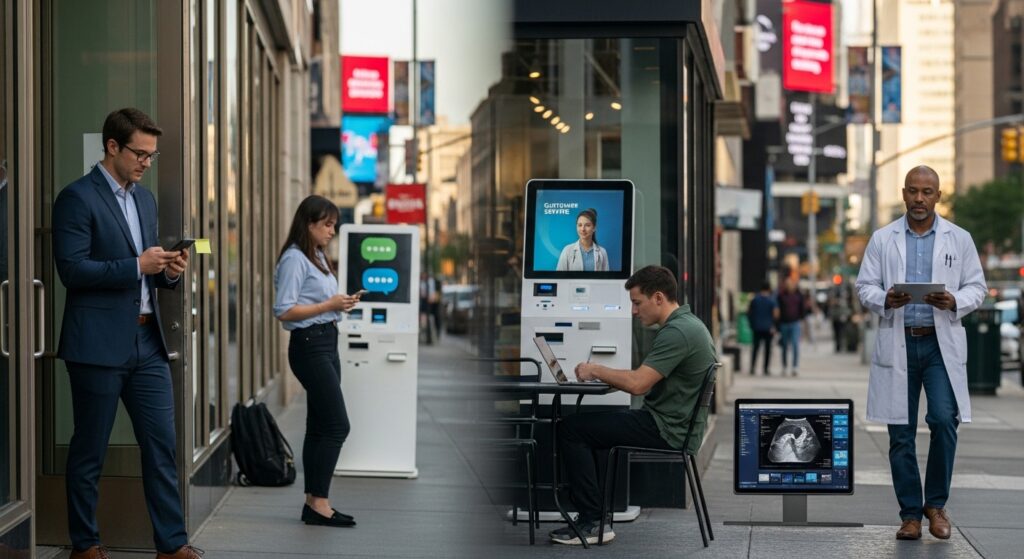
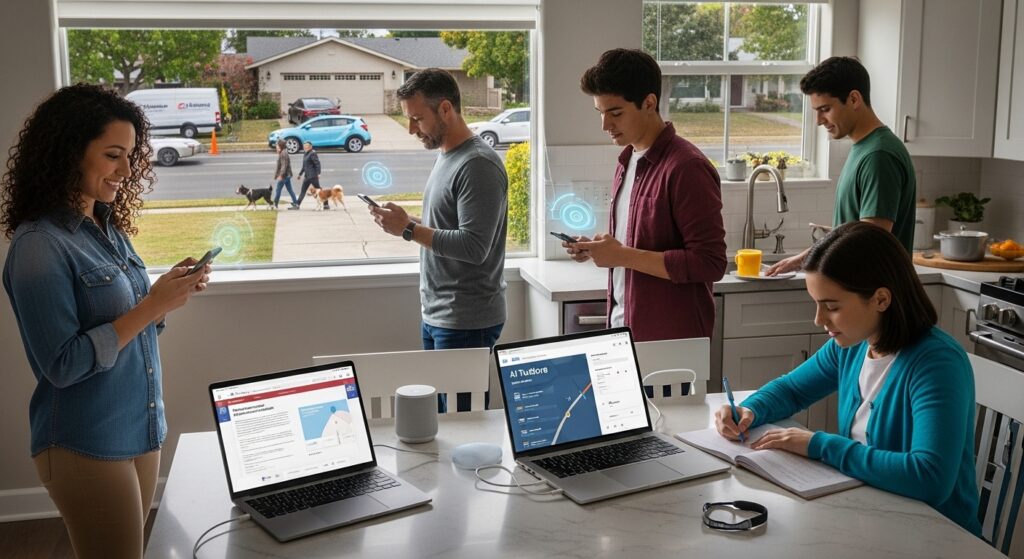
Artificial intelligence in the United States is no longer confined to Silicon Valley labs, corporate presentations or speculative arguments about the future. It has moved into the mundane texture of everyday life. Americans encounter it when they write emails, search online, sort photographs, translate messages, compare products, use customer-service chatbots, get driving directions, stream entertainment or try to detect whether an image is real. In offices, it is becoming a workplace tool. In schools, it is becoming both an aid and a source of anxiety. In hospitals and clinics, it is emerging behind the scenes in diagnostics, software and administrative systems. And in homes, it increasingly sits inside phones, speakers, apps and interfaces that many users do not always recognize as artificial intelligence at all.
That quiet ubiquity is part of what makes the current moment so significant. AI in America is not arriving through a single dramatic breakthrough visible to everyone at once. It is spreading through accumulation. Each new feature promises a little more convenience, speed or personalization. Each small use case looks manageable on its own. Together, they are changing how Americans work, shop, learn, communicate and judge what to trust.
One of the clearest signs of this shift is that AI is becoming normal before it becomes fully accepted. Americans are using it more often than they necessarily feel comfortable admitting. A growing number of workers now rely on AI for at least part of their jobs, especially in writing, summarizing, research, coding, customer support and administrative tasks. Many consumers also interact with AI systems regularly, whether they are asking a chatbot to draft a message, letting an algorithm recommend a movie, or receiving auto-generated suggestions in a word processor. Yet familiarity has not produced wholehearted confidence. The technology is now close enough to be useful and visible enough to make people uneasy.
That tension is particularly sharp in the workplace. For white-collar employees, AI is beginning to act like a junior assistant: fast, tireless and often surprisingly competent at first drafts. It can summarize meetings, organize notes, rewrite presentations and answer routine questions. For managers, it promises efficiency. For workers, it can feel like both a productivity boost and a quiet warning. Tasks that once signaled expertise are being compressed into seconds. The American office is therefore changing not only in output, but in status. Employees increasingly need to prove judgment, originality and accountability rather than simply the ability to assemble information quickly.
This does not mean AI is eliminating human work overnight. In many sectors, it is more accurately changing the composition of work. It handles repetitive or low-level cognitive tasks while leaving people to verify, interpret, correct and take responsibility. But even that partial shift matters. It alters hiring expectations, job design and the pace of output. In practical terms, it is reshaping the daily work life of Americans long before the labor market reaches a settled consensus about who gains and who loses.
Education offers a similarly complicated picture. American students are using AI to brainstorm, summarize readings, check grammar, explain difficult concepts and help organize assignments. Teachers and administrators are using it to generate lesson materials, reduce paperwork and support planning. Colleges are grappling with how to distinguish learning from outsourcing. Schools are not debating a distant possibility anymore; they are dealing with a tool that is already in the hands of students. The result is an uneasy mix of experimentation and control. AI can help a struggling student get immediate feedback, but it can also let that same student bypass the effort that learning requires.
That is why the educational debate in America has widened beyond plagiarism. The deeper question is what kinds of thinking schools should protect. If AI can instantly generate summaries, essays, quiz answers and explanations, educators have to decide whether to redesign assignments around judgment, discussion and process rather than just output. In that sense, AI is not merely changing student habits. It is pressuring American education to define what it considers essential human learning.
Healthcare is another area where AI is becoming real in less visible but consequential ways. In the United States, AI-enabled medical devices and software tools are increasingly present in the health system, often in radiology, image analysis, triage support, workflow management and clinical decision assistance. Much of this operates out of public view. Patients may never hear the phrase “artificial intelligence,” even when it plays a role in how scans are interpreted, records are organized or risk patterns are flagged. That hidden integration is important because it shows how AI often enters everyday life not as a robot-like presence but as infrastructure.
For ordinary Americans, the promise is straightforward: faster systems, earlier detection, less administrative friction and potentially better care. But healthcare also reveals the limits of AI optimism. Medical systems are high-stakes environments where errors, bias and overconfidence can carry real consequences. The question is not simply whether AI can help doctors and hospitals. It is whether it can do so without eroding accountability or widening existing inequalities in care. As with education and work, the daily usefulness of AI does not remove the need for caution.
The consumer economy may be where AI feels most ordinary. Americans now live inside recommendation systems. Shopping platforms suggest products. Streaming services predict taste. Maps estimate traffic. Banks flag transactions. Airlines adjust pricing. Social media feeds arrange what users see. Customer-service bots answer basic questions at all hours. Translation tools reduce friction across languages. Generative systems can draft invitations, plan itineraries and compare purchases. For many households, AI is already embedded in the small decisions that make up daily life, even when it is marketed simply as a “smart” feature.
Yet convenience has a tradeoff. The more AI mediates everyday decisions, the more Americans depend on systems they do not fully understand. Recommendation engines can narrow exposure as well as expand it. Automated support can save time while frustrating users trapped in loops that never reach a human being. Generative tools can make communication easier while also flooding the internet with synthetic content, making trust more fragile. The reshaping of daily life is therefore not just about efficiency. It is also about who controls attention, ranking, visibility and credibility.
Trust may be the defining social issue of the AI era in America. The spread of convincing machine-generated text, audio and images is making it harder for people to know what is authentic. This problem reaches beyond politics and viral misinformation. It touches family photos, online reviews, student work, legal documents, financial offers and health advice. Americans increasingly have to evaluate not just whether something is true, but whether it was made by a person at all. That subtle shift changes the burden of citizenship and consumer life. Suspicion becomes a routine skill.
The risks are not theoretical. AI tools are already being used in deceptive marketing, fraudulent schemes and fake-review operations. That means Americans are encountering AI not only as a helpful assistant but also as a multiplier of manipulation. In practical terms, the technology that saves time can also make lies cheaper to produce and harder to detect. This dual use is one reason public attitudes remain conflicted. Americans may welcome AI for weather forecasts, translation or medical research while rejecting it in intimate or high-trust parts of life.
There is also a broader cultural effect. AI is beginning to change what Americans think ordinary competence looks like. Writing quickly, summarizing clearly, navigating bureaucracy efficiently and generating polished language used to be markers of personal skill. As these capacities become easier to simulate or automate, social value shifts toward discernment: asking better questions, verifying outputs, spotting errors and deciding when human judgment matters more than machine fluency. This may sound abstract, but it plays out in ordinary settings every day, from offices and classrooms to parenting, shopping and online conversation.
The American response to AI is therefore not a simple story of adoption or resistance. It is a story of selective integration. People are letting AI into their lives, but on uneasy terms. They want usefulness without loss of control. They want speed without deception. They want assistance without replacement. They want the gains of automation without the social thinning that can come when too much of daily life is filtered through systems built to predict, optimize and imitate.
That tension is likely to define the next phase. AI will continue to spread because it is already woven into the products and institutions Americans use every day. The more difficult question is whether the country can shape that spread in a way that preserves trust, accountability and human agency. The future of AI in America may not be decided by the most spectacular invention. It may be decided by a quieter test: whether people feel that the technology is helping them live better, or simply teaching them to adapt to systems they never fully chose.
For now, artificial intelligence is reshaping everyday life in America not as an event, but as a condition. It is becoming part of the nation’s routines, anxieties, conveniences and arguments all at once. That is what makes it powerful. And that is what makes it political, cultural and deeply personal.