Denis Villeneuve’s desert epic did more than open big. It built week after week into one of the defining theatrical successes of 2024, underscoring Hollywood’s renewed faith in large-scale, cinema-first spectacle.
When “Dune: Part Two” arrived in theaters, it was already carrying unusual weight. It was not simply a sequel to a critically respected science-fiction adaptation. It was also a test of whether modern audiences would still show up in force for a long, serious, visually dense blockbuster that asked patience rather than pandering, scale rather than speed, and world-building rather than easy familiarity. In an industry still trying to understand what kind of theatrical event can break through after years of pandemic disruption, streaming expansion and franchise fatigue, the film’s box-office performance quickly became more than a commercial story. It became an industry signal.
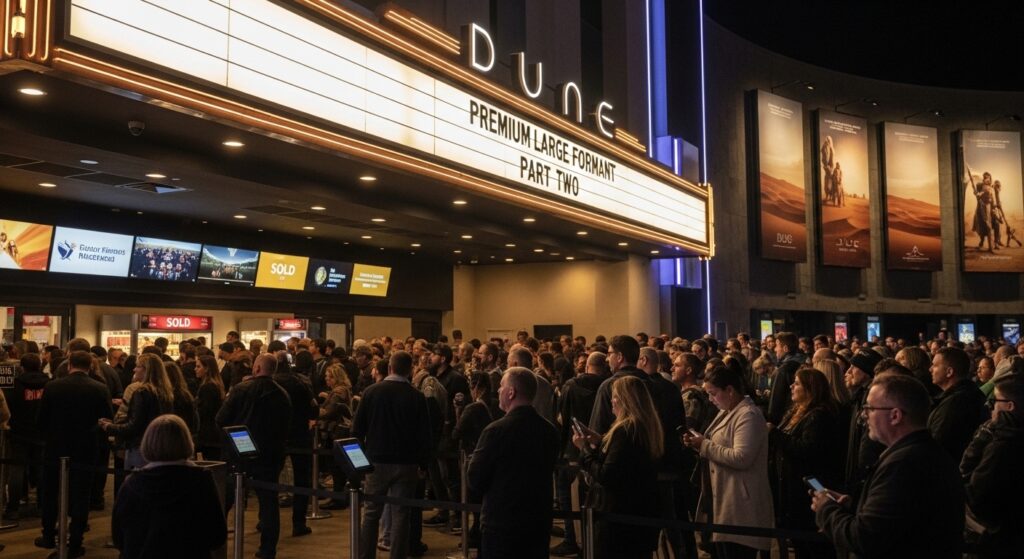
That signal was strong from the beginning. Released after months of anticipation and delayed in part by the Hollywood labor strikes of 2023, “Dune: Part Two” surged out of the gate with one of the year’s most commanding debuts. Its opening was powerful not only because of the raw numbers, but because of what those numbers suggested: audiences were willing to return to theaters in large numbers for a film that treated spectacle as craft rather than noise. Denis Villeneuve’s sequel did not sell itself as disposable content or as a spin-off extension of an overworked universe. It sold itself as a serious cinematic event, and viewers responded accordingly.
That response mattered because the first “Dune,” released in 2021, had arrived under very different conditions. It was launched in a hybrid environment, appearing in theaters while also streaming on HBO Max in the United States during a period when moviegoing had not yet fully recovered. The first installment earned respect, awards attention and a devoted audience, but its commercial ceiling was shaped by circumstances well beyond the film itself. “Dune: Part Two” benefited from a cleaner theatrical runway and from the accumulated cultural capital of the first chapter. More importantly, it capitalized on a growing sense that Villeneuve was delivering a rare kind of blockbuster: one that was intellectually ambitious, emotionally controlled and visually overwhelming without surrendering coherence.
As the weeks passed, the sequel did not behave like a front-loaded curiosity. It held. That is what turned a strong opening into a major success. In the contemporary box office, endurance often means more than impact. Big franchises can explode in their first weekend and then collapse under weak word of mouth or audience indifference. “Dune: Part Two” instead displayed the kind of sustained momentum that executives, theater chains and premium-format exhibitors value most. Viewers were not just arriving once. They kept coming, and many sought out the largest screens available.
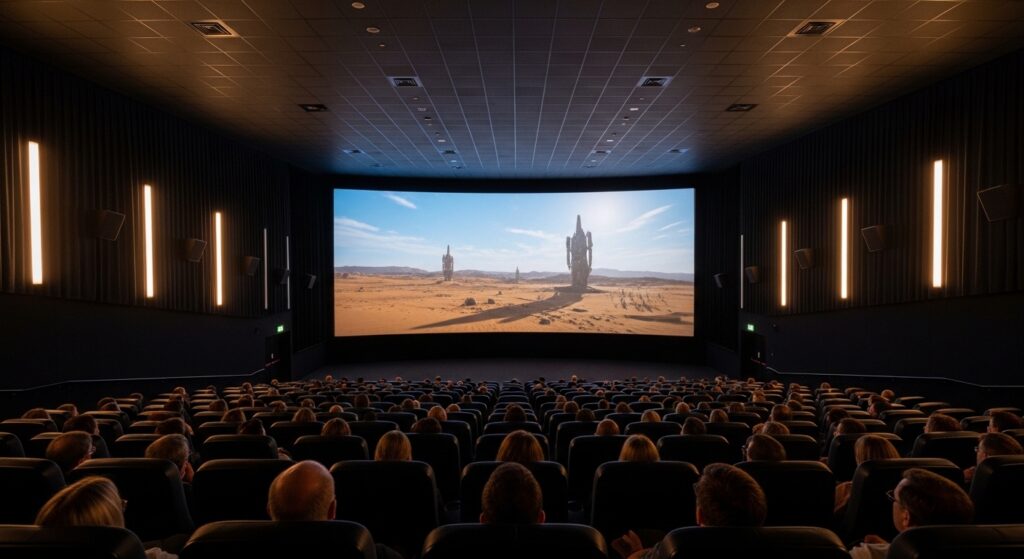
The IMAX performance was especially revealing. For years, Hollywood has argued that the theatrical business increasingly depends on films that can persuade audiences to leave home and pay a premium for immersion. “Dune: Part Two” fit that model almost perfectly. Its deserts, spaceships, ritual combat, thunderous sound design and monumental scale were designed not merely to be watched, but to be inhabited. The film’s success in premium large-format venues reinforced an important lesson for studios: audiences still distinguish between content that can be postponed for home viewing and films that feel incomplete unless seen in a cinema.
This was not just a victory for Warner Bros. and Legendary. It was also a vindication for a style of filmmaking that many in the business worry is becoming harder to finance. Villeneuve’s vision is expensive, exacting and unhurried. It depends on atmosphere, architecture, texture and silence as much as on action. That is not the standard grammar of the contemporary tentpole. Yet the marketplace rewarded it. The result suggests that mass audiences are not necessarily resistant to demanding spectacle. They may simply be starved for spectacle that feels authored rather than assembled.
The cast helped broaden that appeal. Timothée Chalamet and Zendaya brought youth-market visibility and cultural fluency, while the larger ensemble gave the film a prestige aura uncommon in commercial science fiction. But star power alone does not explain the result. What the film offered was a combination that studios chase but rarely secure: event scale with artistic seriousness, franchise recognition with critical approval, and visual grandeur with strong audience enthusiasm. In other words, it became both a commercial product and a cultural recommendation.
The phrase “continues breaking box-office records” also reflects something broader than isolated milestones. The film repeatedly crossed thresholds that reshaped expectations around it. It quickly outpaced the entire worldwide total of the first “Dune.” It became one of the year’s earliest major global hits. For a period, it stood as the top-grossing Hollywood release of 2024. It also demonstrated unusual staying power for a big-budget science-fiction sequel, a genre that can struggle when narratives become too dense or world-building too opaque. Instead of narrowing its appeal, the film’s seriousness appeared to sharpen it.
That is particularly striking given the material. Frank Herbert’s “Dune” is not naturally easy blockbuster fuel. It is political, spiritual, ecological and resistant to simplification. It deals in prophecy, empire, fanaticism and resource warfare. Villeneuve’s adaptation leaned into those qualities rather than sanding them down. “Dune: Part Two” asked audiences to engage with a universe where power is inseparable from myth, where victory carries moral contamination, and where spectacle is tied to dread. The commercial success of such a film complicates the old studio assumption that audiences only reward simplification.
The timing also favored the film in a strategic sense. Early 2024 had lacked a truly dominant theatrical force, and the sequel arrived as both a release-valve and a confidence-restorer. It gave exhibitors a prestige blockbuster at a moment when they needed evidence that moviegoing could still feel culturally central. It gave the industry a talking point beyond anxiety. And it reminded audiences that scale alone is not enough; scale must be paired with intention.
Still, the movie’s revenue story should not be reduced to triumphalism. Box office today exists in a far more fragmented entertainment economy than it did a decade ago. A film clearing more than $700 million worldwide is impressive by any current standard, but the path to profitability for major studio releases remains complicated by high production budgets, global marketing costs and the premium now placed on franchise durability. In that context, “Dune: Part Two” mattered not because it rewrote every record book in history, but because it proved that certain kinds of large-scale cinema still possess gravitational pull.
Its success also strengthened the argument for continuation. Sequels often earn the right to exist because prior installments laid groundwork; third films, however, usually require a deeper form of public trust. “Dune: Part Two” appears to have earned exactly that. Its box-office run gave commercial legitimacy to the next chapter, while its critical standing preserved the sense that this franchise is building toward something more substantial than repetition. The marketplace did not merely consume the film. It endorsed the larger project.
In a broader Hollywood context, the film’s trajectory may have lasting implications. Studios have spent years oscillating between brand certainty and creative caution, often mistaking familiarity for strategy. “Dune: Part Two” offered a different template. It was based on known intellectual property, yes, but it refused the frenetic irony and overexplanation that often define blockbuster filmmaking. It trusted audiences to follow its pace, absorb its imagery and return for more. That trust was rewarded.
There is also a symbolic dimension to its earnings. Box office charts are not only measures of revenue; they are rough maps of collective attention. When a film of this kind rises and stays visible, it signals what viewers are willing to prioritize. In the case of “Dune: Part Two,” audiences rewarded seriousness, scale, formal ambition and a theatrical experience that could not be casually replicated on a phone or laptop. That should matter to an industry still debating what theaters are for.
By the end of its run, the film had done more than become a hit. It had become an argument: for cinema as event, for adaptation as interpretation rather than extraction, and for the idea that blockbuster filmmaking can still be rigorous without becoming inaccessible. The revenue mattered, but the manner of its accumulation may matter even more. “Dune: Part Two” did not simply burst into the marketplace. It occupied it, expanded within it and helped redefine what a modern box-office success can look like.
That is why its performance will likely be remembered as one of the most meaningful commercial stories of its release cycle. In an era when attention is fractured and audience loyalty increasingly fragile, “Dune: Part Two” turned complexity into momentum, prestige into scale and spectacle into sustained demand. Hollywood is always eager to declare the return of theatrical cinema after every major hit. Most of the time, the claim is overstated. But in this case, the desert epic offered something closer to real evidence: not that every film can do this, but that the audience for ambitious big-screen filmmaking remains powerfully alive.