A larger fast-charging footprint, broader access to Tesla’s network and improving reliability have changed the answer, but long-distance EV travel still depends heavily on where you drive, what you drive and how much uncertainty you can tolerate.
For years, the question hanging over electric vehicles was not whether they could handle the daily commute. It was whether they could handle the family vacation, the interstate business trip or the spontaneous weekend drive across several states without turning travel into a logistical exercise. In 2026, that question no longer has the same easy answer it once did.
The most honest response now is this: yes, EV charging networks are finally good enough for many road trips, and in some corridors they are genuinely convenient. But they are still not uniformly good enough in the way gasoline drivers understand the term. The difference matters.
The change has been substantial. Public charging networks have expanded quickly, and the long-promised idea of a more interoperable system is starting to look real rather than theoretical. In the United States, the public charging map is denser than it was just a few years ago, and major automakers have steadily gained access to Tesla’s vast Supercharger network. That single shift may have done more to improve the practical road-trip experience than almost any government announcement or advertising campaign.
For many drivers, Tesla set the benchmark because it solved several problems at once. It built chargers at travel-friendly locations, kept the user experience relatively simple and, crucially, achieved a level of uptime and trust that competitors struggled to match. As other automakers move toward the North American Charging Standard and unlock access to Tesla sites, the biggest historic complaint from non-Tesla EV owners — that too many chargers were broken, busy, confusing or poorly placed — has begun to soften.
That does not mean the problem has vanished. It means the burden has shifted. A road trip in an EV is no longer defined mainly by whether charging exists. It is defined by whether charging is reliable enough, fast enough and well distributed enough along the exact route a driver needs. On major interstate corridors and around large metropolitan areas, the answer is increasingly yes. In remote rural stretches, cold-weather routes, holiday traffic surges or secondary highways, the answer can still become uncertain very quickly.
Reliability remains the deciding factor. A charger listed on an app is not the same as a charger that is operating properly, delivering its advertised speed and available when a driver arrives with 8% battery left. The EV industry has made visible progress here, and that progress is not trivial. Fewer drivers are reporting failed charging attempts than in recent years, suggesting the public experience is improving. But road trips expose the system at its most unforgiving. A commuter can recover from a disappointing station by charging at home that night. A traveler hundreds of miles from home has fewer options.
This is why the experience differs so sharply by vehicle and network. Tesla owners still tend to enjoy the smoothest long-distance travel because the car, charger and route-planning software were designed as a unified ecosystem. Non-Tesla drivers have gained ground as adapter access expands and more new vehicles arrive with native NACS ports, but many still juggle multiple apps, pricing systems and inconsistent station hardware. Some cars precondition their batteries efficiently before a fast-charge stop and recover range quickly. Others charge more slowly in real conditions than their specifications suggest. Two EVs with similar advertised range can feel very different on the highway.
Range itself has also become a more nuanced issue. Most modern EVs have enough rated range to support interstate travel, but highway speed, elevation, wind, temperature and cargo load all cut into real-world performance. Drivers who are comfortable arriving with a large safety buffer will stop more often. Drivers who push deeper into the battery may save time but accept more risk. In that sense, the improvement in charging infrastructure has not eliminated “range anxiety” so much as transformed it into “charger confidence.” Many drivers are less worried about the battery than about the next station actually working.
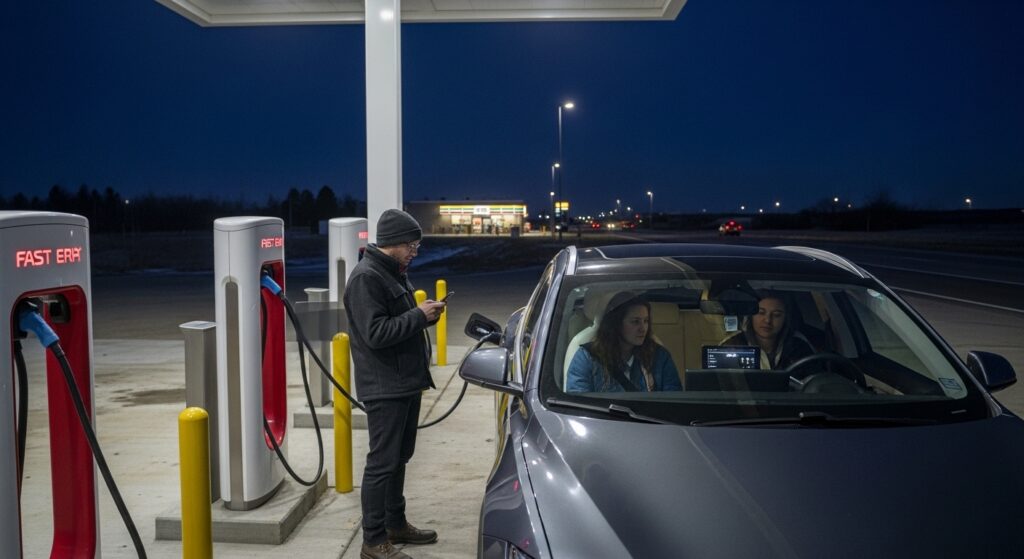
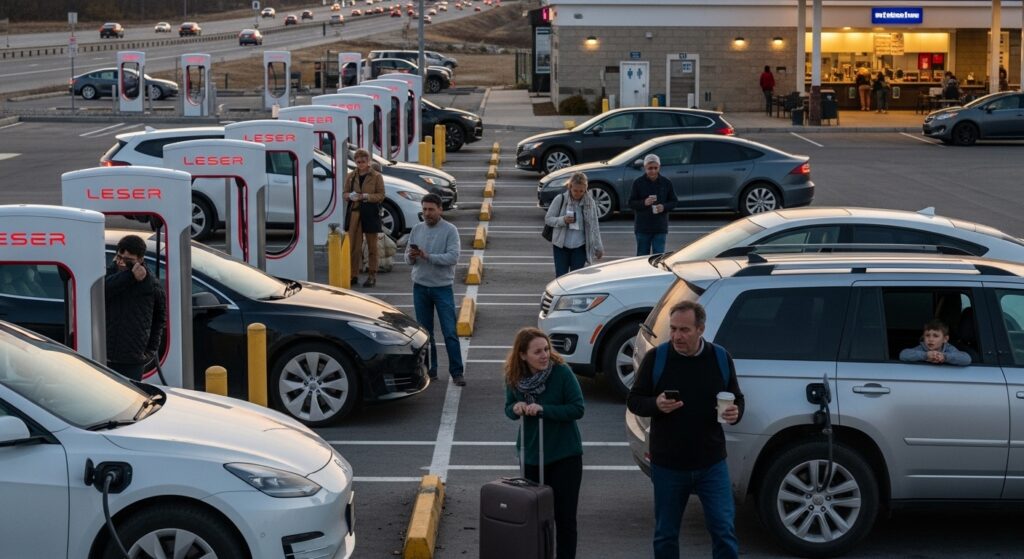
The charging stop, meanwhile, is becoming more normal but not yet frictionless. Fast charging can fit naturally into a road trip when stations are placed near food, restrooms and well-lit amenities. A 15-to-30-minute break can feel reasonable, even welcome. But when a stop involves a wait for an open stall, a malfunctioning payment screen, a cable issue or a site tucked behind a dark parking lot with limited services, the emotional math changes. Gasoline drivers measure convenience in minutes. EV drivers still measure it in both minutes and uncertainty.
Government policy was supposed to help standardize that experience, and over time it still may. Federal efforts in the United States have pushed minimum standards for uptime, interoperability and accessibility for funded charging infrastructure. Those rules matter because they reflect a basic reality: road-trip charging only works at scale when it behaves less like a technology beta test and more like a mature utility service. The public does not care which agency, automaker or charging company gets credit. Drivers care whether the station works the first time.
The market, too, is maturing. Electrify America, EVgo, ChargePoint and newer entrants are all trying to improve hardware, software and site design. IONNA, the automaker-backed venture, is betting that road-trip charging can become a branded hospitality product rather than a roadside compromise. Globally, the trend is even clearer. Public charging infrastructure has expanded rapidly in Europe and China, and in several markets highway charging is becoming a far more routine part of EV ownership. The broad direction is unmistakable: charging networks are getting better, denser and more standardized.
Still, “good enough” depends on the standard being applied. For early adopters and experienced EV drivers, the answer is already yes. They know how to plan around weather, battery curves and backup stations. For Tesla drivers in heavily traveled regions, the answer is often yes as well, with fewer caveats than before. For mainstream buyers who want to drive as casually as they did in a gasoline car, especially in a non-Tesla EV, the answer is closer to “usually, but not always.”
That distinction helps explain why charging perception still lags behind charging reality. Networks have improved, but public memory is sticky. Many consumers still picture the unreliable chargers of a few years ago. Others hear conflicting stories from friends: one describing a seamless 700-mile trip, another recounting a holiday nightmare involving queues, broken stalls and an app that would not authenticate payment. Both stories can be true. The network has advanced enough that success is common, but not so far that failure feels exceptional.
In practical terms, EV road-tripping in 2026 works best under a few conditions. The route should run through well-served corridors. The vehicle should have solid fast-charging performance, competent route planning and preferably access to Tesla’s network. The driver should be willing to plan at least a little, especially in winter or in sparsely populated areas. Under those conditions, the experience can be entirely ordinary. The old idea that EVs are only city cars no longer fits the facts.
But the final psychological barrier has not been fully crossed. Gasoline infrastructure is boring, and that is its advantage. Most drivers assume it will be there, open and usable. EV charging is improving precisely by becoming more boring: more standardized plugs, better uptime, more predictable speeds, simpler payment and more locations where a stop feels normal rather than improvised. The industry has moved meaningfully in that direction, but it has not finished the journey.
So, are EV charging networks finally good enough for road trips? For a large and growing share of trips, yes. For every trip, in every vehicle, with zero planning and zero stress, not yet.
That may sound like an unsatisfying conclusion, but it is also evidence of how much has changed. The debate is no longer about whether long-distance EV travel is possible. It is about how close the charging experience has come to being routine. In 2026, the answer is closer than ever before — close enough that many drivers will stop asking the question, and close enough that the remaining gaps now stand out not as proof of failure, but as the final obstacles of a system that is maturing in public.