
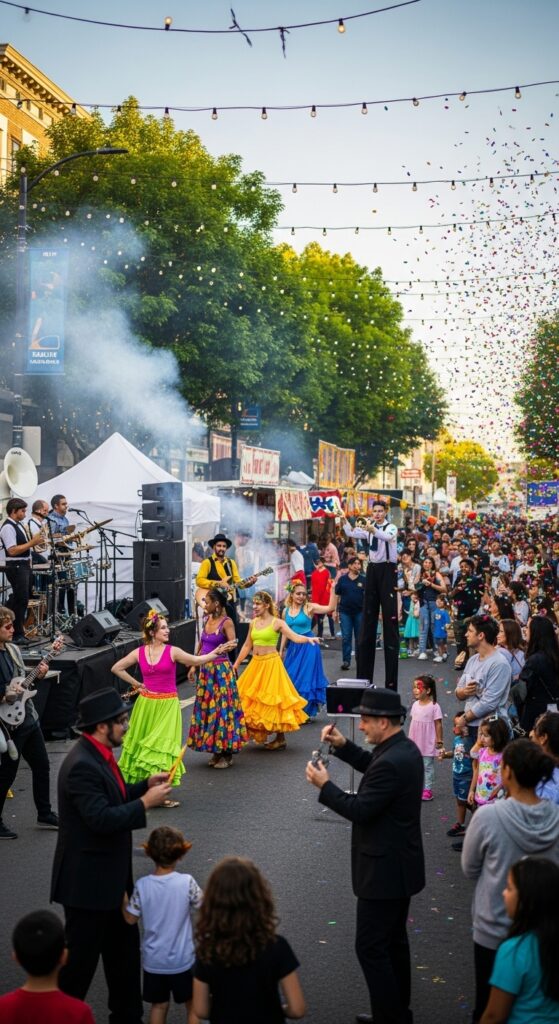
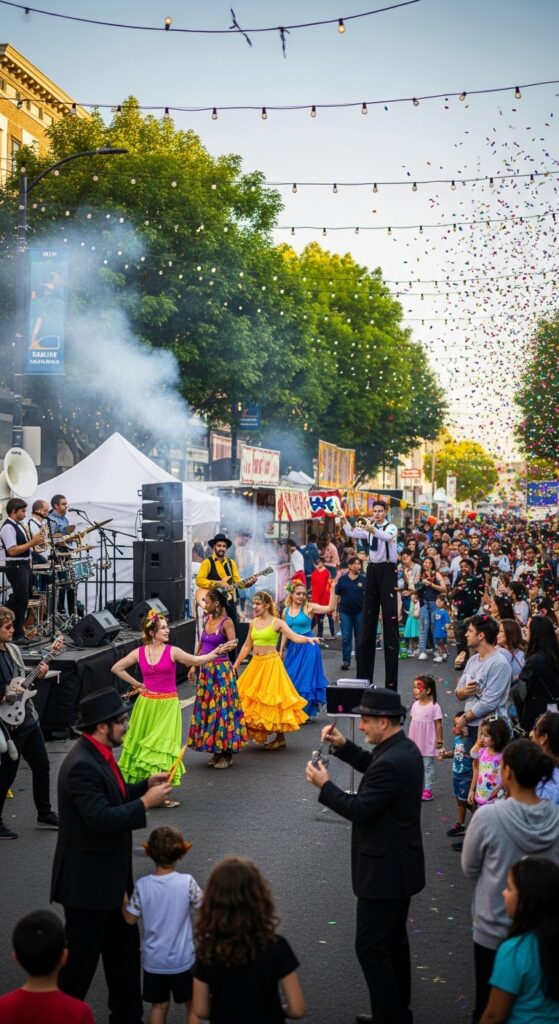
A lively street festival is one of the most powerful expressions of public joy. Unlike formal events held in grand theaters, luxury halls, or private venues, a street festival belongs to everyone. It transforms ordinary roads into spaces of celebration, creativity, and human connection. For a few unforgettable hours, or sometimes for an entire weekend, the familiar rhythm of daily life is replaced by music, dancing, colors, aromas, laughter, and the collective excitement of a crowd united by the simple desire to enjoy the moment. In a vibrant street festival, the streets stop being only places of movement and become places of meaning. They become stages, galleries, dining areas, dance floors, and meeting grounds where culture comes alive in its most open and energetic form.
At the heart of every lively street festival is atmosphere. Long before a visitor notices the details, they feel the event’s energy. Music travels through the air, people move in every direction, voices rise in cheerful conversation, and bright decorations fill the streets with visual excitement. Banners stretch overhead, flags flutter from temporary poles, and strings of lights or paper ornaments turn even the simplest road into something festive. Color plays a major role. Costumes, signs, food stalls, painted faces, and handmade crafts all contribute to a rich visual environment. The festival feels alive not because of one attraction, but because every part of it seems to pulse with movement and intention.
Music is often the first element that captures attention. In a street festival, music does not remain politely confined to a distant stage. It spills outward into the crowd, merging with footsteps, applause, and spontaneous singing. Depending on the cultural setting, the festival may feature traditional drumming, folk music, jazz bands, pop performances, electronic dance sets, or a mixture of many different styles. One street corner may echo with the sound of guitars and singers, while another bursts with percussion and dance rhythms. This diversity gives the festival a sense of discovery. Visitors do not simply attend one performance; they move through a landscape of sound, always hearing something new as they turn the next corner.
Dance naturally follows music, and nowhere is that more visible than in a street festival. Professional dancers may perform on temporary stages or in open areas surrounded by eager spectators. Their movements are often bold, expressive, and filled with cultural meaning. At the same time, ordinary festival-goers also become part of the performance. Children imitate dancers with fearless enthusiasm. Teenagers laugh while attempting new moves with friends. Older adults clap in rhythm or join group dances that have been passed down through generations. This blending of performer and audience is one of the most beautiful aspects of a street festival. The event invites participation rather than distance. It encourages people not only to watch joy, but to enter it.
Street festivals are also deeply tied to food, and the culinary side of the celebration is often as memorable as the music and performances. Food stalls line the streets with an irresistible variety of smells, colors, and flavors. Grilled meats, fried snacks, sweet pastries, fresh fruit, noodles, roasted corn, local specialties, and drinks of all kinds tempt visitors from every direction. The scent of spices, smoke, sugar, and warm bread mixes with the surrounding music and chatter, creating a sensory experience that feels rich and immediate. Food at a street festival is more than nourishment. It is part of the event’s identity. It reflects local culture, family traditions, and shared memories. A single dish can connect a visitor to a region’s history just as clearly as a song or dance can.
One of the most remarkable things about food in a festival setting is how social it becomes. People gather around stalls, recommend dishes to one another, and eat while standing, walking, talking, and laughing. Meals are no longer private or routine. They become communal, casual, and full of spontaneity. Someone may arrive intending only to watch the performances, then find themselves tasting something new simply because the aroma was too tempting to resist. Others may search eagerly for beloved dishes they associate with past festivals, childhood celebrations, or family traditions. In this way, food becomes a bridge between memory and present joy.
Another essential feature of a lively street festival is the presence of artists and performers beyond music and dance. Street magicians, painters, acrobats, puppeteers, clowns, fire performers, and living statues all contribute to the atmosphere of surprise. These performers often work at close range, which makes their art feel more personal and immediate than it might in a formal venue. A magician can make a child gasp only a few feet away. An acrobat’s balance and daring can hold a crowd in total silence before it erupts into applause. A mural artist may transform an ordinary wall into a work of public beauty during the festival itself, allowing visitors to witness creativity in progress. This variety ensures that a street festival remains dynamic. There is always something unexpected waiting nearby.
Craft stalls and local vendors also add richness to the event. Handmade jewelry, pottery, paintings, textiles, lanterns, wooden toys, and souvenirs reflect the imagination and labor of local creators. These objects do more than fill market tables. They tell stories about place, heritage, and craftsmanship. In a world increasingly dominated by mass production, the handmade quality of festival goods can feel refreshing and meaningful. Visitors often value these purchases not merely as products, but as reminders of an experience. A bracelet, print, or woven bag bought at a lively festival may continue to carry the emotional warmth of that day long after the event ends.
Crowds, of course, are central to the spirit of a street festival. At first, a large gathering may seem overwhelming, but within the context of celebration, the crowd becomes a source of energy rather than discomfort. It creates a sense of scale, proving that the excitement is shared. Families push strollers through busy lanes. Couples walk hand in hand beneath strings of lights. Groups of friends stop constantly for photos, snacks, and conversation. Tourists mingle with local residents, each learning from the presence of the other. The crowd is not just an audience. It is the living body of the festival. Without people, decorations and performances would feel empty. With them, the streets become animated by countless individual stories unfolding at once.
One of the most meaningful qualities of a street festival is its power to bring different people together. In everyday life, social groups are often separated by age, class, profession, or routine. A busy city may contain thousands of people living close to one another while rarely interacting in a genuine way. A street festival interrupts this pattern. It offers a public setting in which strangers stand side by side, react to the same music, wait in the same lines, watch the same performers, and laugh at the same moments. For a brief time, differences matter less than participation. The result is a rare feeling of collective belonging.
This sense of community is particularly important in modern urban life, where many people experience loneliness despite living among crowds. A lively street festival reminds people that public space can still be joyful, welcoming, and human. It shows that cities are not only built from roads, buildings, and traffic systems, but also from relationships, traditions, and shared moments of celebration. Even in smaller towns, the festival serves a similar purpose. It reinforces local pride, highlights cultural identity, and gives residents a chance to experience their own community in a brighter and more festive form.
Cultural expression lies at the center of many street festivals. Some celebrate religious traditions, seasonal changes, historical events, or national holidays. Others highlight specific communities, artistic movements, or local heritage. In every case, the festival becomes a visible expression of values and identity. Traditional costumes may appear in parades. Regional instruments may accompany dances passed down through generations. Decorative motifs may reflect legends, symbols, or spiritual beliefs. These details matter because they turn entertainment into cultural preservation. A street festival is not only a place to have fun. It is also a place where memory is performed, displayed, and renewed.
At the same time, many modern street festivals combine tradition with innovation. Alongside folk performances and heritage foods, one may also find contemporary music, digital art, fashion showcases, and social media-friendly installations designed for photography and interaction. This combination reflects the way culture evolves. A successful festival honors the past without becoming trapped in it. It welcomes new forms of expression while maintaining a connection to the community’s roots. In this balance between continuity and change, the festival becomes both a celebration of identity and a sign of creative growth.
For young people, a street festival often feels especially exciting because it offers freedom and movement. Unlike highly structured events, festivals encourage wandering. A person can follow the loudest music, stop suddenly at a compelling performance, buy an unexpected snack, or lose track of time while talking with friends in the middle of a decorated street. There is spontaneity in every part of the experience. This freedom creates strong memories. Many people remember not only what they saw at a festival, but how it felt to move through a crowd full of color and sound, to be surrounded by laughter, and to feel that the city itself had turned playful.
Children, too, experience a street festival with a special kind of wonder. For them, the event can feel almost magical. Giant puppets seem like creatures from stories. Balloons and lights appear larger than life. Musicians, dancers, and costumed characters fill the world with possibility. Simple activities like face painting, games, or sweet treats can become unforgettable highlights. A child at a lively street festival does not always distinguish between performance and reality. The entire environment feels enchanted. This childhood excitement is part of what makes festivals emotionally powerful for adults as well, because it reconnects them with a more open and joyful way of seeing.
As the day moves into evening, the atmosphere of a street festival often becomes even more captivating. Lights begin to glow more brightly, shadows deepen, and the visual contrast makes every color seem richer. Evening performances may feel more dramatic under spotlights or lanterns. Crowds grow denser, music sounds fuller, and the entire street seems to shimmer with life. In some festivals, parades, fireworks, or illuminated art installations create a breathtaking finale. Night adds a layer of beauty and dreamlike intensity to the event. The ordinary street, already transformed by celebration, now feels almost unreal in its brightness and motion.
Yet a street festival is not only about spectacle. Its true value lies in the emotions it awakens. It encourages delight without requiring luxury. It creates beauty in public space rather than behind closed doors. It reminds people that joy can be shared among strangers and that culture becomes strongest when it is lived openly. In a time when many forms of entertainment are increasingly digital and individualized, the physical and communal nature of a street festival feels especially meaningful. It asks people to step outside, to encounter others, and to become part of something larger than themselves.
There is also something democratic about the festival atmosphere. Because it takes place in the street, it feels more accessible than many formal cultural events. People do not need to know the rules of high art or purchase expensive tickets to participate. They only need curiosity and willingness to join. This openness is one reason street festivals often leave such lasting impressions. They make celebration visible and available. They prove that art, music, food, and joy do not belong only to elite spaces. They belong to the public.
When the festival finally begins to end, the streets slowly return to normal. Stalls close, decorations come down, and performers pack away instruments and costumes. The crowd thins. Music fades. Yet what remains is more than a memory of noise and color. People carry home the feeling of connection, surprise, and happiness that the event created. They remember the taste of a dish, the rhythm of a drumline, the sight of dancers in bright costumes, the smile of a stranger in the crowd, or the glow of lights above a busy street. These details become part of personal and collective memory alike.
In the end, a lively street festival is much more than a public party. It is a celebration of community, creativity, and shared humanity. It turns streets into places of art and encounter. It brings together music, movement, food, culture, and emotion in a way that few other events can match. Most importantly, it reminds people that joy becomes even more powerful when it is experienced together. In a vibrant street festival, the city breathes differently. It sings, dances, tastes, and shines. For a brief and beautiful time, the ordinary world is transformed into a place of celebration, and everyone who enters it becomes part of the story.
