
Entertainment has always been an essential part of human life. From ancient storytelling around fires to theater, cinema, television, video games, and digital streaming, each era has reshaped the way people experience joy, wonder, and connection. As technology continues to evolve at a breathtaking pace, the world of entertainment is moving toward a future that feels both extraordinary and deeply transformative. The future world of entertainment will not simply offer people new ways to watch, listen, or play. It will redefine the relationship between audiences and experiences. Instead of passively consuming content, people will enter living, interactive worlds where imagination, technology, and emotion merge in ways never seen before.
At the center of this transformation is immersion. In the past, entertainment often placed a screen or stage between the audience and the performance. People sat in chairs, watched stories unfold, and responded as observers. In the future, entertainment will increasingly remove this distance. Virtual reality, augmented reality, mixed reality, holographic projection, artificial intelligence, and sensory technology will combine to create experiences in which the boundary between reality and fiction becomes less rigid. Viewers will no longer feel like outsiders looking in. They will become participants, explorers, co-creators, and even characters within the story itself.
One of the most important developments in future entertainment will be the rise of fully immersive virtual worlds. Virtual reality has already shown its potential, but in the decades ahead it is likely to become far more advanced, accessible, and realistic. People may enter digital environments that stimulate not only sight and sound, but also touch, temperature, movement, and perhaps even smell. Instead of simply playing a game set in a fantasy kingdom, a person may physically feel the wind on a mountain path, hear distant voices in a crowded market, and walk through a castle that responds intelligently to their presence. The experience will not just be watched. It will be lived.
These virtual worlds may become major centers of social life as well as entertainment. Friends separated by continents could meet inside shared environments that feel almost physical in their realism. They may attend concerts together, explore fictional cities, solve mysteries, compete in games, or create digital art side by side. The future of entertainment will likely blur the distinction between social media, gaming, live events, and storytelling. A single platform might allow users to watch a performance, interact with performers, customize the environment, and continue the story afterward in a game-like setting. Entertainment will become more continuous, more communal, and more personalized.
Augmented reality will also transform how people experience fun in everyday life. Unlike virtual reality, which replaces the surrounding world with a digital one, augmented reality adds virtual layers onto real spaces. In the future, a city street may become an interactive game board, a museum may feature historical figures walking beside visitors as holograms, and a public park might host live performances enhanced with digital creatures, visual effects, and audience participation. The ordinary world itself could become a stage for entertainment. This would make leisure more dynamic and unpredictable, allowing people to discover play and wonder in places that once seemed routine.
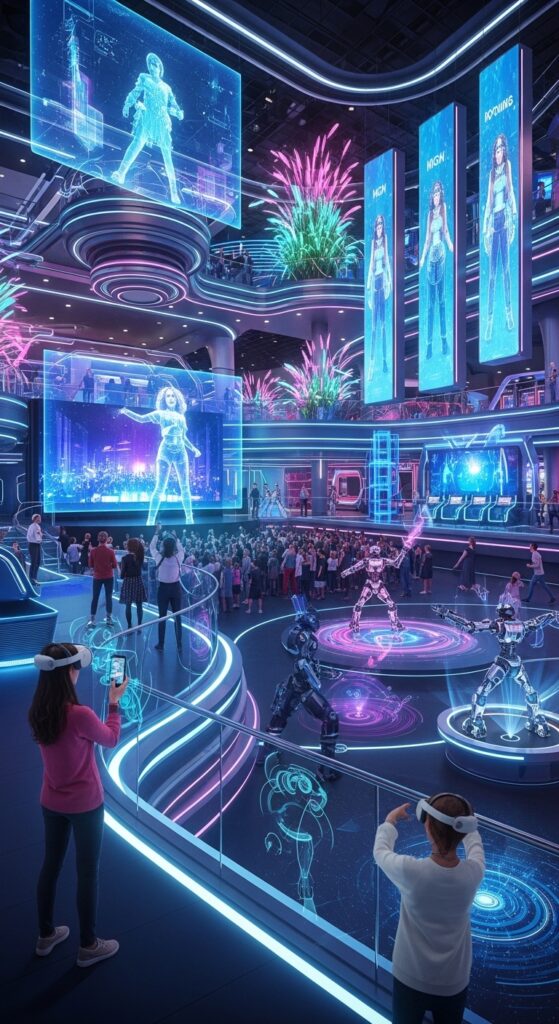
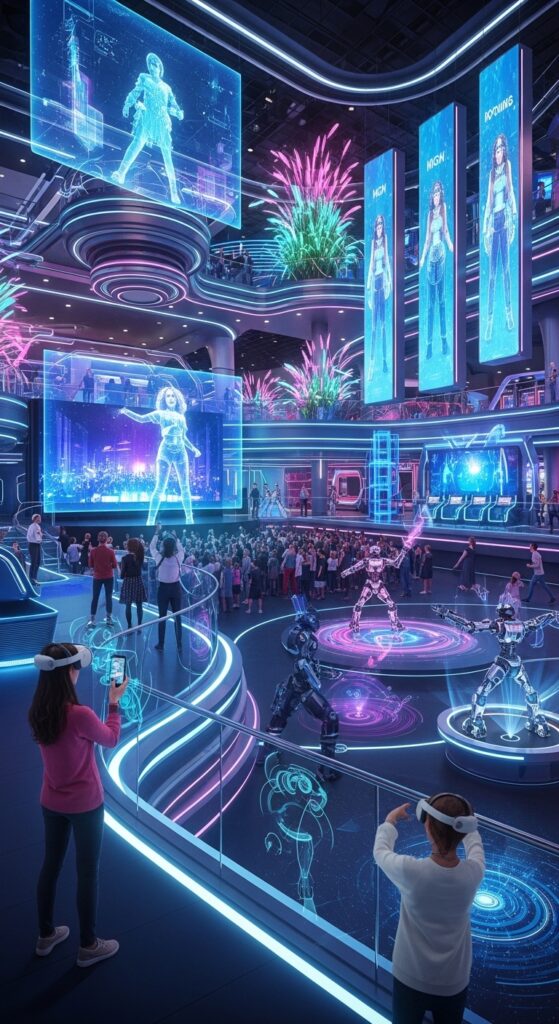
Imagine walking through a future entertainment district at night. Buildings shimmer with programmable surfaces that change color and design according to events. Holographic performers dance above plazas. Interactive advertisements respond to gestures, transforming into mini-games or personalized story invitations. Drone light shows replace traditional fireworks with moving patterns in the sky. Streets pulse with music that changes as people move through different zones. In such a world, entertainment would no longer be limited to enclosed venues like cinemas, stadiums, or arcades. Entire neighborhoods could become living ecosystems of sensory and digital performance.
One of the most exciting possibilities in the future world of entertainment is the rise of intelligent storytelling powered by artificial intelligence. Today, most films, shows, and games are carefully scripted, with audiences following predetermined plots. In the future, AI may allow stories to evolve in real time according to each individual’s choices, emotions, and preferences. A mystery story could alter its clues depending on how observant the participant is. A romantic drama might adapt to the personality of the viewer. A fantasy adventure may generate new kingdoms, characters, and dialogue each time someone enters it. This would make every entertainment experience unique.
AI-generated characters could also become more emotionally convincing and responsive. Instead of non-player characters in games repeating limited lines, future digital characters may hold meaningful conversations, remember past interactions, and respond with subtle emotional complexity. They could act as companions, performers, guides, rivals, or collaborators. A person attending a futuristic role-playing experience might build a genuine bond with an AI character who changes over time, learns from their behavior, and contributes to a story that feels deeply personal. This raises important philosophical questions, but it also points to a future where entertainment is more intimate and emotionally engaging than ever before.
Live performances will be transformed as well. Concerts, theater productions, and festivals in the future may combine real human talent with digital effects of astonishing sophistication. A singer might perform alongside holographic dancers and AI-generated landscapes that shift with the music. Audiences may wear lightweight smart lenses that allow them to see additional layers of the show invisible to the naked eye. People in different countries might attend the same concert simultaneously in hybrid form: some in person, some through immersive virtual platforms, all able to interact with the event and one another in real time. The traditional idea of a stage and audience may give way to a shared, multidimensional experience.
Hologram technology, in particular, is likely to play a major role in the entertainment industry of the future. While today holographic performances are still limited in realism and scale, future improvements could make them nearly indistinguishable from physical presence. This would allow entirely new forms of performance. Historical figures might be recreated for educational theater. Fictional characters could appear live on stage and converse with audiences. Global celebrities might perform in multiple cities at once through realistic projection systems. Entertainment companies may create entire casts of digital performers who never age, tire, or disappear. These possibilities are thrilling, though they also challenge ideas about authenticity, originality, and artistic identity.
Another powerful shift will come from the personalization of entertainment. Modern platforms already recommend films, songs, and videos based on user behavior, but future systems may go much further. Entertainment experiences may be designed moment by moment around biometric data, mood detection, and individual preference patterns. A smart home might recognize that its resident feels tired after work and automatically create a relaxing entertainment environment with soft lighting, calming music, and a recommended interactive film. A theme park of the future may adjust ride narratives, visual effects, and game difficulty according to each visitor’s profile. What people enjoy will not merely be selected for them. It will be shaped around them.
This kind of personalization could make entertainment more satisfying, but it also introduces concerns. If systems know too much about human emotions and desires, they may become extremely persuasive. Future entertainment could become so finely tuned to the user’s psychological preferences that it becomes difficult to disconnect from it. This raises ethical questions about addiction, privacy, autonomy, and commercial influence. The future world of entertainment will therefore require not only innovation, but also wisdom. Society will need to decide how to balance immersive pleasure with human well-being.
Theme parks and physical entertainment centers may become some of the most spectacular expressions of future leisure. Rather than simple collections of rides and food stalls, they could evolve into responsive, story-driven worlds. Visitors may wear devices that track their decisions throughout the day, allowing the park to transform around them. A guest who helps a digital resistance movement in one attraction may be recognized as a hero in another. Buildings may change appearance through projection mapping. Robot performers may interact with guests in real time. Escape rooms, simulations, and live-action experiences could merge into one continuous adventure where every visitor influences the unfolding narrative. These parks would not just offer rides; they would offer alternate realities.
Robotics will likely contribute greatly to this shift. Entertainers of the future may include humanoid robots capable of dancing, acting, hosting shows, or performing acrobatics alongside human artists. In family entertainment spaces, robots could serve as storytellers, teachers, and game leaders. In high-end immersive experiences, they may become convincing inhabitants of fictional worlds. Imagine walking into a futuristic science-fiction attraction where android characters greet visitors, respond naturally to questions, and perform scenes with emotional nuance. Such experiences would deepen the illusion that guests have stepped into another universe.
The future of entertainment will also be shaped by accessibility and global connection. As technology becomes more widespread, people from different backgrounds and regions may gain access to cultural experiences that were once geographically or financially limited. A child in a small town might attend a world-class virtual museum exhibit. A student could sit inside a simulated Shakespeare performance with live interactive translation. Someone unable to travel physically might explore distant landscapes or attend global festivals through immersive systems. In this sense, the future of entertainment could become more democratic, opening doors to wonder and creativity for millions of people.
Education and entertainment may also become more closely linked. The concept of “edutainment” is not new, but future technology will make learning experiences far more engaging. Historical events could be explored through immersive reenactments. Science concepts may be taught through interactive simulations that allow learners to walk inside molecules or travel through the human bloodstream. Language learning might happen through live virtual adventures where users must speak to characters in the target language. In such settings, entertainment becomes a gateway to knowledge, curiosity, and skill development.
Yet even in this dazzling future, the emotional purpose of entertainment will remain fundamentally human. People seek entertainment not only for stimulation, but also for meaning, release, beauty, and connection. The technologies may change, but the desires underneath them remain familiar. Human beings want to laugh, to escape, to wonder, to feel suspense, to share stories, and to experience emotions larger than everyday life. The future world of entertainment will succeed not because it is more digital, but because it finds deeper ways to serve these timeless needs.
There will, however, be important cultural and artistic debates. As AI becomes more capable of generating music, scripts, visuals, and even performers, many will ask what role remains for human artists. Some may fear that technology will replace creativity with algorithmic imitation. Others will argue that these tools can expand human imagination rather than diminish it. The likely future is one of collaboration. Artists may use AI as a partner, not a substitute, creating works that neither human nor machine could produce alone. The entertainment of tomorrow may therefore become a fusion of human emotion and computational possibility.
Environmental sustainability will also matter. Large entertainment industries consume energy, materials, and infrastructure. The future will demand greener solutions, from energy-efficient digital venues to recyclable materials, low-emission transport, and smarter event management systems. Virtual experiences may reduce some environmental burdens, but they too require data centers and hardware. If entertainment is to thrive responsibly, innovation must consider not just excitement, but ecological impact.
Perhaps the most fascinating aspect of the future world of entertainment is that it will not only entertain people; it will reshape how they perceive reality itself. As simulated experiences become richer and more convincing, the difference between what is artificial and what is authentic may become more emotionally complicated. If a virtual concert moves someone to tears, is that experience less real because the environment was digital? If an AI character provides comfort, is that relationship meaningless because it was programmed? These are not merely technical questions. They touch on the future of emotion, art, and identity.
In the end, the future world of entertainment promises a breathtaking expansion of what human experience can be. It will be immersive, intelligent, interactive, and astonishingly creative. People may walk through stories instead of watching them, collaborate with digital beings, attend impossible performances, and transform ordinary spaces into magical ones. Technology will open doors to forms of wonder that past generations could barely imagine. Yet the heart of entertainment will remain what it has always been: the desire to feel more alive.
As humanity moves forward, entertainment will become not just a way to pass time, but a way to explore possibility. It will allow people to step beyond the limits of place, body, and circumstance. It will offer joy in new forms, connection across distances, and beauty shaped by imagination and code alike. The future world of entertainment will not simply be a collection of advanced devices or spectacular effects. It will be a mirror of human creativity at its most ambitious, a realm where dreams are built into environments, where stories respond to the soul, and where the impossible becomes, for a moment, something we can enter and truly experience.
