
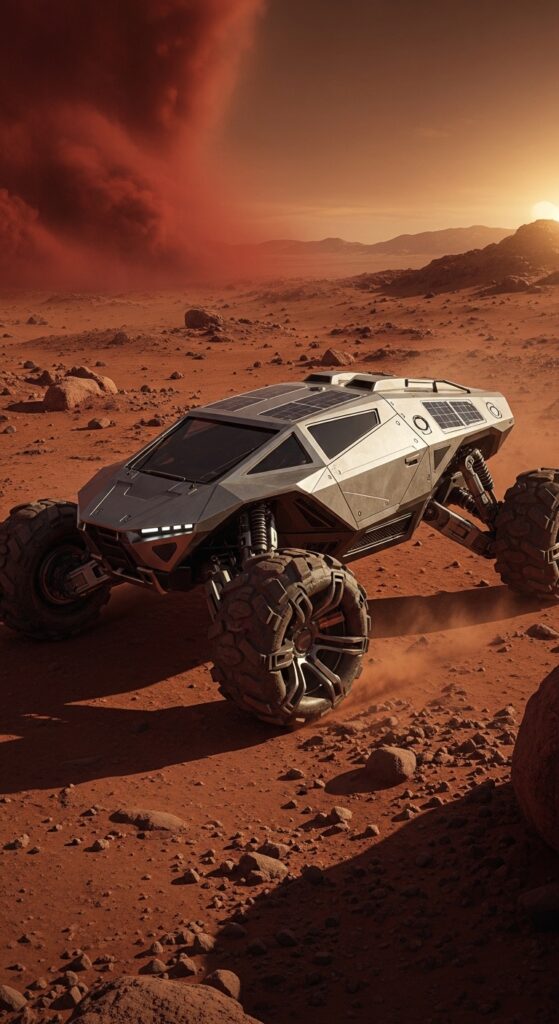
Off-road vehicles have always occupied a special place in human imagination. They represent freedom, resilience, and the ability to go where paved roads end. From early military utility trucks to modern recreational SUVs, these machines have been designed to conquer deserts, mountains, forests, mud, and snow. Yet the off-road vehicle of the future will be far more than a tougher version of today’s four-wheel-drive machines. It will be cleaner, smarter, safer, and more adaptive than anything we currently know.
As the world changes under the pressure of climate concerns, rapid urbanization, digital transformation, and shifting consumer expectations, off-road vehicles are entering a period of radical reinvention. Engineers, designers, and environmental thinkers are now asking a new question: how can a vehicle remain powerful enough for extreme terrain while also becoming efficient, intelligent, and sustainable? The answer is shaping a new generation of vehicles that may redefine exploration, work, and mobility in remote environments.
One of the most important shifts in the future of off-road vehicles is electrification. Traditional off-road machines rely heavily on large gasoline or diesel engines because they need high torque, durability, and reliability in demanding conditions. However, electric motors naturally provide instant torque, which is especially valuable when climbing steep inclines, crawling over rocks, or pulling heavy loads through mud. Unlike internal combustion engines, electric powertrains can deliver smooth and precise power at low speeds, giving drivers better control over technical terrain.
Battery technology remains a challenge, especially for long journeys far from charging infrastructure, but the pace of innovation is accelerating. Solid-state batteries, lighter battery packs, and modular energy systems may help future off-road vehicles travel farther while maintaining rugged capability. In addition, some manufacturers are exploring hybrid systems that combine electric motors with compact combustion engines or hydrogen fuel cells. These solutions may serve as a transition, especially for expedition vehicles, military platforms, and industrial machines that need extended range in isolated areas.
The rise of electrification will also change the physical design of off-road vehicles. Without the need for large engines, transmissions, and exhaust systems, designers gain more freedom to rethink proportions and weight distribution. Batteries can be mounted low in the chassis, lowering the center of gravity and improving stability on uneven ground. Independent electric motors on each wheel could enable precise torque vectoring, allowing a vehicle to send the exact amount of power to each tire depending on grip conditions. This would offer major advantages in sand, ice, and broken rock, where traction can change moment by moment.
Another defining feature of future off-road vehicles will be intelligence. Modern vehicles already include terrain management systems, traction control, hill descent assist, and multiple driving modes. In the future, these systems will become much more advanced through artificial intelligence, machine learning, and sensor fusion. Cameras, radar, lidar, and ground-scanning systems may work together to analyze terrain ahead in real time. Rather than merely reacting to wheel slip after it occurs, the vehicle may predict obstacles and adjust suspension, power delivery, tire pressure, and steering behavior before the driver even reaches them.
Imagine an off-road vehicle approaching a rocky trail. Its onboard systems could scan the terrain, identify unstable stones, measure slope angle, estimate tire contact points, and suggest an optimal path. In a desert, the vehicle might detect soft sand and automatically lower tire pressure through an integrated air management system. In snow, it could shift weight distribution, adapt regenerative braking, and fine-tune wheel torque to prevent loss of traction. These systems would not eliminate the thrill of driving, but they would increase safety and make off-road travel more accessible to less experienced users.
Autonomy will also play a major role, though probably in a different way than in city transportation. Fully autonomous urban driving is aimed at replacing human attention in traffic-heavy environments. In off-road settings, autonomy will likely focus first on assistance rather than complete replacement. Future vehicles may offer semi-autonomous trail navigation, convoy following, obstacle detection, and remote operation. A driver could manually control the vehicle during exciting sections of a route, then allow autonomous systems to handle repetitive or hazardous movement across long stretches of wilderness or industrial terrain.
This will be particularly important for sectors beyond recreation. Mining, agriculture, disaster response, forestry, border patrol, and scientific exploration all depend on vehicles that can operate in places where human access is difficult or dangerous. Autonomous or remotely supervised off-road vehicles could carry supplies through wildfire zones, inspect damaged infrastructure after earthquakes, or deliver medical equipment to isolated regions after floods. In such situations, the future off-road vehicle becomes not just a machine for adventure, but a tool for resilience and humanitarian response.
Material science will further transform what these vehicles can do. Future off-road vehicles will likely use lightweight composites, recycled alloys, advanced polymers, and self-healing coatings. Reducing weight is essential because lighter vehicles consume less energy and place less stress on terrain. This matters both for efficiency and for environmental impact. Traditional heavy off-road vehicles can damage fragile ecosystems, compress soil, and erode trails. A lighter, smarter vehicle with adaptive suspension and low-ground-pressure tires could reduce this footprint significantly.
Durability, however, cannot be sacrificed. Off-road vehicles must survive impacts, vibration, dust, water, and extreme temperatures. For this reason, future materials will need to combine strength with flexibility and reparability. Some concepts already imagine body panels that can absorb small impacts and return to shape, chassis sections that are easier to replace in the field, and modular components that allow quick repairs without specialized workshops. This modular philosophy could make future vehicles more sustainable by extending service life and reducing waste.
Tire technology is another area likely to evolve dramatically. Conventional pneumatic tires perform well in many conditions, but they are vulnerable to punctures and require careful pressure management. Future off-road vehicles may use airless tires, shape-memory materials, or adaptive tread systems that change depending on terrain. A vehicle traveling from asphalt to gravel to deep mud could automatically alter tire stiffness and contact pattern. Some concepts even suggest robotic wheels that can transform shape, becoming round for speed and more claw-like for climbing or crawling.
Suspension systems will become more active and predictive as well. Today’s advanced off-road vehicles already use adjustable dampers and electronically controlled suspension settings. In the future, suspension may become fully dynamic, constantly reading terrain and altering height, stiffness, articulation, and damping in milliseconds. This could improve comfort, stability, and traction simultaneously. Rather than choosing between road comfort and trail performance, drivers may get both. The vehicle could cruise smoothly on highways and then instantly transform into a high-clearance crawler when the surface changes.
The cabin of the future off-road vehicle will also reflect broader changes in mobility culture. Traditional off-road interiors often emphasize ruggedness over comfort, but future users may expect both utility and digital sophistication. Cabins may become more modular, with reconfigurable seating, fold-out workstations, integrated camping functions, and augmented reality displays. Instead of glancing at conventional gauges, drivers might see projected trail data, vehicle angles, energy use, weather alerts, and route overlays directly on the windshield or helmet visor.
Connectivity will extend the usefulness of these vehicles far beyond transportation. Satellite communication, offline mapping, drone integration, and vehicle-to-vehicle networking may become standard in remote travel. An expedition team could deploy drones from the roof to scout a river crossing or identify a safe route around landslides. Vehicles in a convoy could share traction data and hazard information in real time. Rescue teams might coordinate through an integrated digital platform that links vehicles, sensors, and emergency command centers. In these cases, the future off-road vehicle functions as a mobile intelligence hub.
Sustainability will be one of the central pressures shaping this evolution. Off-road culture has often been criticized for its environmental impact, including emissions, noise, habitat disruption, and trail damage. Future vehicles will need to respond to these concerns not only through cleaner powertrains, but through a broader ecological design philosophy. Quiet electric propulsion reduces noise pollution, which is especially important in forests and wildlife-sensitive areas. Precision traction control can minimize wheel spin and erosion. Smart route guidance could help drivers avoid fragile ecosystems or seasonally restricted zones.
Manufacturers may also face growing pressure to build vehicles within circular economic models. This means using recyclable materials, designing for component reuse, and offering battery refurbishment or replacement programs. Ownership itself may evolve. Instead of every enthusiast buying a large personal off-road machine, some future systems may emphasize shared access, subscription fleets, or modular platforms that can serve multiple purposes. A single base vehicle could switch between recreation, utility, and expedition configurations depending on user needs.
At the same time, the emotional identity of off-road vehicles will remain important. People do not love these machines only because they are practical. They love them because they symbolize adventure, self-reliance, and the possibility of discovery. The future vehicle must preserve that emotional core even as it becomes more technological. Designers will need to ensure that automation does not remove the sense of challenge, and that sustainability does not erase the visual and tactile appeal of rugged machines. The best future off-road vehicles will not feel like sterile computers on wheels. They will still feel bold, capable, and alive.
There is also a social dimension to consider. Off-road vehicles have long served not just individual explorers, but also communities in remote regions where infrastructure is limited. In many parts of the world, reliable all-terrain transportation is essential for farmers, rangers, medics, teachers, and supply workers. Future off-road innovation could improve quality of life in these places by making vehicles cheaper to operate, easier to repair, and more adaptable to local needs. Solar-assisted charging stations, swappable battery systems, and open-platform parts ecosystems might help bring advanced mobility to areas where fuel delivery is expensive or unreliable.
Of course, the path toward this future is not without obstacles. Battery supply chains raise geopolitical and environmental questions. High-tech systems may increase costs and make some vehicles difficult to repair without specialist tools. Autonomous features in remote environments must be extremely reliable because mistakes can be life-threatening. Regulations will also need to evolve, especially as authorities attempt to balance innovation with land protection and public safety. The ideal future off-road vehicle will therefore require collaboration across engineering, policy, conservation, and user communities.
Even so, the direction is clear. The off-road vehicle is no longer just a mechanical brute built to overpower nature. It is becoming a sophisticated partner designed to move through difficult landscapes with intelligence and respect. Power is being redefined through efficiency. Capability is being enhanced through software. Ruggedness is being paired with sustainability. Freedom is being expanded by connectivity.
In the decades ahead, the most successful off-road vehicles will be those that combine strength with sensitivity. They will climb mountains, cross deserts, and reach remote worksites, but they will do so with lower emissions, better data, and less damage to the world around them. They will help adventurers explore farther, workers perform better, and emergency teams respond faster. Most importantly, they will reflect a deeper maturity in how humanity approaches mobility beyond the road.
The future of off-road vehicles, then, is not simply about building machines that can go anywhere. It is about building machines wise enough to know how to go there responsibly.
