
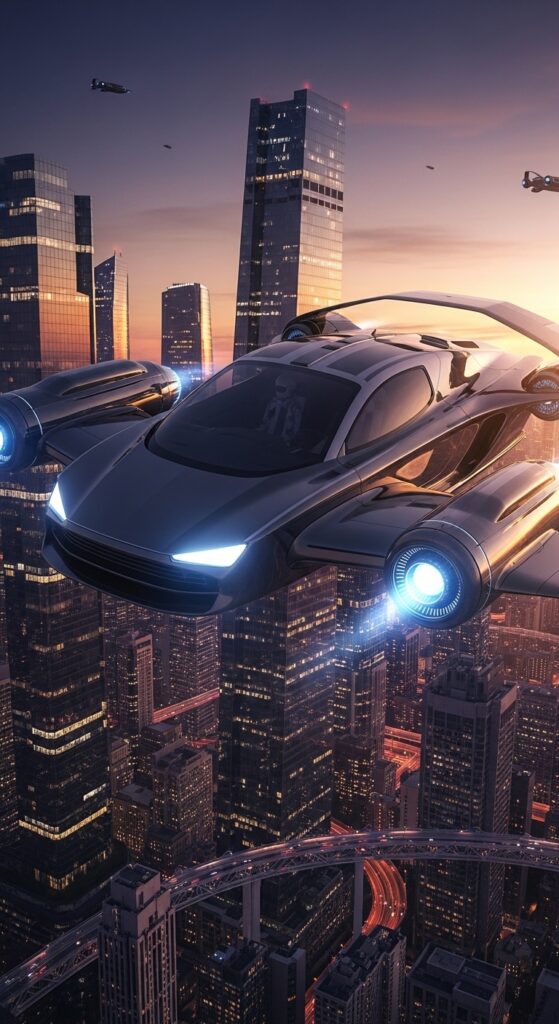
For more than a century, the idea of the flying car has lived at the boundary between fantasy and engineering. It has appeared in novels, comic books, films, and concept sketches as the ultimate symbol of the future: a vehicle that frees humanity from traffic, shortens distances, and turns the sky into a new layer of everyday mobility. For decades, however, the flying car remained mostly a dream because the technologies required to make it practical, safe, and affordable did not yet exist. Today, that situation is beginning to change. Advances in electric propulsion, lightweight materials, battery systems, autonomous navigation, and artificial intelligence have brought the concept closer to reality than ever before.
Yet the flying car of the future will not simply be a road car with wings attached. In fact, the future of personal air mobility is likely to look very different from the classic science-fiction image. Rather than a single machine that drives like an automobile and flies like an airplane, many future “flying cars” may take the form of compact electric vertical takeoff and landing aircraft, often called eVTOLs. These vehicles are being designed to rise vertically like helicopters, fly efficiently like aircraft, and operate with less noise, lower emissions, and greater automation than traditional aviation systems. Whether they are owned privately, used as air taxis, or deployed for emergency transport, flying cars have the potential to transform how people move through cities and across regions.
One of the most important reasons this future now seems plausible is the electrification of flight. Conventional aircraft engines are powerful, but they are noisy, mechanically complex, and heavily dependent on fossil fuels. Electric propulsion changes the design logic entirely. Electric motors can be smaller, more precise, and more responsive than internal combustion engines. They can also be distributed across multiple rotors, creating entirely new possibilities for lift, balance, and redundancy. A future flying car may not rely on one or two large engines, but on many smaller electric propellers working together through coordinated software systems.
This distributed propulsion model offers major advantages. It can improve stability, reduce noise, and increase safety if one rotor fails, because the others may compensate. It also allows designers to build vehicles that can take off vertically from small pads on rooftops, parking structures, or dedicated mobility hubs. In crowded urban areas where ground congestion wastes time and energy, this could create a new transportation layer above the streets. Instead of spending ninety minutes in traffic to cross a metropolitan area, a passenger might board an air taxi and complete the journey in fifteen or twenty minutes.
However, the future of flying cars is not only about speed. It is also about rethinking urban systems. Modern cities are struggling with congestion, pollution, population growth, and pressure on existing infrastructure. Roads and rail networks remain essential, but they are costly and slow to expand. Flying vehicles may offer a complementary solution for certain journeys, especially those between airports, business districts, suburbs, hospitals, and remote or underserved regions. In this sense, flying cars are not meant to replace all ground transportation, but to become part of a broader, multimodal mobility ecosystem.
For that ecosystem to work, the vehicles themselves will need to be highly intelligent. Flying in dense urban airspace is much more complex than driving on roads because there are fewer physical lanes and less room for human error. Future flying cars will therefore depend heavily on automation. Advanced navigation software, real-time traffic coordination, obstacle detection, weather analysis, and autonomous stabilization will all be essential. In many cases, the first generation of flying cars may still include trained human pilots, but over time the systems will likely become increasingly autonomous, with the human acting more as a supervisor than a traditional pilot.
Artificial intelligence will play a critical role in that transition. AI systems can help manage routing, energy use, maintenance scheduling, passenger safety, and air traffic deconfliction. A flying car approaching a city could continuously compare weather conditions, wind patterns, nearby aircraft positions, battery reserves, and landing site availability. Rather than relying only on manual decisions, it could calculate the safest and most efficient path in seconds. If an unexpected storm appears or a landing site becomes unavailable, the vehicle could reroute automatically to another approved location.
Safety, of course, is the central challenge that will determine whether flying cars become a mainstream reality or remain a niche technology. People may tolerate traffic delays on the ground, but they will have far less tolerance for risk in personal air travel. That means future flying cars must meet extremely high safety standards in design, manufacturing, operation, and regulation. Redundancy will be crucial. Critical systems such as power, flight control, communications, and navigation will likely need backup layers. Vehicles may also include ballistic parachutes, emergency autorotation-like descent functions, or multiple fail-safe landing protocols.
Maintenance and diagnostics will also become more advanced. Future flying cars may continuously monitor their own condition using embedded sensors that detect structural stress, rotor wear, battery degradation, and software anomalies. Instead of waiting for a part to fail, predictive maintenance systems could identify issues early and remove the vehicle from service before safety is compromised. This would make operations more reliable while also reducing long-term costs.
Noise is another major issue. Helicopters are often too loud for widespread urban use, especially in residential areas. If flying cars are to operate regularly over cities, they must be much quieter. Electric propulsion offers a major advantage here, but rotor design, flight path optimization, and operating altitude will also matter. Engineers are already exploring ways to reduce acoustic signatures through slower rotor speeds, optimized blade shapes, and flight profiles that minimize disturbance. The future success of flying cars may depend not just on whether they can fly, but on whether communities are willing to accept them overhead.
Infrastructure will shape adoption as much as vehicle technology does. A world with flying cars cannot function with random takeoffs and landings from any open space. Cities will need carefully planned vertiports, charging stations, maintenance centers, digital traffic management systems, and emergency response protocols. These vertiports may be built on rooftops, near transit hubs, beside airports, or in repurposed parking structures. Ideally, they would integrate with ground transportation so that a passenger could move easily from train to air taxi to autonomous shuttle without friction.
Energy infrastructure will be especially important. If future flying cars are electric, they will require high-capacity charging systems and perhaps battery-swapping networks for commercial fleets. The energy demand could be substantial, especially during peak travel periods. For that reason, the environmental promise of flying cars depends partly on how the electricity is generated. If powered by renewable energy, they could significantly reduce emissions compared to helicopters and many short car trips. If powered by fossil-heavy electricity grids, the environmental benefits become less clear. Thus, the future of flying cars is linked not only to aerospace engineering, but also to the broader transformation of energy systems.
There is also a compelling humanitarian and practical case for this technology beyond luxury transport. Popular discussion often imagines flying cars as premium vehicles for wealthy commuters, but their long-term value may be far broader. In remote areas, islands, mountainous regions, or places with poor road infrastructure, compact flying vehicles could connect communities more effectively than expensive road construction. In emergencies, they could transport medical staff, blood supplies, organs, rescue equipment, or injured patients quickly across difficult terrain. During natural disasters, when roads are blocked by floods, landslides, or earthquakes, flying vehicles could become critical tools for relief and communication.
The future flying car may also influence architecture and land use. If aerial mobility becomes common, buildings and urban districts may be designed with rooftop access, vertical mobility corridors, and integrated landing areas. New business centers could emerge farther from current transport lines because access would no longer depend only on roads or rail. At the same time, planners would need to manage equity and avoid creating a system that benefits only a small elite while leaving conventional transit underfunded. The best future scenario is not one in which the rich escape traffic in the sky while everyone else remains trapped below, but one in which aerial mobility serves a useful role within a more efficient and inclusive transport network.
Economics will determine how fast this vision develops. In the early stages, flying cars and air taxis will almost certainly be expensive. The vehicles are technologically advanced, certification is complex, and infrastructure investment is high. But many transformative technologies begin this way. Over time, mass production, battery improvements, software maturity, and operational experience may reduce costs. Shared air mobility services could become more affordable before private ownership does. In fact, it is possible that most people will encounter flying cars first not as personal possessions, but as on-demand services booked through digital platforms.
This raises interesting questions about ownership and identity. The traditional car has long been a personal object, a symbol of freedom and status. The future flying car may be different. It may function more like a networked service than a privately maintained machine. Users may care more about reliability, route access, and booking convenience than about engine size or brand prestige. Still, there will likely remain a market for privately owned recreational or executive flying vehicles, especially in regions with low population density and supportive regulations.
Regulation will be one of the most difficult aspects of this transition. Aviation is governed by strict standards for good reason, and integrating thousands of low-altitude flying vehicles into urban airspace will require new frameworks. Authorities will need to define pilot requirements, autonomous system certification, maintenance standards, insurance rules, noise limits, route permissions, privacy protections, and emergency procedures. Cybersecurity will also be vital. A future flying car is not just a physical machine but a software-driven network node. Protecting it from hacking, communication interference, and data misuse will be fundamental to public trust.
Weather presents another limitation that cannot be ignored. Ground cars can operate in rain, fog, and moderate storms with reduced speed, but small aerial vehicles are much more sensitive to wind, icing, lightning, and visibility problems. This means flying cars may not be a universal replacement for daily commuting. Instead, they may serve as premium or specialized transport under suitable operating conditions. Future forecasting systems, resilient control software, and improved vehicle stability may expand operational windows, but weather will remain a harder constraint in the sky than on the road.
Even with these challenges, the cultural power of the flying car remains enormous. It represents more than a machine. It represents humanity’s persistent desire to overcome limits. Every major transport revolution has changed not only travel times but also social patterns, economic structures, and ways of imagining space. Railroads reshaped nations. Automobiles reshaped cities and suburbs. Commercial aviation reshaped continents and global business. Flying cars, if they mature successfully, could reshape the relationship between vertical and horizontal movement in everyday life.
At the same time, society must be careful not to confuse technological possibility with automatic progress. A successful future for flying cars depends on wise integration. The goal should not be to fill the sky with chaotic machines simply because we can. It should be to use aerial mobility where it genuinely solves problems: reducing travel time on key routes, improving emergency access, connecting isolated regions, and complementing existing infrastructure. The most advanced flying car is not necessarily the one that looks most futuristic. It is the one that is safe, useful, quiet, efficient, and socially accepted.
Design will also matter in subtle ways. Future flying cars must inspire confidence. Passengers who are not trained aviators will need to feel secure in vehicles that lift vertically, hover, and navigate above crowded environments. Cabin design, visibility, vibration control, digital interfaces, and boarding simplicity will all affect public acceptance. The interior may resemble a blend of luxury car, helicopter cabin, and autonomous shuttle. Some vehicles may prioritize panoramic views and executive comfort; others may focus on high-frequency public service with durable, easy-to-clean interiors.
Looking farther ahead, one can imagine several different categories of flying cars emerging. There may be compact one- or two-person recreational craft for rural and suburban users. There may be air taxis optimized for short urban routes. There may be cargo variants for logistics and medical delivery. There may even be amphibious or all-weather models for specialized environments. In this sense, “the flying car” may not be one invention but an entire family of vehicles serving different roles.
In the end, the future of flying cars will not arrive in a single dramatic moment. It will emerge gradually through pilots, trials, regulatory experiments, infrastructure development, and public adaptation. At first, the vehicles may seem limited, expensive, and restricted to select corridors. But if the technology continues to improve and the systems around it mature, the once-fictional flying car may become as ordinary to future generations as elevators, subways, or ride-sharing apps are today.
The dream of rising above traffic has survived for so long because it speaks to something deeply human: the wish to move more freely through the world. The challenge now is to turn that dream into a system that is not only exciting, but responsible. The true future of flying cars lies not in spectacle, but in integration. When engineering, safety, urban planning, energy systems, and public trust come together, the sky may finally open as a practical new frontier of mobility.
