
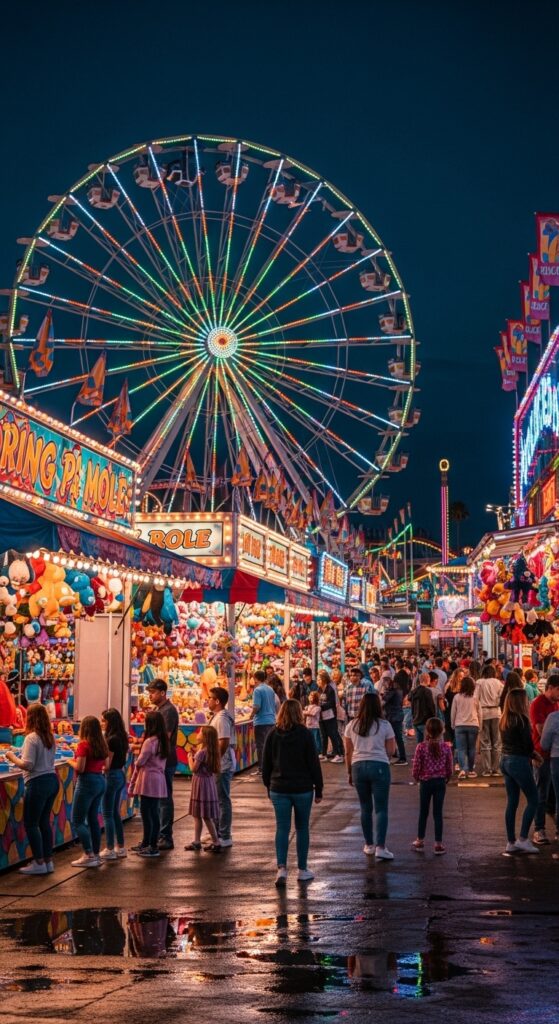
As the sun sinks below the horizon and the last traces of daylight fade from the sky, a different kind of world begins to awaken. The amusement park at night is not merely a place of rides and games. It becomes a glowing kingdom of color, music, motion, and emotion. By day, it may appear cheerful and inviting, but after dark it transforms into something almost magical. Strings of lights sparkle overhead like artificial stars, the giant Ferris wheel glows against the black sky, and the air hums with laughter, music, and the distant rush of roller coasters cutting through the night. In this illuminated world, people of all ages seem to set aside their worries and step into a shared experience of joy.
Nighttime gives the amusement park a personality of its own. It is not just brighter in appearance, but richer in atmosphere. During the day, visitors notice the rides, the crowds, and the attractions. At night, they feel the place. There is something about darkness that makes light more meaningful, and nowhere is that more obvious than in a park built for entertainment. Neon signs flicker above food stalls, colorful bulbs trace the curves of roller coasters, and carousel horses shine beneath golden lamps. Every direction offers movement and light. The park seems alive, as if each ride, each game booth, and each stage performance contributes to one giant heartbeat.
One of the most iconic sights in a nighttime amusement park is the Ferris wheel. Towering above everything else, it turns slowly and gracefully, each cabin outlined in brilliant color. From far away, it serves as a beacon, calling people toward the center of excitement. Up close, it offers something different from the fast thrills of the other rides. While roller coasters scream through sharp drops and spinning rides twist riders into dizzy laughter, the Ferris wheel lifts people gently into the air. At the top, the noise of the park softens for a moment. Below, the lights spread out like a glittering sea, and beyond the gates the city or countryside rests in darkness. That contrast is part of the beauty. For a few minutes, riders are suspended between stillness and spectacle, able to see the amusement park not just as a collection of attractions, but as a whole universe of excitement.
The roller coasters, of course, are the wild engines of the park’s energy. At night, they seem even more dramatic than they do during the day. Their tracks twist through darkness, only partially visible under colored lights. Riders climb slowly upward, the chain clicking beneath them, until they reach the peak. Then comes the sudden drop, the scream, the burst of speed, and the exhilarating sense of surrender. In daylight, the thrill comes from what you can see. At night, part of the thrill comes from what you cannot. The darkness hides the next turn, the next loop, the next plunge. It adds mystery to the motion. For many people, riding a roller coaster at night feels more intense, more cinematic, and more unforgettable.
But the soul of a nighttime amusement park is not found only in the giant rides. It lives in the smaller spaces too: the midway lined with game booths, the snack stands releasing tempting scents into the air, the little stages where dancers and musicians perform beneath spotlights. These details turn the park into a complete sensory experience. Visitors hear upbeat music blending with the mechanical sounds of rides. They smell popcorn, grilled meat, caramel, sugar, and fried dough. They taste cotton candy that melts instantly on the tongue, cold lemonade that cuts through the heat of the crowd, and salty snacks eaten while walking from one attraction to another. The park is designed to surround the senses, to pull people into the present moment so fully that the outside world begins to disappear.
Game booths are especially lively at night. Their bright banners and flashing signs create pockets of competition and excitement. The prizes hang overhead in exaggerated abundance: giant stuffed bears, glowing toys, colorful balloons, and novelty items that seem irresistible under the lights. Players try their luck at basketball tosses, ring throws, dart games, and water races. Sometimes they win. Often they do not. But the joy is not only in victory. It is in the attempt, in the laughter that follows a near miss, in the playful teasing between friends, in the determination of a child who believes the next try will succeed. These games offer a different kind of thrill from the rides. They are not about speed or height, but about hope, chance, and shared amusement.
Crowds are an essential part of the atmosphere. At first glance, a packed amusement park might seem chaotic, but at night the crowd contributes to the feeling of celebration. Couples walk hand in hand beneath glowing arches. Families pause to take photos in front of illuminated fountains. Groups of teenagers move quickly from ride to ride, full of energy and loud conversation. Children wave light-up toys and tug at their parents’ sleeves, eager for one more turn on the carousel or one more scoop of ice cream. Though these visitors come from different backgrounds and belong to different worlds outside the gates, inside the park they are united by a common purpose: to enjoy themselves. The amusement park creates a rare public space in which joy becomes collective.
This shared joy is one reason amusement parks remain so beloved. In daily life, people are often separated by responsibilities, schedules, and personal worries. Adults carry the weight of work, bills, and expectations. Students think about exams and the future. Even children increasingly live within structured routines. But in the amusement park at night, these burdens feel lighter. The experience encourages spontaneity. A person can decide, in a single moment, to board a ride, to dance to live music, to buy a sweet snack, or to simply sit and watch the lights. There is freedom in that. Not the grand freedom of politics or philosophy, but the immediate freedom to be playful, excited, and fully present.
That sense of youthful freedom is perhaps most visible among teenagers and young adults. For them, the nighttime amusement park often feels like a symbol of possibility. It is social but not formal, crowded but not restrictive. It allows for adventure, conversation, flirtation, and memory-making. Friends dare each other onto the most frightening rides. Couples share quiet moments at the top of the Ferris wheel. Groups pose for photos under neon signs, trying to preserve the glow of the evening. Many people remember amusement parks not only for the rides themselves, but for the emotions attached to them: the first hand held during a haunted house walkthrough, the laughter after a spinning ride, the freedom of being out at night with friends and no urgent need to be anywhere else.
At the same time, amusement parks also awaken nostalgia in older visitors. A parent watching a child ride a carousel may remember doing the same decades earlier. A melody from a parade may bring back the memory of a family trip long ago. The lights, the games, the food, and the sounds have a timeless quality. They belong to a tradition of public entertainment that stretches across generations. This gives the amusement park emotional depth. It is not only a place to seek thrills, but also a place to reconnect with simpler feelings: wonder, anticipation, delight. Night intensifies these emotions because it makes everything feel slightly unreal, slightly dreamlike.
The visual beauty of a nighttime amusement park deserves special attention. In many ways, it resembles a living painting. Colors reflect off metal rails and polished surfaces. Water in fountains captures and scatters light. Fireworks, if they appear, explode above the park like sudden flowers in the sky. Even ordinary pathways become beautiful under decorative lamps and glowing signs. This beauty matters because it shapes memory. People often leave an amusement park remembering flashes of image before they remember specific details: the blue and pink lights of a ride turning in circles, the silhouette of a roller coaster against the sky, the sparkle of a child’s toy wand, the golden glow of a carousel spinning endlessly to music. These images linger because they combine excitement with beauty.
Music also plays a powerful role in creating the night atmosphere. Fast, energetic songs near thrill rides build excitement and encourage movement. Softer tunes near family attractions create a more relaxed mood. Live performances add another layer of entertainment, giving visitors moments to pause and watch rather than constantly rush from one ride to another. The soundtrack of the amusement park is never singular. It is a mix of melodies, announcements, screams, laughter, machinery, and applause. Somehow, instead of becoming unpleasant noise, these sounds blend into a recognizable language of fun. A person standing at the center of the park may hear a dozen different things at once, yet all of them seem to say the same thing: enjoy this moment.
Food is another unforgettable part of the experience. Night seems to make amusement park food even more appealing. Perhaps it is because warm lights make everything look inviting, or because excitement increases appetite. Whatever the reason, people are drawn to the stalls and carts that line the walkways. Cotton candy glows like a cloud under colored bulbs. Popcorn crackles in warm machines. Ice cream shines under glass displays. Fried foods, grilled skewers, sweet pastries, and cold drinks all compete for attention. While such food may not be elegant, it suits the spirit of the park perfectly. It is festive, casual, and immediate. Eating in an amusement park is part of the adventure, not a pause from it.
What makes the amusement park at night so powerful is that it offers both stimulation and escape. On one hand, it overwhelms the senses in the best possible way. On the other, it provides a temporary release from ordinary life. This combination explains why even a few hours at the park can feel like entering another reality. Inside the gates, people live differently. They move according to excitement rather than routine. They choose delight over duty. They are invited to laugh loudly, to react openly, to feel fear without danger and joy without apology. In a world that often values efficiency, seriousness, and control, the amusement park celebrates excess feeling. It tells people that for one night, it is acceptable to scream, to spin, to eat sweets, to chase prizes, and to be enchanted by lights.
Eventually, however, the night begins to wind down. The music softens. The lines shorten. Families gather their tired children. Workers begin cleaning booths and closing gates. The Ferris wheel continues to turn, but more slowly now, like a final farewell. The last rides send their passengers into the dark one more time before stopping. Visitors leave carrying prizes, snacks, photos, and most importantly, memories. Behind them, the lights still shine for a little while longer, but soon they too will go out. What remains is the feeling the park created: a mix of excitement, wonder, and happiness that can outlast the evening itself.
In the end, the nighttime amusement park is more than an entertainment venue. It is a stage for human joy. Under its lights, people reconnect with play, with each other, and with the freer parts of themselves. It reminds us that delight does not have to be practical to be meaningful. A Ferris wheel does not solve life’s problems. A roller coaster does not answer serious questions. A game booth prize may be silly and temporary. Yet together, these experiences create something valuable: moments of shared happiness in a world that often feels too heavy. That is why the amusement park at night continues to captivate so many people. It is a place where color defeats darkness, where laughter rises above noise, and where for a few unforgettable hours, life feels wonderfully bright.
