The rapper’s recovery has brought relief to fans and family, but the gunfire outside a South Florida casino has again exposed the volatile mix of celebrity, nightlife and unresolved violence that continues to shadow hip-hop.
NEW YORK — Rapper Offset has been released from the hospital after being shot outside a Florida casino earlier this week, a development that has eased immediate fears over his condition while leaving major questions unanswered about the violence that unfolded at one of South Florida’s highest-profile entertainment venues.
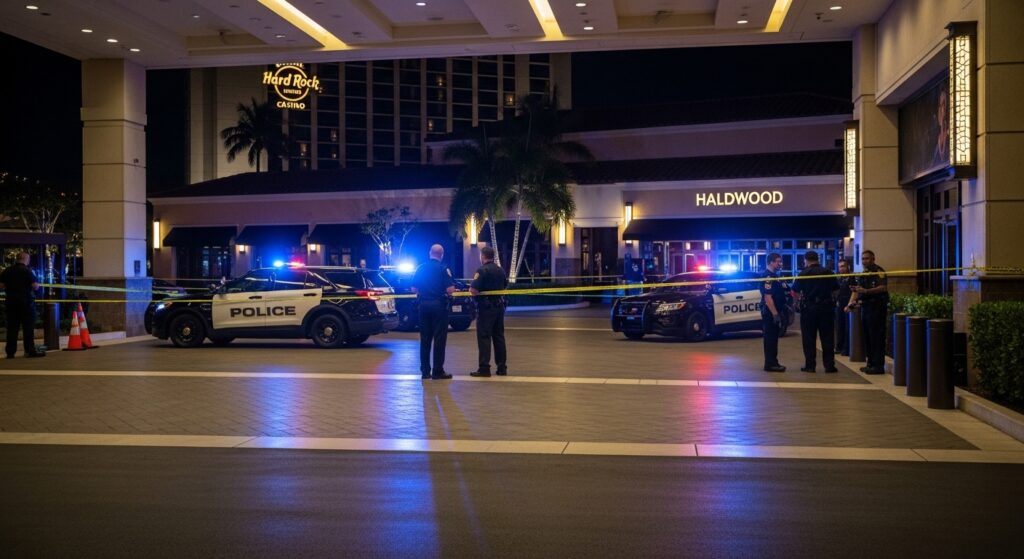
A spokesperson for the artist said Friday that Offset is recovering well and is now “up and walking,” days after he was injured in a shooting outside the Seminole Hard Rock Hollywood in Florida. Authorities have said the injuries were not life-threatening, and the casino incident, while swiftly contained, remains under active investigation.
The shooting happened Monday evening, April 6, in the valet area of the resort complex in Hollywood, just north of Miami. Police have said the violence followed an altercation, though they have released few details about what triggered the confrontation, who opened fire, or whether Offset was the intended target. Two people were detained in connection with the broader disturbance at the scene, but as of Friday, law enforcement had not announced charges directly tied to the shooting itself.
That uncertainty has become central to the story. While Offset’s hospital discharge marks a positive turn in a week that began with alarming headlines, the larger criminal investigation is still moving through its early stages. Authorities are continuing to identify who was involved, what led up to the fight and whether additional arrests could follow.
One of the two people detained was rapper Lil Tjay, whose legal name is Tione Jayden Merritt. Police said he was arrested on charges of disorderly conduct and driving without a valid license. Importantly, authorities have not charged him with carrying out the shooting, and his lawyer has publicly denied that he had any role in the gunfire. Another person was detained at the scene but has not been charged in connection with the shooting.
That distinction matters in a case already shaped by rumor, social media speculation and the speed with which celebrity incidents can spiral beyond the confirmed facts. Since the shooting, clips and claims have circulated widely online, but investigators have released only a narrow set of verified details: an altercation broke out, gunfire followed, Offset was wounded, his injuries were not life-threatening, and two individuals were detained in relation to the disturbance at the scene.
For Offset, whose legal name is Kiari Kendrell Cephus, the episode is the latest brush with violence in a career repeatedly touched by the darker side of rap celebrity. As one-third of Migos, the influential trio that helped redefine the sound of mainstream rap in the 2010s, Offset rose to prominence in an era when artists were not only music stars but constant public figures, moving through clubs, festivals, casinos and high-visibility events under the gaze of fans, rivals and cameras alike.
The group’s success made its members household names far beyond hip-hop. Migos became synonymous with a generation of trap music, helping popularize a style and cadence that reshaped the sound of rap across the industry. Hits including “Versace,” “Bad and Boujee,” “Stir Fry” and “Narcos” helped establish the trio’s commercial power and cultural footprint. In the years since, Offset has also built a solo career while remaining a central figure in celebrity media through his music, family life and public profile.
That profile has often come with vulnerability. The shooting of Migos member Takeoff in Houston in 2022 left a lasting scar not only on the group but on the broader hip-hop community, which has repeatedly seen violence intrude into spaces linked to fame and nightlife. While the circumstances of this week’s shooting in Florida are different and far less understood, the resonance is difficult to ignore. Each new incident revives a familiar unease around how quickly public disputes, personal tensions or chaotic environments can turn dangerous.
This week’s case also highlights another modern reality: celebrity crime stories now unfold in two parallel arenas. One is the official investigation, shaped by police statements, witness interviews and evidence collection. The other is the social-media echo chamber, where allegations harden into presumed fact before authorities have even outlined a timeline. In that environment, a detention can be mistaken for a shooting charge, a rumor can become a headline, and a still-fragmentary narrative can be treated as settled.
That has been especially visible around Lil Tjay’s role in the case. Law enforcement has linked his arrest to the altercation connected to the incident, not to the act of shooting Offset. His attorney has gone further, insisting he was neither shot nor charged with any weapons offense. The distinction may seem procedural, but in a high-profile case it is central to accuracy, fairness and the credibility of the investigation itself.
For investigators, the challenge now is to separate the fight from the shooting and determine whether they were part of a single chain of events or overlapping but distinct acts in a crowded, fast-moving scene. Casinos, hotel forecourts and valet areas are dense with surveillance coverage, private security and heavy foot traffic, which can help investigators reconstruct events but can also complicate early witness accounts. In such environments, a few seconds of confusion can produce conflicting stories that take days to untangle.
The Seminole Hard Rock Hollywood is no minor backdrop. It is one of South Florida’s most recognizable entertainment complexes, drawing tourists, nightlife crowds and high-profile guests. A shooting there inevitably commands broad attention, not only because of who was injured but because it happened in a place associated with glamour, money and constant public exposure. When violence breaks through that setting, the contrast intensifies the public reaction.
Offset’s discharge from the hospital has provided the first clear sign of stabilization since the incident. His spokesperson’s update — that he is recovering well and now walking — shifted the tone of coverage from emergency to aftermath. Offset himself also signaled resilience in a social-media post, thanking supporters and saying he was focused on family, recovery and music.
Still, the story is far from over. Police have said the investigation is continuing and that they are still working to identify all those involved. That means the central questions remain unresolved: who fired the shot, why the altercation escalated, and whether the event was spontaneous or connected to prior tensions.
Such uncertainty is often uncomfortable for audiences accustomed to instant clarity. But it is also where responsible reporting matters most. At this stage, the confirmed facts are limited, and the temptation to fill in the blanks is high. What can be said with confidence is that Offset survived, is out of the hospital and appears to be improving. What cannot yet be said with certainty is who is criminally responsible for the shooting itself.
In that sense, the case reflects a broader pattern that extends well beyond one artist or one location. Violence around entertainers often produces immediate spectacle, but the legal and factual truth tends to emerge slowly, if at all. Public attention surges on the first video clip, the first booking photo, the first celebrity name attached to an arrest. The quieter work — reviewing security footage, matching statements, testing evidence, sorting rumor from reality — unfolds afterward, largely out of sight.
For fans, the relief is immediate: Offset is alive, walking and recovering. For investigators, the harder phase is only beginning. Until authorities provide a fuller account, the Florida shooting will remain suspended between reassurance and uncertainty — a case defined as much by what is known as by what is still missing.
That is the uneasy reality surrounding Offset’s release from the hospital. It closes the most urgent chapter of the week’s events, but not the most important one. The medical emergency may have passed. The questions left by the gunfire outside the casino have not.