As display makers push organic light-emitting diode panels to become thinner, lighter and more flexible, smartphone-style OLED technology is increasingly reshaping not only phones but also foldables, tablets, laptops, cars and even the architecture of future screens.
For years, the smartphone has been the industry’s most influential display laboratory. It is where manufacturers have had the strongest incentive to make screens brighter, thinner, lighter and more power-efficient while preserving color quality and durability. Out of that pressure has come one of the most important hardware shifts in consumer electronics: the rise of ultra-thin OLED panels, built with the kind of slim, flexible engineering once associated mainly with premium handsets.
At first glance, the appeal is obvious. OLED screens can be much slimmer than traditional LCDs because they do not need a separate backlight. Each pixel emits its own light. That structural difference sounds technical, but its consequences are highly visible. Remove the backlight, and manufacturers gain space. Gain space, and they can make devices thinner, reduce weight, curve the display around the frame, or use the saved volume for larger batteries, better cameras or new industrial designs. In consumer electronics, fractions of a millimeter matter, and OLED has turned those fractions into a competitive advantage.
That is why smartphone-style OLED engineering has become a template far beyond phones themselves. What began as a way to make handsets feel sleeker is now influencing the design language of foldables, rollables and other new form factors. Samsung Display says flexible OLED uses a polyimide substrate and thin encapsulation technology instead of conventional glass-heavy structures, allowing panels to become thinner and lighter while also bending or rolling more easily. LG Display, describing its own flexible OLED development, says the challenge was to preserve image quality while achieving flexibility, durability and ultra-thin form factors. Together, those statements capture the central promise of the category: a display that is not just flatter or brighter, but structurally freer.
The smartphone has been the proving ground because it rewards every part of that promise at once. Thinness matters in the hand. Weight matters in the pocket. Power efficiency matters in daily use. Outdoor readability matters under sunlight. Curved or edge-integrated panels matter to industrial design. Fast response matters for gaming and high-refresh interfaces. Samsung Display says OLED supports high refresh rates and fast response characteristics while also benefiting from a simplified, self-emissive structure. In practical terms, this means the same display architecture that helps create a slimmer phone can also improve fluidity and visual punch.
The current fascination with ultra-thin OLED is therefore not simply aesthetic. It is about mechanical freedom. Once a display no longer depends on a bulky backlight assembly, engineers can begin treating the screen less like a fixed window and more like an adaptable material. That opens the door to foldable phones, slidable concepts and devices whose screen area changes with the moment. Samsung’s OLED concept line now includes foldable, slidable and rollable designs, while LG has emphasized that OLED’s self-emissive architecture and ultra-thin glass can enable rollable or curved products that would be difficult to realize with LCD. Not all of these concepts become mass-market hits. But they reveal the direction of travel: the display is no longer just the front of the device. It is becoming the device’s main structural idea.
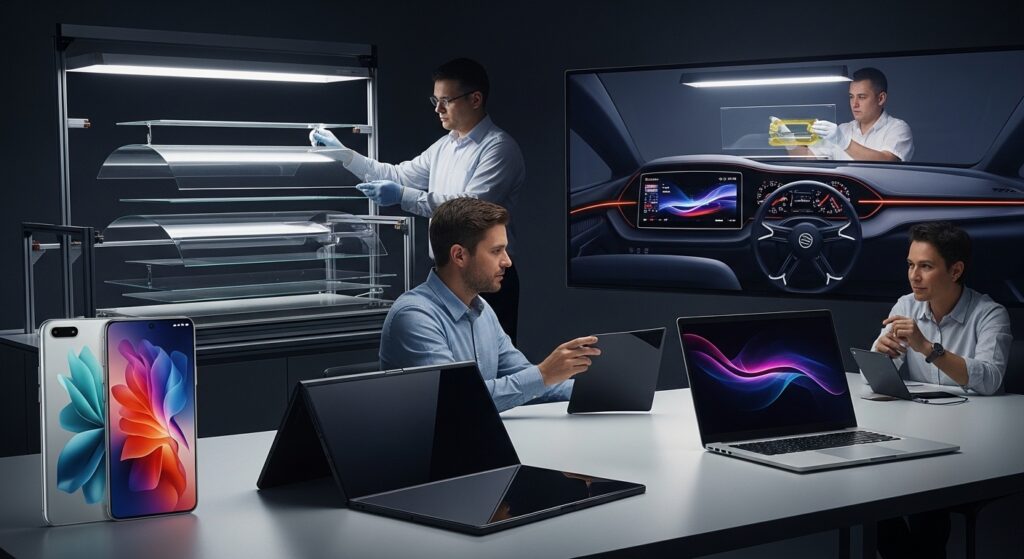
That shift has implications well beyond the smartphone business. Tablets and laptops are increasingly borrowing display technologies first refined in mobile devices, especially where thinness and battery life are at a premium. Automotive interiors, too, are becoming a major destination for flexible and curved OLED panels because carmakers want wider design freedom, seamless dashboard integration and premium visual quality. LG Display and Samsung Display both highlight automotive and mobility use cases as part of OLED’s future, suggesting that the smartphone’s display revolution is now spilling into much larger and more expensive products.
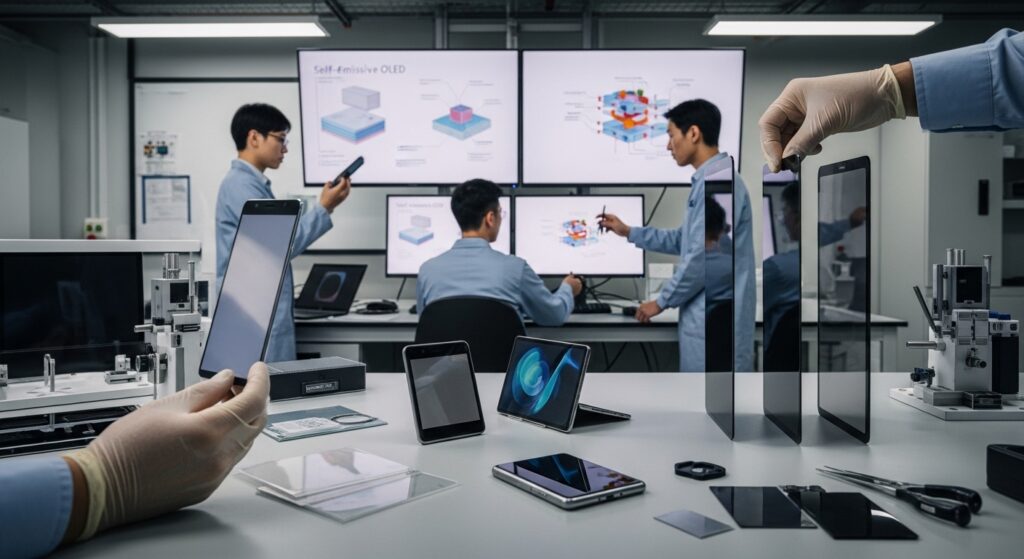
There is also a manufacturing story behind the thinness. Ultra-thin OLED is not merely a matter of shaving material from the edge of a panel. It depends on advances in substrates, encapsulation, cover windows and reliability engineering. Flexible OLED panels are vulnerable to oxygen and moisture, which means barrier technologies are critical. Thin-film encapsulation, ultra-thin glass and plastic substrates all help make modern OLED possible, but they also add complexity and cost. A recent AIP conference paper on flexible OLED encapsulation described that layer of the industry as a fast-moving technical frontier precisely because durability becomes harder when a display is expected to stay bright and stable while bending, thinning and surviving repeated use.
This is where the elegance of the finished product can obscure the difficulty of building it. A premium phone may present an OLED panel as a smooth, seamless surface only a few millimeters deep within the device. But behind that finish lies a demanding manufacturing process, high materials sensitivity and a continuous trade-off between slimness, power, brightness, lifetime and resilience. Thinner is not automatically better if it makes a display more fragile or harder to mass-produce. The industry’s achievement has been in making these panels thinner while still reliable enough for mainstream consumer products.
That does not mean the technology is without drawbacks. Burn-in and image retention remain part of OLED’s reputation, especially in products that display static interface elements for long periods. Manufacturers stress that mitigation tools have improved. LG says OLED screens now include protective technologies and panel-care features to reduce the risk of permanent image retention, while Samsung support materials continue to describe burn-in as a real phenomenon that can occur when static images remain on screen for too long. The most accurate view is neither panic nor denial. The risk has been reduced, and vendor protections are better than they used to be, but the physics of self-emissive pixels still impose constraints that consumers and designers need to respect.
Cost remains another limiting factor. Smartphone-sized OLED panels have become common enough that they are no longer rare luxury components, but pushing the technology into larger, bendable or unusually thin formats can still be expensive. Yield rates, materials choices and supply-chain concentration all influence how quickly these screens move from flagship products into broader price bands. The OLED Association says smartphone transitions from LCD to OLED continue to support wider market growth, reflecting the fact that scale in phones helps drive cost improvements elsewhere. Even so, not every device category will adopt ultra-thin OLED at the same speed.
The next phase of competition may center less on whether OLED is thin enough and more on what that thinness allows. In phones, it may enable lighter foldables and more ambitious industrial designs. In headsets and near-eye devices, it may support compact, high-contrast displays where every gram matters. In cars, it may allow dashboards to blend more naturally into interior surfaces. In consumer electronics generally, it may accelerate the move away from the idea that screens must be rigid rectangles attached to rigid products.
In that sense, ultra-thin OLED technology is not just about making a display look sleek “like a smartphone.” It is about exporting the smartphone’s design logic to the wider hardware world. The phone taught manufacturers that users value slimness, vivid color, low weight and edge-to-edge integration. OLED gave engineers the architecture to pursue those goals more aggressively. Now that same architecture is being adapted across multiple industries.
The result is a quiet but meaningful change in how devices are imagined. The display is no longer simply a component that shows content. It is becoming a decisive factor in the shape, feel and identity of the product itself. Ultra-thin OLED made that possible first in phones. Its larger significance is that it is now teaching the rest of the electronics industry to think the same way.