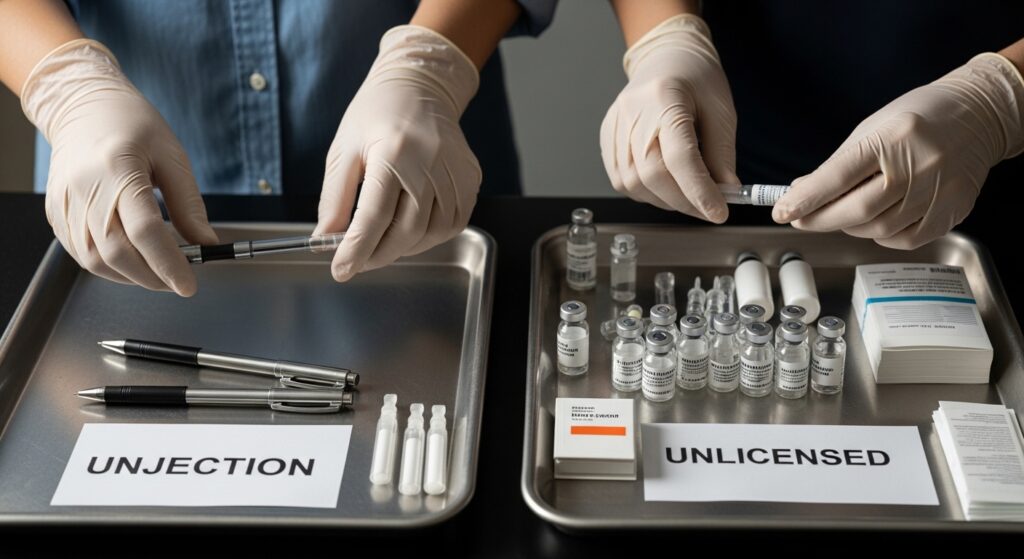

Health regulators warn that the boom in low-cost slimming injections and copycat drugs sold online is exposing consumers to contamination, counterfeit products, dosing errors and false promises at a scale that is becoming harder to contain.
LONDON — The promise is deceptively simple: dramatic weight loss at a fraction of the usual price, delivered discreetly to a doorstep after a few clicks or a brief online consultation. For consumers squeezed by high demand, patchy insurance coverage and the soaring cost of branded obesity drugs, the offer can look irresistible.
But health authorities in the United States, Britain and globally are sounding an increasingly urgent warning. Behind the surge in so-called “cheap” weight-loss drugs is a fast-expanding trade in unapproved, falsified, illegally compounded or outright counterfeit products that regulators say may contain the wrong ingredients, the wrong doses, unsafe contaminants — or no reliable medicine at all.
What began as a scramble for access to blockbuster obesity drugs has turned into a public-health problem with international dimensions. The medicines at the center of the frenzy belong largely to the GLP-1 class, including semaglutide and tirzepatide, which have transformed the treatment of obesity and diabetes and become some of the most sought-after pharmaceutical products in the world. Their success has created a market not only for legitimate prescriptions, but also for a booming gray and black economy of copycat products sold through social media, questionable websites, underground suppliers and poorly vetted online intermediaries.
Regulators say the danger lies not simply in people taking prescription medication without proper medical oversight, but in the growing difficulty of knowing what is actually inside some of the products being sold as cheaper alternatives. In recent warnings, the U.S. Food and Drug Administration said unapproved GLP-1 drugs used for weight loss may expose patients to serious risks because they do not undergo the agency’s review for safety, effectiveness and quality before being marketed. The agency has also highlighted problems involving improper shipping and storage, fraudulent labels and dosing errors linked to compounded injectable semaglutide products.
That warning lands at a moment when demand remains intense even as supply conditions have evolved. For years, shortages of high-profile obesity drugs helped create an opening for compounders and opportunistic sellers who argued they were meeting unmet consumer demand. But as official supply has begun to stabilize in parts of the market, regulators have hardened their stance, signaling that the era of broad tolerance for mass-marketed alternatives is ending. The FDA has reminded compounders that once shortages are resolved, there are legal limits on making copies of commercially available approved drugs. It has also escalated enforcement against telehealth companies accused of using misleading language to market compounded GLP-1 products as if they were equivalent to approved branded medicines.
That shift reflects a wider anxiety: the cheaper the promise, the harder it may be for patients to distinguish legitimate care from dangerous imitation. In some cases, authorities say, the products are not merely compounded in a legal gray zone but openly fraudulent. The FDA has reported that some compounded semaglutide and tirzepatide sold in the United States carried false information on their labels. Some named pharmacies did not exist. In other cases, labels used the names of licensed pharmacies that, according to the agency, did not actually produce the products in question.
Britain has offered one of the clearest illustrations of how serious the illegal trade has become. In October 2025, the Medicines and Healthcare products Regulatory Agency said it had dismantled what it described as a major illicit manufacturing site producing and distributing unlicensed weight-loss jabs. Officers seized thousands of ready-to-ship pens, raw chemicals, cash, packaging materials and manufacturing equipment. The agency called it the first illicit production facility for weight-loss medicine discovered in the United Kingdom and said it was believed to be the largest single seizure of trafficked weight-loss medicines ever recorded by a law-enforcement agency worldwide.
For regulators, cases like that underscore how a consumer trend can quickly become an organized-crime opportunity. Weight-loss drugs occupy an unusually potent intersection of medical need, celebrity culture, social pressure and online commerce. They are expensive, heavily discussed on social media and often difficult to access through conventional health systems. That combination creates ideal conditions for illicit sellers: high demand, high margins and a customer base willing to act quickly out of frustration, hope or embarrassment.
Global health agencies are also involved. The World Health Organization has already issued an alert on falsified Ozempic, saying counterfeit products had been detected in multiple countries and warning that their use could result in ineffective treatment, incorrect dosage, contamination with harmful substances or exposure to unknown ingredients. Because these products are injected, the risks are particularly serious. A falsified tablet is dangerous enough; a falsified injectable carries the additional threat of contamination entering directly into the body.
None of this means legitimate obesity medicines lack a place in care. On the contrary, GLP-1 therapies have become one of the most consequential advances in obesity treatment in decades. The World Health Organization, in guidance issued late last year, acknowledged that these medicines can be effective for adults living with obesity, while also stressing that they are not a standalone answer and that long-term safety, affordability and equitable access remain major concerns. That point matters because the illegal market has flourished partly in the gap between medical breakthrough and real-world affordability.
In many countries, the economic logic is brutally simple. Approved weight-loss medicines can be costly, not always covered by insurance and sometimes available only to patients meeting strict clinical criteria. For people desperate to lose weight or maintain recent progress, the difference between a regulated branded medicine and a suspiciously cheap online offer can amount to hundreds of dollars a month. Public-health experts say that when demand is high and legitimate access is narrow, a black market is almost guaranteed to form.
The marketing tactics used to sell such products have become more sophisticated as well. Some websites promise “the same active ingredient” as better-known brands at “a fraction of the cost.” Others blur the line between telehealth consultation and e-commerce, encouraging patients to believe they are receiving personalized medical treatment when they may in fact be buying from a chain of marketers, middlemen and suppliers with limited transparency. Low prices become part of the psychological lure, signaling not danger but opportunity.
Yet clinicians say the real price can emerge later, in the form of dehydration, severe gastrointestinal symptoms, injection-site reactions, uncontrolled dosing or a complete lack of therapeutic effect. Even genuine medicines in this category require careful prescribing, monitoring and counseling. Patients often need guidance about side effects, escalation schedules, contraindications and when to stop treatment. Strip away that medical supervision, and even a real product can be misused. Replace it with a falsified or mishandled product, and the risk multiplies.
What makes the current wave especially troubling is that it exploits a genuine medical revolution. These are not fringe supplements sold on late-night television. They are medicines linked to one of the most intensely watched areas in modern healthcare. Their success has changed expectations among patients and investors alike. That success, however, has also created a parallel economy feeding on scarcity, hype and unequal access.
The warning from authorities is therefore broader than a simple anti-counterfeit message. It is also a warning about the structure of the market itself. So long as demand vastly outstrips safe, affordable and well-regulated access, cheaper underground alternatives will continue to appear. Cracking down on illegal sellers may remove some of the worst actors, but it will not eliminate the conditions that made them profitable in the first place.
For consumers, regulators offer a blunt rule: obtain weight-loss medicines only through licensed healthcare professionals and regulated pharmacies, and treat bargain offers with extreme suspicion. In a market driven by urgency and image, that may be easier said than done. But the central reality is becoming harder to ignore. When a prescription injection is sold online like a fashion accessory or flash-sale beauty product, the discount may be the first sign that something is seriously wrong.
The world’s appetite for weight-loss drugs shows little sign of fading. Neither, for now, does the trade in cut-price imitators riding that demand. The result is a dangerous contradiction at the heart of the obesity-drug boom: the more effective the medicines become, the greater the temptation for criminals, opportunists and dubious sellers to cash in. Health authorities are trying to catch up. For many patients, the question is whether they can tell the difference before the damage is done.