Artemis II has returned four astronauts safely to Earth, closing the first human mission around the Moon since Apollo 17 in 1972 and giving NASA a major milestone in its effort to resume deep-space exploration.
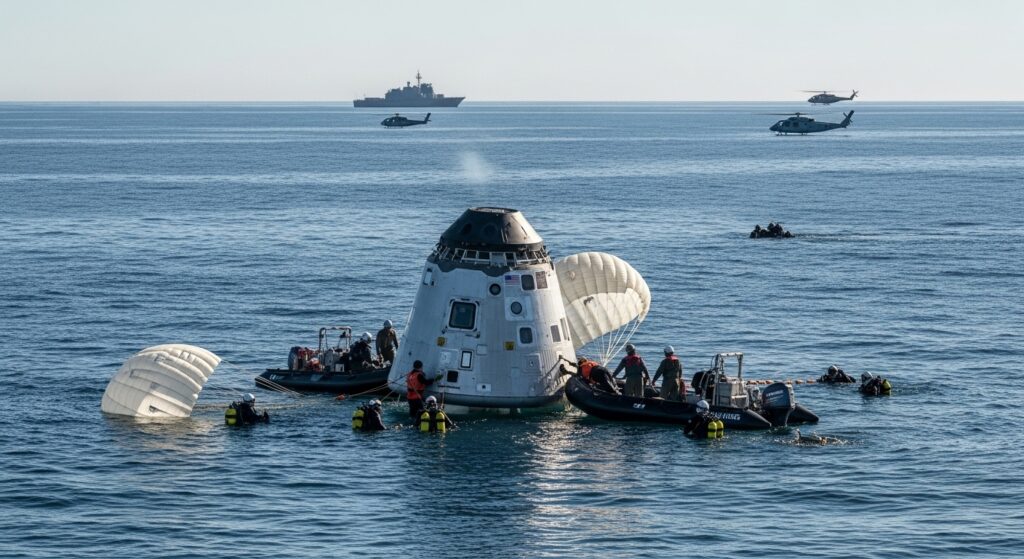
NASA has completed its first crewed journey around the Moon in more than 50 years, bringing home four astronauts after a mission that the U.S. space agency says will shape the next phase of its Artemis program. The Orion spacecraft, carrying commander Reid Wiseman, pilot Victor Glover, mission specialist Christina Koch and Canadian astronaut Jeremy Hansen, splashed down in the Pacific Ocean off the California coast on April 10, ending a mission that began with launch from Florida on April 1.
The nearly 10-day flight did not land on the Moon. Instead, it was designed as a high-stakes test of the systems NASA plans to use in future lunar missions, including the Space Launch System rocket, the Orion crew vehicle, life-support hardware, manual piloting procedures, re-entry systems and the operational rhythm required for deep-space flight with astronauts aboard. In that sense, Artemis II was both a symbolic return and a practical engineering trial, one intended to prove that NASA can once again send people beyond low-Earth orbit and bring them home safely.
For NASA, the symbolism was impossible to miss. No humans had traveled to the Moon since Apollo 17 in December 1972, when Eugene Cernan and Harrison Schmitt became the last people to walk on its surface. Since then, human spaceflight has focused largely on low-Earth orbit, from the space shuttle era to long-duration missions aboard the International Space Station. Artemis II therefore marked the restoration of a capability that had existed only in history books and museum displays for more than five decades.
Yet the mission was not built around nostalgia alone. Artemis II represented the first crewed flight of NASA’s Orion spacecraft and the first time astronauts flew atop the agency’s new heavy-lift Space Launch System. Those vehicles are intended to form the backbone of the Artemis campaign, which aims to establish a long-term human presence tied to science, exploration and eventually broader ambitions deeper into the solar system. Before astronauts can attempt more complex operations, NASA needed to know whether its deep-space transportation architecture could perform under real conditions with a crew on board.
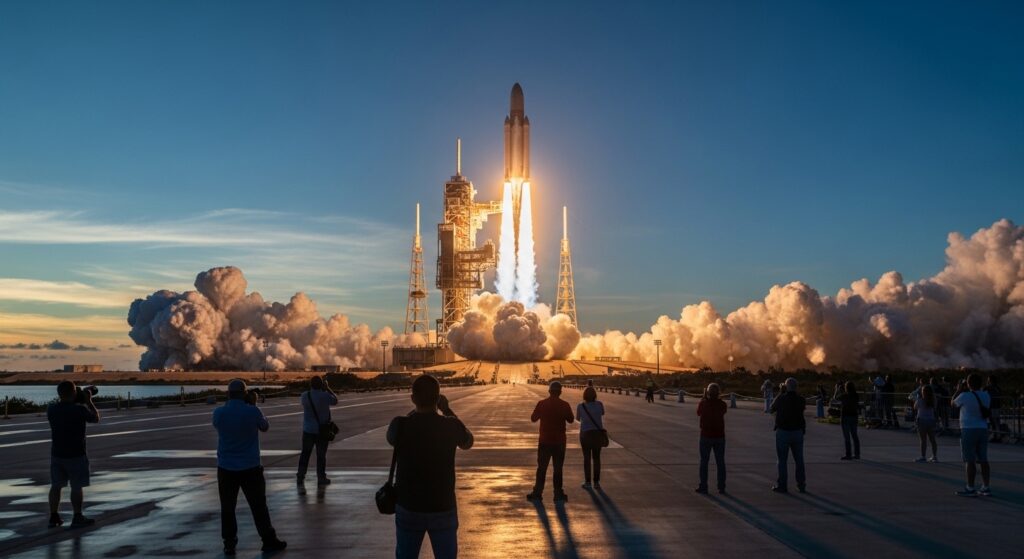
The mission unfolded in phases that reflected that goal. After lifting off from Launch Complex 39B at Kennedy Space Center, Orion entered orbit and underwent initial health checks before heading outward. Over the following days, the crew evaluated spacecraft systems, exercised in microgravity, worked through emergency procedures and conducted piloting demonstrations meant to validate how Orion handles with humans inside. The spacecraft, named Integrity by the crew, then continued on a trajectory that carried the astronauts around the far side of the Moon before beginning the journey back to Earth.
NASA said the flight set a new record for the farthest distance humans have ever traveled from Earth. At its maximum separation, the crew reached 252,756 miles from home, surpassing the record associated with Apollo 13 in 1970. Across the entire mission, the astronauts traveled 694,481 miles. Those figures matter not only as milestones, but as indicators of the mission’s deeper purpose: to expose hardware, systems and people to the realities of deep space, where communication gaps, radiation exposure, navigation demands and re-entry stresses create a much harsher environment than missions close to Earth.
One of the most closely watched moments came during the lunar flyby itself on April 6, when Orion passed behind the Moon and the crew entered a zone familiar from the Apollo era but unseen by human eyes for generations. NASA said the lunar portion of the mission lasted about seven hours and included views of the far side of the Moon, imagery of craters and ancient lava plains, and a period of lost communication as the spacecraft moved behind the lunar body. The astronauts later transmitted back photographs that included earthrise, earthset and even a solar eclipse from Orion’s perspective.
That imagery carried scientific as well as emotional weight. NASA said the crew returned with more than 7,000 images, including views of the lunar terminator, where low-angle sunlight throws long shadows across the terrain. Such lighting resembles conditions expected in the Moon’s polar regions, which are of particular interest for future missions because of their scientific value and the possibility of water ice. The astronauts also reported meteoroid impact flashes on the Moon’s night side, observations that could help future crews sharpen their understanding of the lunar environment.
The crew itself reflected another defining feature of the Artemis era: international and institutional breadth. Three members of the mission flew from NASA, while Hansen represented the Canadian Space Agency, underscoring the extent to which lunar exploration is now framed as a multinational effort rather than a strictly national contest. The crew’s public appearances throughout training and mission operations emphasized not only technical readiness but also the political message that the United States and its partners intend to remain central players in the next chapter of lunar exploration.
Still, the mission’s most immediate significance was technical. NASA used Artemis II to test Orion’s life-support systems in the actual environment of deep space, verify crew interfaces and procedures, and evaluate how astronauts move, work and respond during a long-duration mission outside Earth orbit. Engineers also collected data on re-entry, parachute deployment and recovery operations. These are not glamorous milestones in the public imagination, but they are precisely the systems that determine whether future lunar missions can shift from demonstration to routine execution.
The return phase provided the final proof point. On re-entry, Orion raced back into Earth’s atmosphere at roughly 25,000 miles per hour before descending under parachutes and landing in the Pacific at 5:07 p.m. PDT. Recovery teams assisted the astronauts out of the spacecraft and transported them by helicopter to the USS John P. Murtha for initial medical evaluations. NASA said all four crew members returned in good condition, closing the test flight without the kind of major anomaly that might have forced a rethinking of the program’s timeline.
Even so, Artemis II was never meant to answer every question. It was a mission of validation, not completion. NASA has said its attention now turns to Artemis III, the next step in the sequence, which the agency describes as a mission to test integrated operations with commercially built lunar landers in low-Earth orbit before pushing further toward future lunar surface operations. That means Artemis II should be viewed less as a finish line than as the reopening of a path that NASA hopes to extend in the years ahead.
There is also a broader meaning in the mission’s success. Human space exploration has often been judged by dramatic moments: first steps, first orbits, first landings. But the durability of a program depends on less cinematic achievements such as systems engineering, international coordination, logistics and repetition. Artemis II suggested that NASA is trying to move beyond one-off spectacle toward a sustained framework for operations beyond Earth orbit. Whether that framework proves durable will depend on budgets, industrial execution, political support and the performance of hardware still to come. But the mission has at least given the agency something it badly needed: proof that the post-Apollo lunar project is no longer theoretical.
For a generation raised on robotic probes, Mars rovers and space station livestreams, the sight of astronauts once again circling the Moon also carried a psychological charge. It revived a dormant frontier in human spaceflight and reminded the public that deep-space travel is no longer only a legacy of the 1960s and 1970s. The distance traveled by the Artemis II crew was measurable in miles, but the larger distance may have been historical. NASA has now crossed the gap between Apollo’s memory and Artemis’ reality.
That does not mean the harder challenges are over. Missions that aim eventually to support repeated lunar operations will require more than safe flybys. They will demand robust lunar landers, dependable spacesuits, surface power, communications, cargo delivery and the ability to operate in a hostile environment for extended periods. Artemis II solved none of those problems outright. What it did do was establish that the journey out and back, the first condition for all the rest, can once again be done with people aboard.
After more than half a century, that alone makes Artemis II a turning point. It restored a human route to the Moon, tested the spacecraft and rocket meant to carry the next generation of explorers, and gave NASA a successful mission at a moment when long-term ambitions require hard evidence rather than aspiration. The Moon has not yet been reached in the way NASA ultimately intends. But for the first time since 1972, the route there is active again.