From the Olympics to the World Cup, the planet’s most famous sporting spectacles have become far more than contests of strength, speed and skill: they are rituals of identity, memory and global attention.
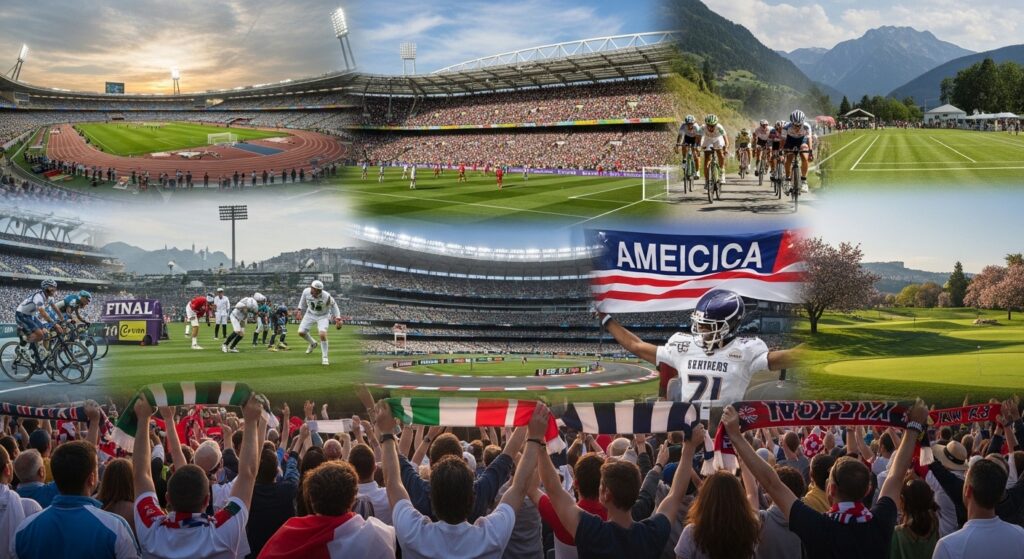
On any given year, the world’s sporting calendar is crowded with fixtures, championships and tours. But only a small number of events rise above the rest and become shared international landmarks. These are the occasions that stop traffic, fill airports, dominate broadcasts and turn athletes into symbols that reach beyond their own countries. They are not all alike. Some are rooted in century-old tradition, others in modern television culture. Some belong to one sport and one place, while others travel across borders. What they share is an ability to gather millions of people into the same emotional moment.
No event better captures that scale than the Olympic Games. Their origins stretch back to ancient Olympia, with written references often citing 776 BC, and the modern Olympics were revived in Athens in 1896. Since then, the Games have evolved into the broadest stage in international sport, bringing together athletes from across the world in a competition that is also a ceremony of flags, anthems and national narratives. The Olympics are distinctive because they do not belong to one discipline. A single edition can elevate the familiar glamour of sprinting and gymnastics while also introducing lesser-known sports to massive audiences. The result is a rare event in which a swimmer, a judoka, a skateboarder and a marathon runner can all become part of the same global story.
If the Olympics represent the widest range of sports, the FIFA World Cup stands as football’s most concentrated expression of global passion. First staged in 1930, the tournament has grown into the defining event of the world’s most popular game. Every four years, it produces a month in which club loyalties temporarily give way to national colours and entire cities seem to breathe in rhythm with the matches. The appeal of the World Cup lies partly in its simplicity: one ball, one field, one winner. But its deeper power comes from the way football crosses class, language and geography with unusual ease. A single goal can bind a country together, while a missed penalty can become a national memory for decades.
Tennis has its own version of immortality in Wimbledon, the oldest of the sport’s major championships. The tournament began in 1877, when only 22 men entered and a crowd of roughly 200 watched the final. Today, it remains one of the most recognizable events in world sport, not because it is the loudest, but because it has preserved an atmosphere unlike any other. Grass courts, white clothing, patient queues and a setting steeped in English summer tradition have turned Wimbledon into something larger than a tennis tournament. Its prestige rests on continuity. In a sporting age often shaped by reinvention and speed, Wimbledon’s power comes from ritual, restraint and the sense that each match is connected to more than a century of memory.
The Tour de France offers a different kind of grandeur. First run in 1903, the race transformed endurance into national theater and then into international spectacle. Unlike stadium events, the Tour stretches through landscapes, villages, mountains and city streets, making the route itself part of the drama. It is sport in motion and public space at the same time. For three weeks, cyclists battle not only one another but also terrain, weather and exhaustion, while roadside crowds turn the race into an open-air festival. The Tour’s appeal lies in that blend of hardship and beauty. It is both deeply physical and intensely visual, a sporting contest staged across some of Europe’s most memorable scenery.
Cricket’s equivalent on the global stage is the Men’s Cricket World Cup, which began in 1975 in England. To audiences outside cricket’s traditional heartlands, the game can appear measured and highly technical. But inside those heartlands, the World Cup carries enormous political and emotional weight. In South Asia, Australia, England, parts of Africa and the Caribbean, it is not merely a championship but a referendum on sporting identity. Cricket’s tempo allows stories to develop over hours and days, turning pressure into a long-form drama rather than a quick shock. That makes World Cup victories especially resonant: they are built not on a single burst of brilliance but on patience, depth and control under scrutiny.
The Super Bowl occupies a category of its own. Officially, it is the National Football League’s annual championship game. In practice, it has become one of the most recognizable media events in the world. Its influence extends beyond sport into advertising, music, celebrity culture and television production. That hybrid identity is central to its fame. The Super Bowl is watched not only by devoted American football fans but also by viewers drawn to the halftime show, the commercials and the broader spectacle. It represents a distinctly American model of sports entertainment, one in which the game is inseparable from the event built around it. For some critics, that makes it overly commercial. For others, it explains exactly why it has become so culturally dominant.
Motor racing contributes one of the most glamorous entries on the list through the Monaco Grand Prix. The race was first held in 1929, entered the Formula 1 world championship in 1950 and has remained a defining stop on the calendar since 1955. Monaco’s fame rests on setting as much as speed. The tight circuit twists through the streets of Monte Carlo, past harbor, barriers and hillsides lined with wealth and spectators. In purely technical terms, drivers speak of the track’s narrow margins and relentless concentration. In symbolic terms, Monaco has become shorthand for prestige. It is the rare event where the location is as famous as the competition itself.
Golf’s Masters Tournament belongs to the same family of place-based prestige. First played in 1934 at Augusta National, the Masters has built its reputation through consistency of setting and carefully guarded tradition. In a sport that travels widely, Augusta is a fixed point, and that constancy gives the event a near-mythic quality. The green jacket, the flowering course, the quiet tension of the back nine on Sunday — these have become part of golf’s universal vocabulary. The Masters is not the oldest major in golf, but it may be the one most shaped by atmosphere. It feels curated, controlled and timeless, which is precisely why it remains so powerful.
What makes these events famous is not only their history or audience size. It is their ability to create recurring moments in which sport becomes a language that many millions understand at once. The details differ: a sprinter exploding from the blocks, a striker stepping toward a penalty, a cyclist climbing in silence, a quarterback reading the final defense, a batsman settling under pressure, a driver brushing the barrier, a golfer standing over a putt that seems to stop time. Yet the emotional architecture is the same. Suspense, hope, fear, release and memory arrive in sequence, and people far from one another experience them together.
In that sense, the world’s most famous sports events are not just competitions. They are stages on which nations imagine themselves, cities present themselves and fans locate themselves within a wider world. Their commercial power is enormous, but so is their human pull. Long after medals are awarded and trophies lifted, what endures is the feeling that for a few hours or a few weeks, the world was watching the same thing and caring for the same reason. That is the rare achievement that turns a sporting event into a global institution.