As EV adoption spreads, its influence is reshaping power grids, buildings, mining, software, retail and recycling, turning the car into a catalyst for wider industrial change.
For years, electric vehicles were framed mainly as a contest inside the car business: battery versus engine, new entrants versus century-old manufacturers, charging stations versus fuel pumps. That story is still being written. But a broader shift is now underway. Electric vehicles are no longer just changing what people drive. They are pushing innovation far beyond the auto industry, forcing changes in how electricity is managed, how buildings are designed, how raw materials are sourced, how software is deployed and how waste is reimagined as a new supply stream.
In that sense, the EV is becoming something larger than a product. It is turning into a node in a wider industrial system.
One of the clearest ripple effects is in the power sector. Unlike conventional cars, EVs are deeply tied to the electrical grid, and that link is forcing utilities, regulators and technology companies to rethink how electricity is generated, distributed and priced. Charging millions of vehicles is not simply a matter of adding more plugs. It requires smarter ways to shift demand away from peak hours, to balance local distribution loads and to connect transport with renewable energy systems that do not always produce power at the same time people want to drive.
That challenge is helping accelerate a new market for managed charging. Utilities and software firms are building systems that can delay or modulate charging to reduce stress on the grid. For office parks, apartment complexes and logistics depots, EV charging has become a planning issue as significant as heating, cooling or backup power. In many places, the arrival of large EV fleets is pushing upgrades to transformers, substations and energy-management platforms that might otherwise have taken years to materialize.
The innovation does not stop there. Bidirectional charging, once a niche concept, is increasingly being treated as a serious tool for resilience. In practical terms, that means an EV may not only draw electricity from the grid but send it back to a building or even help support the grid during periods of strain. For homeowners, that opens the possibility of using a parked car as backup power during outages. For companies and campuses, it raises the prospect of vehicles functioning as mobile energy assets rather than passive loads. The implications reach well beyond transportation, touching disaster preparedness, building operations and distributed energy planning.
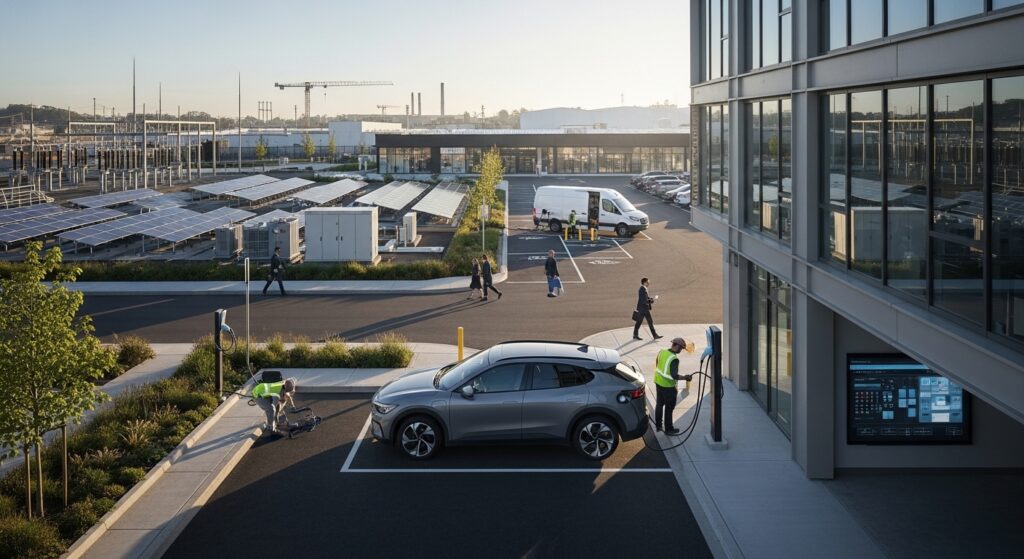
The building sector is already feeling those effects. Architects, developers and property managers are having to treat charging access as a core feature of modern real estate. In premium office towers, shopping centers, hotels and residential projects, EV charging is rapidly moving from optional amenity to commercial expectation. That is changing construction plans, parking design, electrical layouts and tenant services. It is also creating room for new businesses that combine charging hardware, payment systems, software monitoring and building energy management into a single service.
Retail is being pulled in as well. The time required for charging, however much it improves, is still different from the quick transaction of filling a fuel tank. That difference is encouraging new thinking about where people spend time while their cars recharge. Supermarkets, restaurants, big-box stores and highway service operators increasingly view chargers not only as infrastructure, but as a way to attract and retain customers. The EV economy is therefore influencing foot traffic, site selection and consumer behavior in sectors that once had little reason to think of themselves as part of transportation.
Then there is the battery supply chain, where EV growth is reaching into mining, chemicals, refining and geopolitics. Batteries have turned materials such as lithium, nickel, graphite and rare earth-related inputs into strategic industrial concerns. That has triggered a wave of investment not only in extraction, but in processing, component manufacturing and research into alternative chemistries. Companies far removed from car showrooms are now central to the EV transition: mineral developers, cathode makers, copper-foil producers, data firms tracking traceability and startups working on low-cobalt or cobalt-free designs.
The pressure to secure these materials has also pushed innovation in transparency and sustainability. Investors, governments and consumers increasingly want to know where battery inputs came from, under what labor conditions they were produced and how much carbon was emitted along the way. As a result, digital tracking tools, supply-chain certification systems and cleaner processing techniques are becoming more important. The EV boom is effectively pulling old-line extractive industries into a new era of scrutiny, automation and environmental accounting.
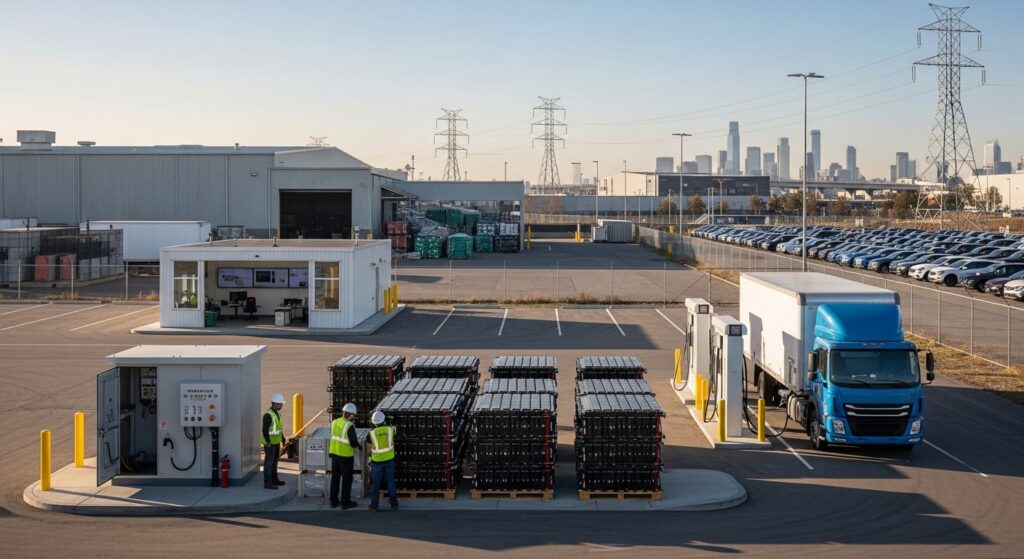
At the other end of the battery life cycle, recycling and reuse are becoming industries in their own right. For much of the public, the EV battery is seen mainly as a cost or a future waste problem. But to recyclers and grid developers, it is increasingly a source of recoverable value. Used batteries can yield critical materials that reduce dependence on newly mined supply. In some cases, packs that no longer perform well enough for a car can still be repurposed for stationary energy storage, extending their economic life and supporting renewable integration or backup power projects.
That shift is helping create a circular economy around transport electrification. What was once treated as industrial scrap is being reconceived as feedstock. The companies benefiting are not only automakers, but chemical processors, logistics firms, recyclers, utilities and data-center operators looking for large-scale storage. In this way, EVs are pushing innovation into the waste and resource-recovery sectors, where safe handling, dismantling and materials recovery are becoming strategic capabilities.
Software may prove to be the biggest crossover force of all. Modern EVs depend heavily on code for battery management, charging optimization, route planning, thermal performance and driver interfaces. As that software becomes more sophisticated, the expertise required starts to look less like traditional mechanical engineering and more like a blend of cloud computing, consumer electronics and energy analytics. That has encouraged talent migration between automotive firms, utilities, chipmakers and software companies, blurring the boundaries between industries that once operated separately.
The data generated by EVs and charging systems is also creating new business models. Fleet operators can optimize delivery routes around charging windows. Utilities can forecast neighborhood electricity demand with greater precision. Building owners can coordinate chargers with rooftop solar and battery storage. Insurers can incorporate new patterns of usage and maintenance into risk calculations. The car, in other words, is becoming part of a larger information network, and that is drawing in sectors that specialize in data, cybersecurity and digital services rather than transportation alone.
Heavy industry and freight are beginning to feel the same pull. As more delivery vans, buses and trucks electrify, depots require high-capacity charging and complex energy planning. That is stimulating development in power electronics, transformer manufacturing, industrial software and advanced cooling systems. It also forces logistics companies to rethink scheduling, property use and grid interconnections. For industrial landlords and warehouse developers, access to electricity is becoming as decisive as highway access once was.
Even labor markets are shifting. The EV ecosystem requires battery technicians, charger installers, grid planners, software engineers, electricians, recyclers and safety specialists. That means innovation is not only technical but institutional, affecting training programs, vocational schools and public policy. Regions that once focused on engine plants now have to think about battery lines, power infrastructure and electronics manufacturing. The spillover is as much about new skills as it is about new machines.
None of this means the transition is simple. Charging networks remain uneven, supply chains are exposed to geopolitical risk and the economics of recycling, mining and grid upgrades are still evolving. Consumers continue to worry about cost, convenience and resale value. Automakers themselves are navigating a market that has expanded quickly but not uniformly. Yet the broader industrial direction is becoming harder to miss.
Electric vehicles are acting as an organizing force across multiple sectors at once. They are pushing electricity providers to digitize faster, real estate developers to build differently, retailers to rethink dwell time, recyclers to scale up, miners to modernize and software companies to engage more deeply with the physical economy. The result is that EVs are no longer merely an automotive story. They are an industrial innovation story, with consequences that stretch far beyond the factory floor and the dealership lot.
That may prove to be their most lasting impact. Long after the novelty of the electric drivetrain fades, the wider systems built around it could continue reshaping how economies manage energy, materials, data and infrastructure. The car may still be the most visible symbol of the transition. But the real transformation is spreading far beyond the road.