American shoppers are putting a premium on crash-avoidance systems that can intervene before impact, even as trust in fully self-driving technology remains limited.
For U.S. car buyers, safety is no longer judged only by airbags, seat belts and crash-test stars. Those still matter, and they remain the foundation of vehicle protection. But in today’s market, many shoppers are increasingly focused on a different question: what can a car do to prevent a crash from happening in the first place?
That shift is changing how Americans compare vehicles. Features once treated as premium add-ons are moving closer to the center of the buying decision, especially among households trying to balance high vehicle prices with concerns about distracted driving, crowded roads and the growing complexity of modern traffic. The systems drawing the most attention are not the most futuristic ones. They are the tools that feel practical, immediate and easy to understand: automatic emergency braking, reverse automatic emergency braking, lane-keeping assistance, blind-spot warning and other forms of driver assistance that offer a warning or intervene when a driver is about to make a costly mistake.
The strongest signal comes from buyer and driver surveys that show U.S. consumers are far more interested in proven crash-avoidance technology than in the idea of fully autonomous cars. That distinction matters. Buyers may be curious about hands-free highway systems and the broader push toward automation, but what they consistently value most are features that reduce stress, provide backup in dangerous moments and help avoid common crashes in daily driving.
Automatic emergency braking has become the clearest example. For many shoppers, it represents the kind of technology they can instantly understand: if traffic stops suddenly and the driver reacts too slowly, the car may brake on its own. That is not a theoretical benefit. It addresses one of the most common and familiar crash scenarios on American roads, the rear-end collision. In a market crowded with giant touchscreens, subscription software and marketing claims about intelligence, automatic emergency braking stands out because its purpose is simple and its safety case is easy to explain.
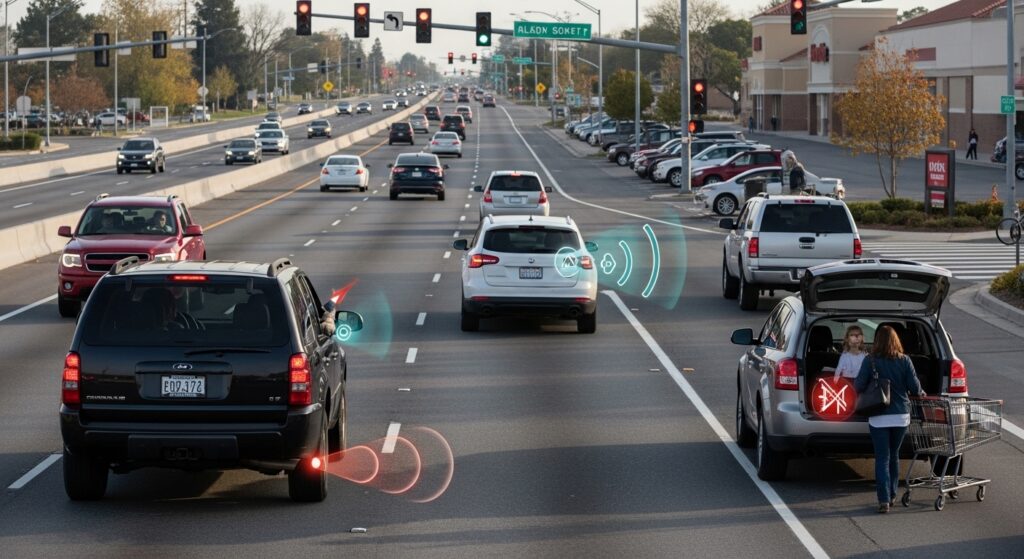
Reverse automatic emergency braking is gaining attention for similar reasons. Parking lots, driveways and low-speed backing maneuvers may not generate the dramatic headlines of highway crashes, but they are exactly the kind of everyday situations that shape how buyers think about safety. Parents worry about children behind the vehicle. Older drivers worry about visibility. Urban drivers worry about tight spaces, poles, carts and pedestrians emerging unexpectedly. A system that can detect danger while reversing and stop the vehicle before impact speaks directly to those concerns. It feels useful not someday, but every week.
Lane-keeping assistance is also high on the list because it targets another familiar risk: brief lapses in attention. A moment of distraction, fatigue or poor visibility can send a vehicle drifting out of its lane. For buyers, the appeal of lane-keeping technology is not that it turns the car into a robot. It is that it acts as a guardrail when the driver slips. That is especially attractive to commuters and highway drivers who spend long periods behind the wheel and know how easy it is for concentration to fade.
Blind-spot warning has become another widely valued feature because it addresses a fear that many drivers experience repeatedly but cannot fully eliminate through habit alone. Mirrors and shoulder checks remain essential, yet modern traffic conditions, larger vehicles and multi-lane highways create constant uncertainty around adjacent lanes. A visual or audible warning when another vehicle is hidden beside the car can feel less like luxury and more like reassurance. For buyers moving into larger crossovers, SUVs or pickups, that reassurance can carry even more weight.
What ties these features together is not novelty. It is trust. U.S. buyers tend to respond most strongly to safety systems that preserve the role of the driver while providing a layer of support when needed. These technologies are easier to accept because they do not ask motorists to surrender control. They fit the American preference for assistance over replacement. A vehicle can help brake, warn or gently steer, but the driver remains responsible.
That helps explain why consumer enthusiasm for advanced safety features has remained stronger than enthusiasm for self-driving promises. Many Americans still express skepticism toward fully autonomous vehicles, and that skepticism has created a wide gap between what automakers sometimes promote and what buyers say they actually want. The message from the market is not anti-technology. It is selective. Consumers want the technology that clearly solves a problem, not the technology that requires them to believe a major leap of faith.
Regulators are moving in the same direction. Federal safety policy in the United States is increasingly emphasizing crash-avoidance systems, especially those with strong evidence behind them. That matters because regulation often reinforces consumer expectations. Once buyers see that automatic emergency braking, pedestrian detection, lane-keeping assist and blind-spot-related protections are becoming more central to safety ratings and federal rules, they begin to view these features not as optional extras but as markers of what a modern safe vehicle should include.
Crash-test organizations and safety researchers have also helped shape demand by giving consumers a vocabulary for comparing protection. It is no longer enough for a vehicle to perform well after a collision has begun. Buyers are being taught to look for prevention as well as survivability. A top safety pick, a five-star score or a favorable safety verdict means more when it is paired with technology designed to stop the collision from occurring at all.
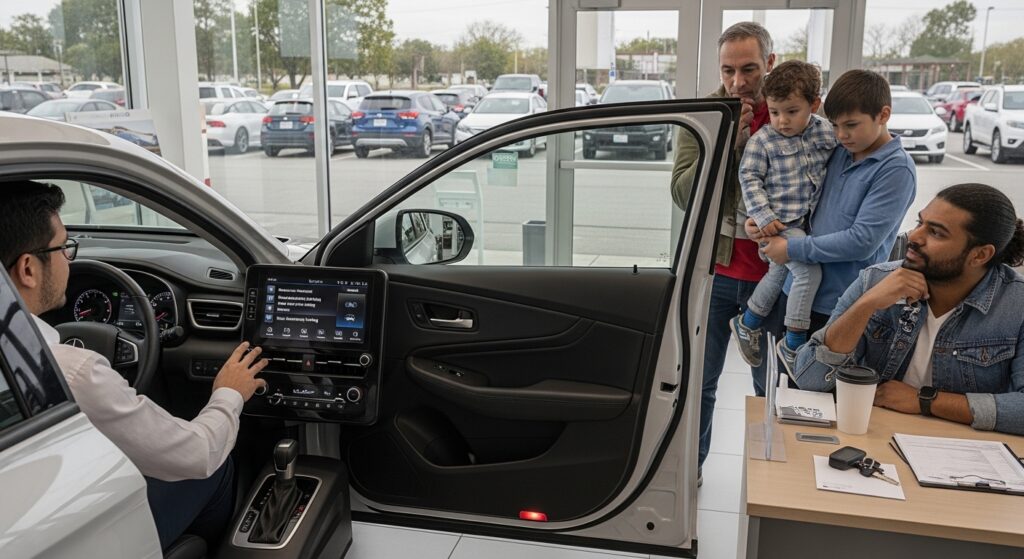
At the dealership level, this change is influencing how vehicles are sold. Sales staff once led with horsepower, trim levels and infotainment. Today, many buyers arrive already asking whether a vehicle includes blind-spot monitoring, rear cross-traffic alert, adaptive cruise control or automatic braking. Safety technology has become part of mainstream shopping language. It is no longer confined to luxury brochures or enthusiast forums. Families, first-time buyers, retirees and fleet customers all increasingly treat it as part of the value proposition.
Yet there is also caution in the market. Buyers care not just about whether a feature exists, but whether it works well. Annoying lane-centering behavior, overly sensitive alarms or confusing driver-monitoring systems can quickly turn a selling point into a source of frustration. American shoppers are learning that not all safety technology is created equal. They want systems that feel calibrated, predictable and unobtrusive. In that sense, the winning features are not only the ones with the best technical case, but the ones that integrate smoothly into normal driving.
Cost remains a major factor. Even safety-conscious buyers may hesitate if essential features are buried in expensive option packages. As vehicle prices remain elevated, shoppers are increasingly asking whether automakers treat core crash-avoidance tools as standard equipment or as premium upgrades. The brands that make the most desired safety features widely available are likely to gain an advantage, especially among middle-income households that cannot stretch indefinitely for higher trims.
The broader lesson is that U.S. buyers are defining automotive safety in a more practical way than the industry’s boldest rhetoric sometimes suggests. They are not primarily shopping for science fiction. They are shopping for fewer close calls, less daily stress and better odds of getting home without incident. That is why the features that matter most are the ones built around ordinary risks: traffic suddenly stopping, a vehicle sitting in the blind spot, a slow drift out of lane, a hidden obstacle behind the car, or a pedestrian appearing in the vehicle’s path.
In the years ahead, those priorities are likely to shape both marketing and engineering. More sophisticated automated systems will continue to develop, and some buyers will embrace them. But the center of demand in the United States still appears grounded in a simpler idea: the most valuable safety technology is the kind that steps in quietly, effectively and at exactly the right moment.
For now, the message from American buyers is remarkably consistent. They care most about the features that help prevent the crash they can imagine happening tomorrow morning on the way to work, at the school pickup line or in the grocery store parking lot. In a crowded and expensive market, the safety systems earning the most attention are the ones that feel real, relevant and proven.