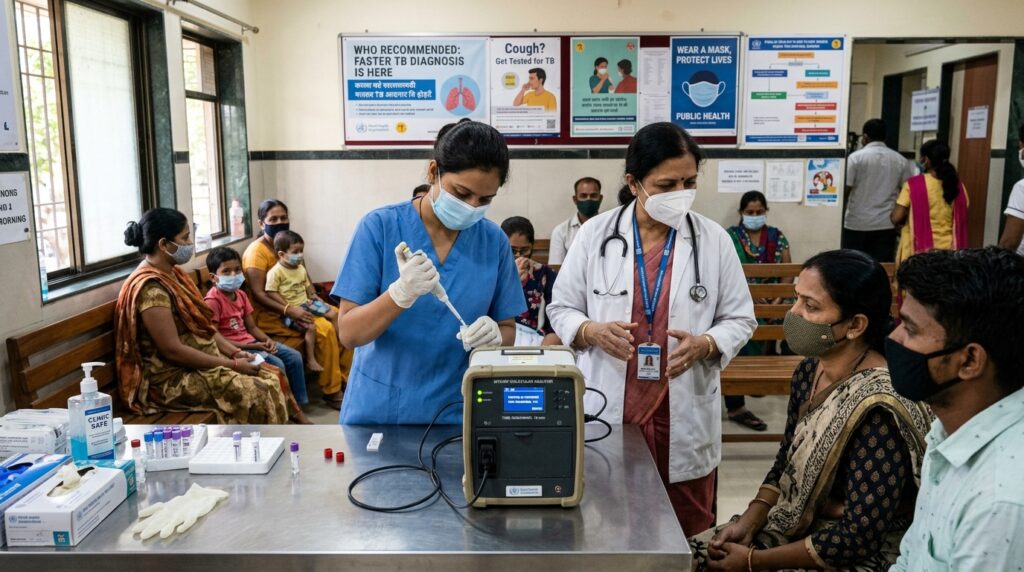
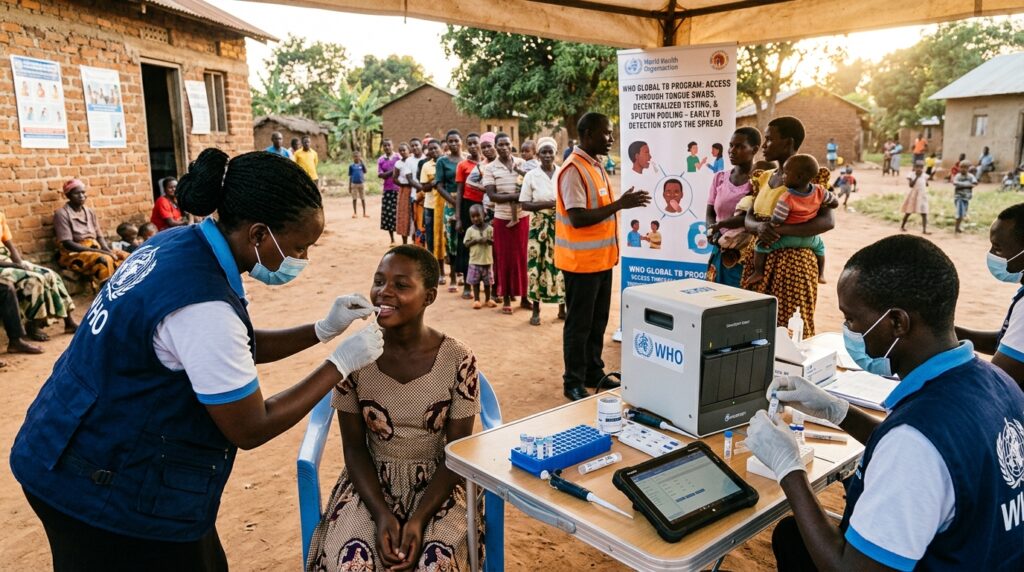
The recommendations issued around World TB Day aim to bring tuberculosis testing closer to patients through portable molecular tests, tongue swabs and resource-saving strategies, as the disease remains one of the world’s deadliest infectious killers.
The World Health Organization has recommended a new package of tuberculosis diagnostic tools designed to bring testing closer to patients, speed up detection and widen access for people who are often missed by conventional approaches, in what public health officials see as an important update in the global fight against one of the world’s deadliest infectious diseases.
The new recommendations, highlighted by WHO around World TB Day on March 24, center on three developments: a new class of near-point-of-care molecular tests, the use of tongue swabs as an easier-to-collect sample for some patients, and sputum pooling as a strategy to reduce costs and improve efficiency when resources are tight.
Taken together, the package reflects a practical shift in TB control. Rather than relying mainly on centralized laboratories and difficult-to-obtain sputum samples, WHO is encouraging countries to use tools that can move diagnosis closer to primary care clinics, peripheral laboratories and even community settings. The goal is not only scientific progress, but operational reach: finding patients earlier, starting treatment sooner and reducing the long delays that still allow tuberculosis to spread and kill.
That matters because TB remains a formidable global health threat even though it is preventable and curable. WHO said in its World TB Day statement that more than 3,300 people die from the disease each day and more than 29,000 fall ill daily. The agency has also warned that diagnostic gaps remain a central weakness in the response, especially in lower-resource settings where high costs, transportation bottlenecks and limited laboratory capacity still slow access to rapid testing.
The most eye-catching element of the new package is the recommendation for near-point-of-care nucleic acid amplification tests, or NPOC-NAATs. These are molecular tests designed for use at more decentralized levels of the health system, including primary healthcare centers and peripheral laboratories. WHO said they can operate on battery power, deliver results in less than an hour and come at lower unit cost than many existing molecular diagnostic systems.
That combination addresses one of the most persistent problems in TB diagnosis: the distance between the patient and the machine. In many countries, people with suspected tuberculosis must still provide samples that are transported to centralized facilities, sometimes over long distances, before results are returned. That can mean delays of days or longer, and those delays often translate into lost follow-up, prolonged infectiousness and delayed treatment. By moving testing closer to routine points of care, WHO is betting that speed and simplicity can become just as important as sensitivity and specificity in real-world disease control.
The second notable innovation is the endorsement of tongue swabs as a specimen type for use with certain rapid molecular platforms. That may sound modest, but the implications are potentially significant. Sputum has long been the standard sample for pulmonary TB diagnosis, yet not all patients can produce it easily. This is a major obstacle for some adults and adolescents, and particularly for people who are very ill, frail or otherwise unable to expectorate on demand.
WHO said tongue swabs can help adults and adolescents who cannot produce sputum receive TB testing for the first time. That could widen access among people at increased risk of dying from the disease because they often face the greatest barriers to timely diagnosis. In public health terms, the shift is important because a technically excellent test is only useful if patients can realistically complete the sampling process.
The third pillar of the WHO update is sputum pooling, a strategy in which samples from several individuals are combined and tested together. If a pooled sample is negative, multiple people can be cleared with a single test run. If it is positive, further testing is then used to identify the individual case or cases. WHO is recommending this as a cost-saving and efficiency-enhancing approach for the initial detection of TB and rifampicin resistance when resources are especially constrained.
For overstretched TB programs, the attraction is obvious. Molecular diagnostics are powerful but can also be expensive, especially where machine time, cartridges and trained personnel are in short supply. Pooling can reduce commodity use and machine burden, freeing capacity while maintaining a pathway to identify infections more quickly than some traditional workflows allow. WHO described it as a strategy that can improve turnaround times and lower costs under constrained conditions.
The wider significance of the announcement lies in how it connects innovation with access. Global TB discussions often focus on new medicines, vaccine research or broad political commitments. Diagnostics, by contrast, can receive less public attention even though they are the gatekeepers to treatment. A patient who is never diagnosed does not benefit from any drug regimen, however effective. In that sense, WHO’s updated recommendations go to the heart of the problem: too many people with TB still remain undetected or are diagnosed too late.
WHO’s language around the new tools reflects that urgency. Director-General Tedros Adhanom Ghebreyesus said the technologies could be “truly transformative” by bringing fast, accurate diagnosis closer to people, saving lives, curbing transmission and reducing costs. The organization also framed the recommendations as part of a broader effort to support universal access to rapid molecular testing under the End TB Strategy and commitments made at the United Nations high-level meeting on TB.
There is also a systems-level logic to the package. WHO noted that some of the newer near-point-of-care platforms could have utility beyond tuberculosis, with potential applications for other diseases such as HIV, mpox and HPV. That creates an argument for integrating diagnostics more broadly into patient-centered primary care rather than treating TB testing as a siloed vertical function. In practice, countries that invest in decentralized molecular capacity for TB may also strengthen their readiness for other infectious threats.
Yet the announcement also comes with a cautionary undertone. WHO has repeatedly warned that global progress against TB is vulnerable to financial strain. In its 2025 global TB report and related messaging, the agency said cuts in international donor funding were threatening to reverse hard-won gains. Even as it promoted new diagnostic technologies in March, WHO stressed that investment, implementation planning and country leadership would determine whether the recommendations actually reach the people who need them.
That challenge may be the hardest part of the story. Recommending a tool is not the same as deploying it at scale. National TB programs must decide where new devices fit into existing algorithms, how to train staff, how to ensure quality assurance, how to manage procurement and maintenance, and how to finance consumables over time. WHO has acknowledged that complexity by saying the full updated policy will be published in a second edition of its consolidated TB diagnosis guidelines later this year, alongside an operational handbook and a dedicated toolkit for near-point-of-care and swab-based TB testing.
That implementation focus suggests WHO is trying to avoid a familiar pattern in global health: promising technology that remains trapped in pilot projects or urban referral centers. The inclusion of readiness assessments, training materials, testing guidance, monitoring tools and webinars points to a more deliberate attempt to bridge the gap between recommendation and uptake.
For patients, however, the core promise is simpler. A faster test closer to home can mean fewer clinic visits, less money spent on travel, less waiting and a shorter path to treatment. For health systems, earlier diagnosis can reduce transmission and lower the burden of advanced disease. For governments facing tight budgets, approaches such as lower-cost decentralized testing and sputum pooling may offer a more realistic way to expand coverage without waiting for ideal conditions.
The recommendations do not solve the tuberculosis epidemic on their own. WHO itself has made clear that ending TB will still require stronger health systems, sustained funding, better access to treatment, continued research and eventually new vaccines. But diagnostics remain one of the most immediate levers available, and the latest WHO package is notable because it tries to match scientific evidence with the practical constraints of everyday care.
That is why this update stands out. It is not only about better technology. It is about making diagnosis possible in the places where patients actually show up, with sample types they can provide and workflows health systems can afford. In the long global campaign against tuberculosis, that kind of operational realism may prove just as important as any laboratory breakthrough.