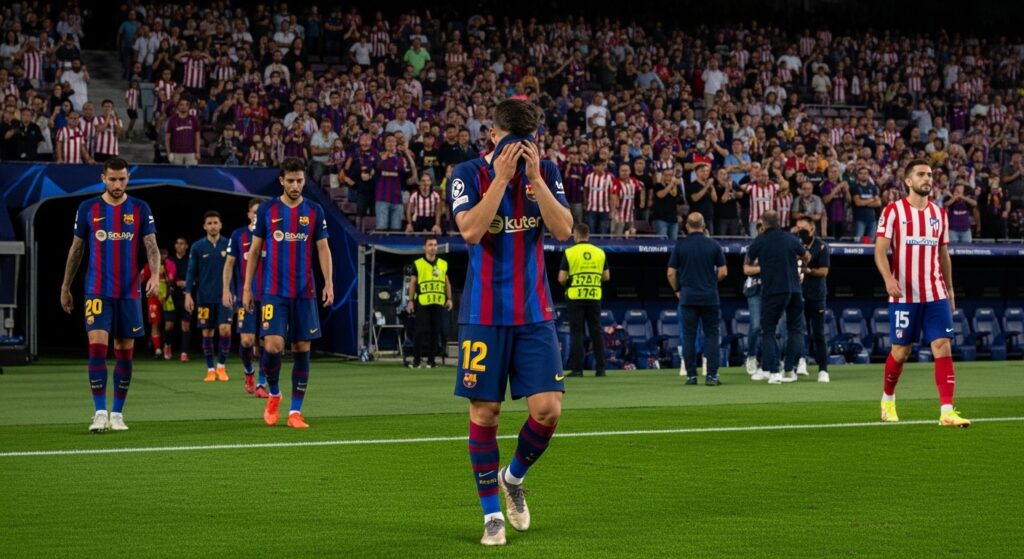
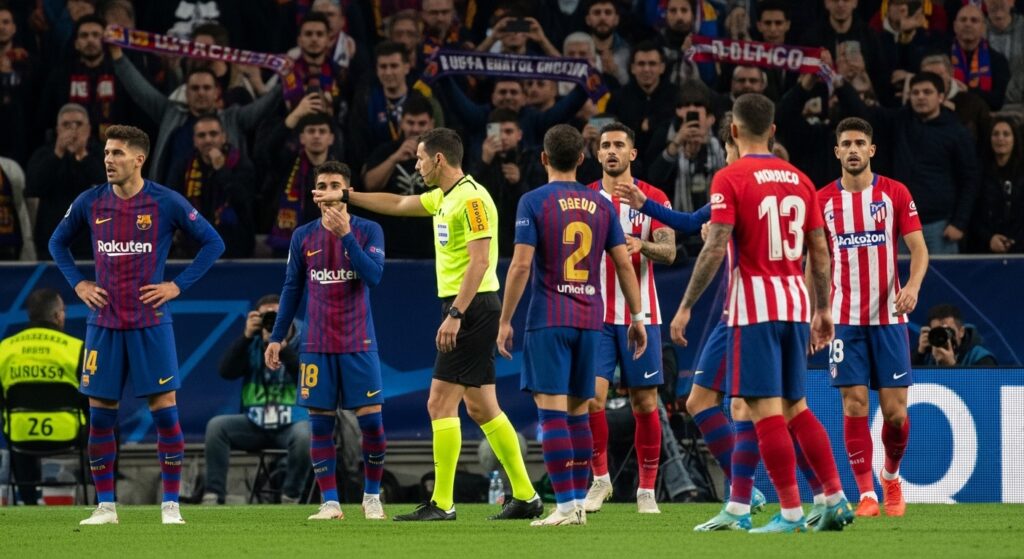
A 2-0 home loss to Atletico Madrid in the first leg of the quarter-finals has left Barcelona facing one of their most demanding European rescue missions in years, after a night that turned from control to collapse in a matter of minutes.
Barcelona are used to carrying the emotional weight of European expectation. Few clubs in the Champions League are judged only by progress; they are judged by style, authority and whether they look like a team capable of imposing themselves on the continent. That is why the defeat to Atletico Madrid felt larger than the scoreline alone. Losing a quarter-final first leg is damaging. Losing it 2-0 at home, after long stretches of territorial dominance and amid growing frustration over key refereeing decisions, felt like something closer to a psychological ambush.
The result leaves Hansi Flick’s side with little room for error in the return leg in Madrid. In purely mathematical terms, the tie is still alive. In emotional terms, Barcelona suddenly look vulnerable, exposed to exactly the kind of Champions League night they were supposed to have outgrown. This was not a collapse born from being outplayed for 90 minutes. It was more unsettling than that. It was a game Barcelona seemed to be steering, until one dismissal, one free-kick and one ruthless counterattacking plan flipped the narrative entirely.
For much of the opening period, Barcelona looked like the more comfortable side. They had the ball, they pushed Atletico backwards and they appeared determined to dictate the tempo rather than react to it. Atletico, by contrast, looked like Atletico often do under Diego Simeone in high-level knockout football: compact, patient, abrasive, and fully willing to let the opponent mistake control for safety. There is a difference between owning possession and owning a tie. Barcelona had the former. Atletico were always waiting for a route to the latter.
That route opened late in the first half. Pau Cubarsí, one of Barcelona’s brightest defensive talents and one of the young faces of the club’s long-term future, was sent off after bringing down Giuliano Simeone as Atletico broke toward goal. Whether the decision will remain debated is almost secondary now; its impact was immediate and overwhelming. In one moment, Barcelona lost a defender, their numerical balance and, crucially, the emotional calm the match had demanded.
What followed was classic knockout punishment. From the resulting set piece, Julián Álvarez struck a superb free-kick to put Atletico ahead. A game that had felt manageable for Barcelona suddenly felt hostile. Instead of reaching halftime with the score level and time to reorganize, they walked into the break trailing, reduced to 10 men, and facing the kind of strategic disadvantage that Simeone’s teams are built to exploit.
The second half revealed both the courage and the limitations of Barcelona’s response. Flick’s side did not fold. They continued to press, continued to look for combinations, and continued to chase moments that might restore the tie before the return leg. But Atletico were too disciplined, too direct and too comfortable with the chaos of an undermanned opponent. Barcelona’s attacks increasingly carried a trace of desperation, while Atletico’s defensive shape grew more authoritative with every passing minute.
When Alexander Sørloth added the second goal, the sense of shock around the stadium hardened into something more serious. This was no longer simply a bad night. It was a result with structural consequences. A 1-0 defeat can be treated as inconvenience. A 2-0 home loss in the first leg of a quarter-final changes the whole geography of the tie. It gives Atletico the scoreboard, the emotional advantage and the tactical freedom to shape the second leg on their own terms.
There is a reason this defeat stings so sharply for Barcelona. The club had entered the latter stages of the competition carrying a sense of momentum. They had swept past Newcastle in the round of 16 and were leading La Liga. There was an emerging idea that Flick had given the team clearer defensive shape without dulling its attacking edge, and that a squad mixing experience with high-end youth had matured enough to withstand the emotional swings of Europe. Against Atletico, that confidence did not disappear completely. But it was punctured.
Atletico deserve full credit for that. Simeone’s side did not merely survive pressure; they interpreted the game better. They understood where the turning point had left the match, and they attacked that new reality without hesitation. The away goals rule is gone, but there remains a psychological premium to scoring away from home and defending a lead in the second leg. Atletico now hold that premium, and they earned it through calculation as much as resilience.
For Barcelona, the questions now become as much mental as tactical. Can they go to Madrid and play with enough composure to overturn a two-goal deficit? Can they do so without overcommitting too early against a team that thrives on transitions, physical duels and emotional disorder? Can they replace the suspended Cubarsí without losing more balance? And perhaps most importantly, can they prevent the tie from becoming another chapter in the modern story of Barcelona’s European fragility?
That last question matters because Barcelona’s Champions League history in the past decade has been shaped not only by eliminations, but by the manner of them. Even when the circumstances differ, each setback revives memories of previous nights when control dissolved and confidence drained quickly under pressure. Fairly or not, the club continues to be judged against those ghosts. A first-leg home defeat to a domestic rival in Europe only sharpens that scrutiny.
Flick’s reaction after the match reportedly carried both anger and belief. That is understandable. Barcelona can point to the red card as the decisive rupture, to their earlier control of the game, and to moments in the second half when they still looked capable of changing the tone of the tie. They can also argue that the scoreline was harsher than the balance of play. But knockout football has never been a sport of aesthetic fairness. It is a sport of punishments. Atletico saw the opening and widened it.
The scale of the challenge ahead is therefore clear. Barcelona do not merely need a good performance in the return leg; they need an assertive, emotionally disciplined, and probably near-flawless one. They will need to score without feeding Atletico’s counterattack, press without losing shape, and play with urgency without letting desperation dictate every decision. That is an extremely narrow tactical line to walk, especially away from home against a Simeone side protecting a two-goal advantage.
And yet the tie is not dead. That may be the strangest part of Barcelona’s situation. The defeat was shocking because it was so abrupt and because it came in circumstances that exposed familiar anxieties. But it was also only the first leg. One early goal in Madrid would alter the emotional climate instantly. One moment of Atletico panic would reopen the contest. Barcelona still have the talent to do that, and enough attacking quality to make any opponent nervous. The problem is that they now have to prove it under maximum strain.
In the broader Champions League context, this was exactly the sort of result that reshapes a round. Barcelona had been viewed as one of the more convincing teams left in the field. Atletico, as ever, arrived with fewer aesthetic admirers but deep knockout credibility. After 90 minutes at Camp Nou, credibility beat fluency. Discipline beat rhythm. And the team that looked as if it should be controlling the road to the semi-finals is now staring at the possibility of going out.
That is why the defeat qualifies as a shock. Not because Barcelona are incapable of losing to Atletico Madrid. Few serious observers would argue that. It is shocking because of where it happened, how suddenly the match turned, and how damaging the score may prove to be. Champions League quarter-finals often hinge on a detail. For Barcelona, one detail became a red card, a free-kick, a second goal and suddenly a mountain.
The second leg will decide whether this becomes a painful warning or a defining failure. For now, though, the verdict is simple and brutal: Barcelona took command of the ball, lost command of the night, and now risk losing command of their European season.