
Technology has always played a central role in human progress. From the invention of the wheel to the rise of the internet, each technological breakthrough has changed the way people live, work, and think. Today, humanity stands at the edge of another major transformation. Future technology promises not only to improve existing systems but also to redefine the structure of society itself. Innovations in artificial intelligence, biotechnology, robotics, quantum computing, renewable energy, space exploration, and communication are expected to shape the coming decades in ways that may be even more dramatic than the technological revolutions of the past. While these advancements offer enormous potential, they also raise important questions about ethics, security, equality, and human identity. Understanding future technology is therefore essential for anyone who wants to understand the world of tomorrow.
One of the most influential technologies of the future is artificial intelligence. AI has already become part of daily life through virtual assistants, recommendation systems, translation tools, and automated customer service. However, future AI systems are likely to be far more advanced, capable of learning more efficiently, solving more complex problems, and interacting with humans in increasingly natural ways. In education, AI may provide highly personalized lessons based on each student’s abilities and learning style. In healthcare, it may assist doctors in diagnosing diseases earlier and more accurately. In business, it may improve productivity by automating repetitive tasks and supporting better decision-making. AI may also help scientists analyze huge amounts of data, accelerating research in climate science, medicine, and engineering. Despite its benefits, artificial intelligence also creates concern about job displacement, privacy, bias, and the concentration of power in the hands of those who control advanced systems. The future of AI will depend not only on technical development but also on how wisely society chooses to regulate and apply it.
Closely connected to AI is the future of robotics. Robots are no longer limited to factory assembly lines. They are becoming more adaptable, mobile, and intelligent. In the future, robots may assist in hospitals, care for the elderly, deliver goods, perform dangerous rescue operations, and even support household chores. In agriculture, robots could help plant, monitor, and harvest crops with high precision. In disaster zones, they may enter unsafe areas where human lives would be at risk. Robotic technology may also transform industries such as construction, mining, and transportation. Autonomous machines could reduce accidents and improve efficiency. However, the widespread use of robots may also increase unemployment in certain sectors, especially those involving routine physical labor. This means that societies will need to rethink education and workforce training to prepare people for jobs that require creativity, problem-solving, and emotional intelligence.
Another major area of future technology is biotechnology. Advances in genetics, bioengineering, and medical science may dramatically improve human health and longevity. Scientists are already developing gene-editing technologies that can potentially treat inherited diseases by correcting harmful mutations. In the future, biotechnology may allow doctors to create personalized treatments based on a person’s genetic profile. This could make medicine more precise and effective. Lab-grown organs may one day solve the shortage of transplant donors, while regenerative medicine could help repair damaged tissues and restore lost functions. Future vaccines and diagnostics may become faster, smarter, and more accessible, helping the world respond more effectively to new diseases. Biotechnology may also improve agriculture by creating crops that are more resistant to drought, pests, and climate stress. At the same time, these advancements raise ethical concerns. Questions about genetic privacy, human enhancement, cloning, and access to medical breakthroughs will become increasingly important. Technology that can change life at the biological level must be handled with great care.
Quantum computing is another technology that may revolutionize the future. Traditional computers process information using bits that represent either 0 or 1. Quantum computers use quantum bits, or qubits, which can exist in multiple states at once. This allows them to solve certain types of problems much faster than current computers. Although quantum computing is still in its early stages, it could transform fields such as cryptography, materials science, finance, and pharmaceuticals. For example, it may help researchers simulate molecular interactions more accurately, leading to the discovery of new medicines or advanced materials. In logistics, it could optimize supply chains and transportation networks. In finance, it may improve risk analysis and market modeling. However, quantum computing also poses serious risks, especially to cybersecurity. If sufficiently powerful quantum computers are developed, they could break many of the encryption systems currently used to protect digital communication. This would require the creation of new forms of secure computing and global preparation for a post-quantum world.
Future technology will also be deeply linked to energy and the environment. As climate change becomes one of the most urgent global problems, technological innovation will be essential for building a more sustainable world. Renewable energy technologies such as solar, wind, geothermal, and advanced battery storage are expected to become more efficient and affordable. Future energy systems may rely on smart grids that automatically balance supply and demand, reducing waste and increasing reliability. Scientists are also exploring the possibility of nuclear fusion, a form of energy that could produce massive power with minimal environmental harm. If fusion becomes commercially viable, it could transform the global energy landscape. In transportation, electric vehicles are likely to become more common, and future breakthroughs may lead to cleaner aviation and shipping systems. Green technology may also improve buildings, farming, and manufacturing, helping reduce carbon emissions and resource consumption. Nevertheless, technological solutions alone will not solve environmental problems. They must be combined with responsible policies, international cooperation, and changes in consumer behavior.
The future of communication technology is equally significant. The internet has already connected billions of people, but future systems may make digital interaction even faster, more immersive, and more integrated with daily life. Developments in 6G networks, satellite internet, and edge computing may provide more reliable access to information across urban and rural areas alike. Virtual reality and augmented reality may create new ways to work, learn, shop, and socialize. Students may attend virtual classrooms that feel almost physical. Doctors may guide remote surgeries through advanced digital interfaces. Employees may collaborate in immersive virtual workplaces without needing to travel. These technologies could save time, reduce costs, and expand access to opportunities. However, they may also blur the boundary between physical and digital life. As people spend more time in virtual environments, society will need to address issues such as digital addiction, identity, misinformation, and mental health.
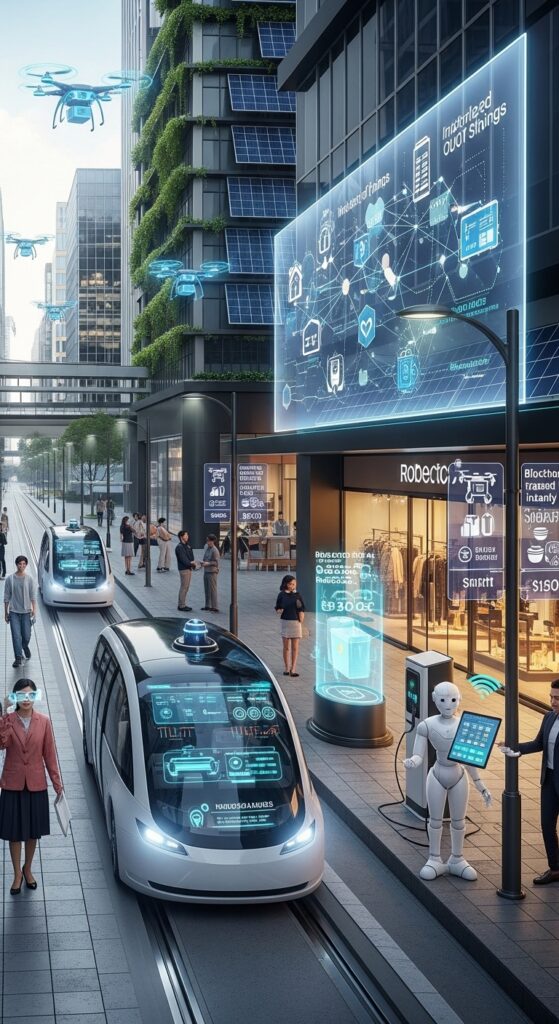
Smart cities are another important vision of future technology. A smart city uses sensors, data analysis, and connected infrastructure to manage urban life more efficiently. Traffic systems may use real-time data to reduce congestion. Buildings may automatically adjust energy use based on weather and occupancy. Waste management systems may optimize collection routes, while public safety systems may respond more quickly to emergencies. Smart cities could improve quality of life by making transportation, energy use, and public services more effective. They may also help cities deal with growing populations and environmental stress. Yet this vision comes with challenges. Smart cities depend heavily on data collection, which raises concerns about privacy and surveillance. If not governed carefully, such systems could increase social control or exclude vulnerable populations. The future city must therefore be not only smart, but also fair, transparent, and respectful of individual rights.
Future transportation technology may also radically change how people move. Self-driving cars are one of the most discussed innovations in this field. Autonomous vehicles may reduce traffic accidents, improve mobility for the elderly and disabled, and make transport systems more efficient. Public transit could become more responsive through AI-based scheduling and route planning. High-speed rail and advanced electric transport may reduce the need for short-distance flights. Some companies are also developing air taxis and flying vehicles, though these remain experimental. In logistics, autonomous trucks and drone delivery systems may make supply chains faster and more flexible. These changes could reshape urban design, reduce travel time, and transform industries. However, the transition will be complex. Legal responsibility, infrastructure adaptation, public trust, and employment effects must all be addressed before such technologies become fully mainstream.
Space technology is another field with extraordinary future potential. For centuries, space was a mystery; today, it is becoming a new frontier for science, business, and exploration. Private companies and national agencies are developing reusable rockets, lunar missions, and plans for human exploration of Mars. In the future, space technology may expand satellite networks that support communication, weather monitoring, navigation, and environmental observation. It may also allow mining of rare materials from asteroids or the establishment of research bases beyond Earth. Space exploration can drive scientific discovery and inspire international cooperation. It can also generate innovations that benefit life on Earth, as many space technologies have already done. Still, space development raises concerns about militarization, orbital debris, and unequal access. The expansion of human activity beyond Earth should ideally be guided by peaceful and cooperative principles.
One of the most fascinating aspects of future technology is its impact on human identity and daily experience. Wearable devices are already tracking health, sleep, and movement. In the future, technology may become even more closely integrated with the human body through brain-computer interfaces, smart implants, and advanced prosthetics. These systems could help people with disabilities regain mobility, communication, or independence. They might also allow faster interaction with machines and digital environments. Some thinkers believe humans may eventually enhance memory, perception, or physical ability through technology. Such possibilities raise profound ethical questions. What does it mean to be human in an age when biology and technology merge? Who will have access to enhancement technologies? Could they create new forms of inequality between enhanced and non-enhanced individuals? These questions show that future technology is not only about devices and systems, but also about values and the meaning of progress.
Education will play a crucial role in preparing society for future technology. As innovation accelerates, traditional education models may become less effective if they focus only on memorization or fixed career paths. Future workers will need adaptability, digital literacy, critical thinking, collaboration, and lifelong learning. Schools and universities will have to teach students how to work with AI, interpret data, understand ethics, and respond to rapid change. At the same time, education itself will be transformed by future technology. AI tutors, virtual labs, immersive simulations, and personalized learning platforms may make education more flexible and inclusive. However, the human role in education will remain vital. Teachers are not simply providers of information; they are mentors who guide moral development, creativity, and social understanding.
Alongside the many benefits of future technology, there are serious risks that must not be ignored. One major risk is inequality. Advanced technology may improve life dramatically for some people while leaving others behind. Countries with strong economies and digital infrastructure are likely to benefit more quickly, while poorer regions may struggle to access the same tools. Within societies, wealthier individuals may have better access to advanced healthcare, education, and automation. If future technology is distributed unfairly, it could widen social and economic gaps. Another risk is the abuse of technology for surveillance, manipulation, or warfare. Artificial intelligence, facial recognition, autonomous weapons, and mass data collection could be used in harmful ways if not properly regulated. Future technology also increases dependence on complex digital systems, making societies more vulnerable to cyberattacks, technical failures, or misinformation. For these reasons, ethics, law, and public oversight must develop alongside innovation.
The future will also require a new relationship between humans and machines. Rather than viewing technology as either entirely good or entirely dangerous, society must learn to manage it wisely. Technology is a tool, and its impact depends on the intentions, structures, and values that shape its use. Governments will need policies that encourage innovation while protecting human rights. Companies will need to develop responsible business practices and transparent systems. Scientists and engineers will need ethical awareness, not just technical skill. Citizens will also need to stay informed and involved in public debate about how technology should be used. The future should not be designed only by a small group of powerful institutions. It should be shaped through broad participation and shared responsibility.
In conclusion, future technology holds the potential to transform every dimension of human life. Artificial intelligence, robotics, biotechnology, quantum computing, renewable energy, immersive communication, smart cities, advanced transport, and space exploration may bring extraordinary improvements in health, knowledge, productivity, and sustainability. At the same time, these developments raise serious concerns about inequality, ethics, privacy, employment, and human identity. The future of technology is therefore not simply a matter of invention, but of choice. Humanity must decide how to use these powerful tools in ways that promote dignity, justice, and collective well-being. If guided wisely, future technology can help create a world that is not only more advanced, but also more humane. If misused, it may deepen division and uncertainty. The challenge of the future is not whether technology will change the world. It is whether humanity will be wise enough to shape that change for the common good.
