
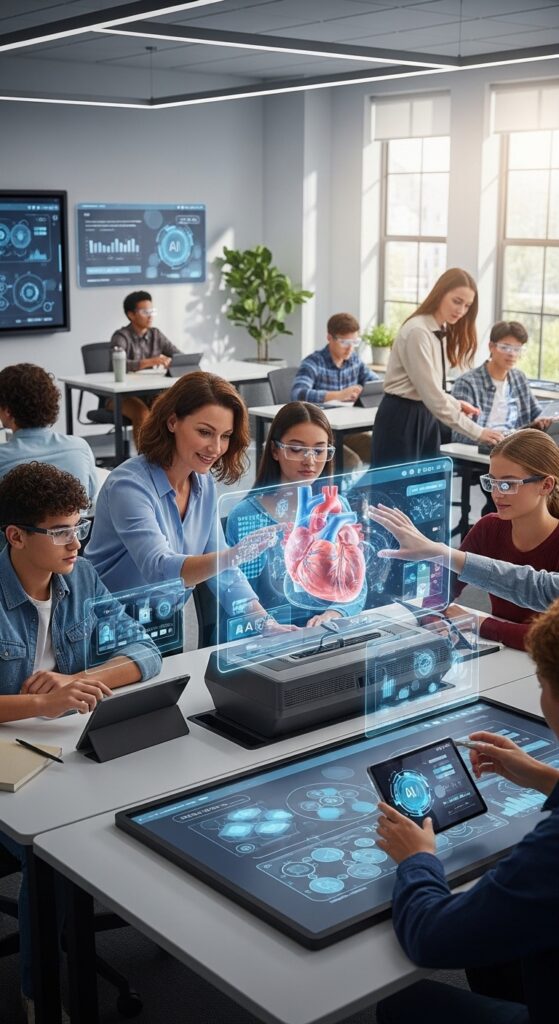
Artificial intelligence is rapidly reshaping education across the world. What was once considered a futuristic concept has become a practical tool used in classrooms, universities, and online learning platforms. From personalized tutoring systems to automated grading and data-driven lesson planning, AI is changing not only how students learn but also how teachers teach. Its growing presence in education has sparked both excitement and concern. Supporters see AI as a way to make learning more efficient, inclusive, and adaptive, while critics warn about ethical risks, dependency, and inequality. Despite these debates, one fact is clear: artificial intelligence is becoming a major force in modern education.
At its core, AI in education refers to the use of computer systems that can perform tasks normally requiring human intelligence, such as recognizing patterns, analyzing language, making predictions, and generating responses. In educational settings, these systems can support students individually, help teachers manage workloads, and assist institutions in making better decisions. AI is not meant to replace teachers, but rather to enhance human teaching by handling repetitive tasks and providing insights that would otherwise take a great deal of time to produce.
One of the most important contributions of AI to education is personalized learning. Traditional classrooms often follow a one-size-fits-all model in which all students receive the same instruction at the same pace. However, students learn differently. Some grasp concepts quickly, while others need more explanation, practice, or alternative examples. AI-powered learning platforms can analyze student performance in real time and adapt lessons accordingly. If a student struggles with algebra, for instance, the system can provide additional exercises, simpler explanations, or visual demonstrations. If a student advances quickly, the platform can introduce more challenging material instead of forcing them to wait for the rest of the class.
This adaptability has the potential to improve both student outcomes and motivation. When learners receive content suited to their level, they are more likely to remain engaged and less likely to become frustrated or bored. Personalized learning also allows students to take greater control of their educational journey. They can receive immediate feedback, revisit difficult topics, and progress at a pace that reflects their own abilities. In this sense, AI can support a more student-centered model of education.
AI also plays a growing role in tutoring and academic support. Intelligent tutoring systems can provide explanations, answer questions, and guide students through complex problems. Unlike traditional homework help, these systems can be available at any hour, making learning support more accessible beyond school hours. For students who may feel embarrassed to ask questions in class, AI tutors can offer a private and low-pressure environment to practice and learn. Language learning apps, writing assistants, and virtual study coaches are examples of how AI can extend educational support beyond the classroom walls.
In addition, AI can help teachers save time by automating administrative and repetitive tasks. Grading multiple-choice tests, tracking attendance, organizing student data, and generating performance reports can consume a large portion of a teacher’s time. AI tools can complete many of these tasks quickly and accurately, allowing educators to focus more on instruction, creativity, and student relationships. Some systems can even help teachers design quizzes, generate lesson materials, or suggest classroom interventions based on student progress. In schools where teachers are overworked and under-resourced, such support can be especially valuable.
Another major advantage of AI in education is its ability to improve accessibility and inclusion. Students with disabilities often face barriers that make learning more difficult in traditional settings. AI tools such as speech recognition, real-time captioning, text-to-speech software, and visual recognition can make educational content more accessible. Students with hearing impairments can benefit from automatic transcription, while students with visual impairments can use audio-based tools to engage with written material. AI can also support learners with dyslexia, attention difficulties, or language barriers by offering customized interfaces and assistance. In this way, artificial intelligence can contribute to a more inclusive learning environment in which more students are able to participate fully.
AI is also transforming language education and communication. Translation tools, pronunciation analysis, and conversational chatbots can help students learn new languages in interactive ways. These systems allow learners to practice speaking, writing, and comprehension more frequently than would be possible in a traditional classroom alone. For multilingual classrooms, AI can help bridge communication gaps between teachers, students, and parents. This is particularly important in increasingly global and diverse educational communities.
Beyond the classroom, educational institutions are using AI for decision-making and management. Schools and universities collect large amounts of data related to attendance, grades, course enrollment, student behavior, and graduation rates. AI systems can analyze this data to identify patterns and predict outcomes. For example, they may help detect students at risk of dropping out, allowing educators to intervene early. Universities can also use AI to improve admissions processes, allocate resources more efficiently, and provide targeted support services. When used responsibly, such applications can make institutions more responsive and effective.
The rise of online learning has further increased the importance of AI in education. Digital platforms often rely on AI to recommend courses, track progress, evaluate participation, and provide instant support. During periods when remote learning becomes necessary, such as health emergencies or disruptions caused by conflict or natural disasters, AI can help maintain continuity in education. Students in remote areas may also benefit from AI-powered platforms when qualified teachers are not readily available. In this sense, AI can expand access to education across geographical and social boundaries.
However, the use of AI in education is not without serious challenges. One major concern is the risk of overdependence. If students rely too heavily on AI tools to answer questions, write essays, or solve problems, they may not develop critical thinking, creativity, or independent learning skills. Education is not simply about getting correct answers; it is also about learning how to think, question, reflect, and communicate. If AI becomes a shortcut rather than a support tool, it may weaken these essential abilities.
Academic integrity is another important issue. AI writing tools and answer generators make it easier for students to complete assignments without doing the intellectual work themselves. This raises difficult questions for teachers and institutions: How can they distinguish between authentic student work and AI-generated content? How should they design assessments in a world where AI can produce essays, summaries, and code in seconds? These questions do not have simple answers. They require schools to reconsider what they assess and how they assess it. More emphasis may need to be placed on oral exams, project-based learning, in-class writing, and tasks that require personal reflection or applied understanding.
Privacy and data security are also major concerns. AI systems often depend on large amounts of student data to function effectively. This may include academic records, behavioral information, speech samples, and personal interactions. If such data is not handled carefully, students’ privacy may be at risk. There is also concern about who owns the data, how long it is stored, and whether it could be used for commercial purposes. Educational institutions must therefore establish strong policies to protect student information and ensure that AI systems operate transparently and ethically.
Bias in AI systems is another challenge that cannot be ignored. AI models learn from existing data, and if that data contains social or cultural biases, the technology may reproduce or even amplify them. In education, this could lead to unfair assessments, inaccurate predictions, or unequal treatment of students from different backgrounds. For example, an AI system trained primarily on one language, culture, or educational context may perform poorly when used with students from another. This means that AI tools must be tested carefully and monitored continuously to ensure fairness and reliability.
There is also the issue of inequality in access. Although AI has the potential to expand educational opportunities, it may also deepen the gap between those who have access to advanced technology and those who do not. Wealthier schools are more likely to afford AI tools, digital infrastructure, and teacher training, while underfunded schools may struggle with basic internet access or outdated devices. If AI becomes central to education without equal investment in access, it could reinforce existing educational inequalities instead of reducing them. Governments and institutions must therefore treat digital equity as a priority.
The role of teachers in an AI-enhanced classroom remains central. Some people fear that AI will replace educators, but this view misunderstands the nature of teaching. Teaching is not only the delivery of information. It involves mentorship, emotional support, moral guidance, inspiration, and the creation of human connection. A teacher understands classroom dynamics, student emotions, and social context in ways that machines cannot fully replicate. AI may assist with information and analysis, but it cannot replace the empathy, judgment, and leadership of a skilled teacher. The future of education should not be framed as humans versus machines, but rather as a collaboration in which teachers use AI thoughtfully to enrich learning.
For this reason, teacher training is essential. Educators need to understand not only how to use AI tools, but also when to use them and when not to. They must be able to evaluate the quality of AI-generated content, recognize its limitations, and teach students responsible use. Digital literacy should become a core part of both teacher education and student learning. In the age of AI, students must learn how to ask good questions, verify information, identify bias, and use technology ethically. These skills are as important as traditional academic knowledge.
Looking ahead, the future of AI in education will likely involve even more interactive and immersive experiences. We may see increasingly sophisticated virtual tutors, AI-supported simulations, intelligent feedback systems, and learning environments that respond to students’ emotions and behaviors. Yet the success of these innovations will depend not only on technical progress, but also on the values that guide their implementation. Education should remain focused on human development, social responsibility, and equal opportunity. Technology should serve these goals rather than define them.
In conclusion, artificial intelligence is transforming education in powerful and complex ways. It offers major benefits, including personalized learning, greater accessibility, improved efficiency, and broader educational reach. At the same time, it raises serious concerns about dependency, bias, privacy, academic honesty, and inequality. The challenge is not whether AI should be used in education, but how it should be used. When applied responsibly, AI can be a valuable partner in creating more effective and inclusive learning systems. But its role must be carefully managed to ensure that education remains deeply human at its center. The most promising future is one in which artificial intelligence supports teachers, empowers students, and helps build a more flexible, fair, and meaningful educational experience for all.
