
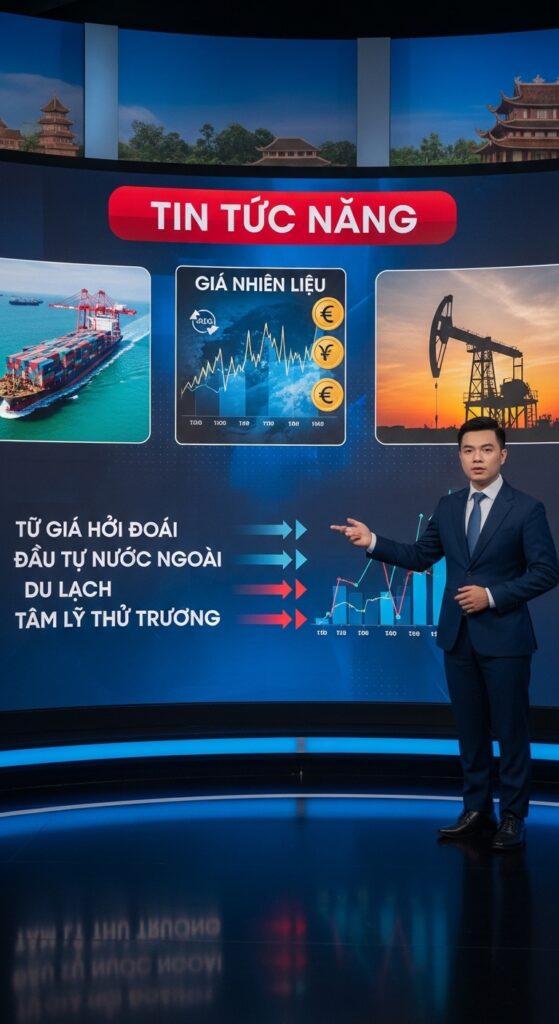
From Hanoi, the world’s latest breaking news does not look like a string of distant headlines. It looks like a map of pressure points closing in on Vietnam at the same time. The renewed U.S.–Iran crisis has threatened energy routes that matter to every importing economy in Asia. The intensifying U.S.–China trade confrontation is shaking the manufacturing model on which Vietnam has built much of its modern success. A new Philippine coast guard base in the South China Sea is a reminder that maritime disputes remain active even when Vietnam and China themselves are keeping tensions comparatively restrained. And all of this is unfolding just as Vietnam’s top leader, To Lam, has consolidated power at home and is preparing for a closely watched visit to China. Seen from Vietnam, then, this is not merely a week of international breaking news. It is a test of whether the country can keep balancing growth, sovereignty, and diplomatic flexibility in a world that is becoming harsher and less predictable.
The first and most immediate story is energy. Rare face-to-face talks between U.S. and Iranian officials began in Islamabad on April 11 after a fragile two-week ceasefire, with the Strait of Hormuz once again central to negotiations. That narrow waterway carries roughly one-fifth of the world’s oil, and the mere threat of disruption there is enough to rattle commodity markets, shipping schedules, and inflation expectations across Asia. For Vietnam, this is not an abstract geopolitical concern. Vietnam still depends heavily on imported energy inputs and remains exposed to swings in oil prices, transport costs, and supply-chain delays when Gulf tensions surge. Even when a ceasefire holds, the risk premium created by conflict can linger in freight and fuel markets long after missiles stop flying.
That pressure is already visible inside the Vietnamese economy. Vietnam’s National Statistics Office reported that gross domestic product grew 7.83% year on year in the first quarter of 2026, an impressive figure that confirms strong momentum in manufacturing, services, consumption, and exports. But the same official reporting also shows how exposed the economy remains to the outside world: exports of goods and services rose 19.85%, while imports rose 24.27%, underlining just how deeply Vietnam’s growth model depends on open trade and stable global logistics. Fast growth, in Vietnam’s case, does not reduce vulnerability to global shocks; in some ways it increases it, because a more integrated economy feels external disruptions faster.
That is why the Middle East crisis matters so much from a Vietnamese perspective. A country trying to sustain high growth cannot ignore shipping insecurity or energy inflation. Bloomberg’s reporting last week noted that Vietnam’s economic momentum slowed somewhat in the first quarter as rising Middle East energy costs and disrupted trade routes fed new uncertainty into the growth outlook. Even though Vietnam still posted strong GDP expansion, the message was clear: the country can outperform expectations and still be dragged down by global turbulence beyond its control. In the coming quarter, if fuel prices remain elevated or logistics networks stay under pressure, the effects could spread from airlines and shipping firms to factories, food prices, and household spending.
Vietnam’s response has been to emphasize stabilization rather than panic. The Ministry of Industry and Trade said this week that the government had moved early to secure fuel supply, coordinate across ministries, and prevent domestic shortages amid global market volatility. That messaging is politically important. Vietnam is trying to signal to investors, consumers, and trading partners that it understands the scale of the external shock and still has enough administrative coordination to protect the basics. In other words, Hanoi’s approach to the Iran-related crisis is not to pretend Vietnam is insulated, but to show that vulnerability can be managed. That is a subtle but important distinction in a country that wants to be seen as both dynamic and dependable.
If the Iran story is about energy security, the second major story of the moment is about trade security. Vietnam has spent years benefiting from supply-chain diversification as companies looked for alternatives to China. That trend helped turn the country into one of the world’s most important manufacturing and export platforms. But the same success has also made Vietnam highly sensitive to American protectionism. Reuters reporting carried this month through syndication said Vietnam had been prepared to crack down on some China-linked trade and tighten controls on sensitive exports in hopes of avoiding punishing U.S. tariffs, reflecting concern in Hanoi that Vietnamese territory could be seen in Washington as a channel for Chinese transshipment. That issue is not just technical customs policy. It goes to the heart of Vietnam’s place in the world economy: Hanoi wants to attract production shifting out of China, but not be accused of merely serving as China’s back door.
This tension reveals the central strategic problem of modern Vietnam. The country cannot choose between the United States and China in any simple sense. China is its giant neighbor, a leading trade partner, and a permanent security factor. The United States is a crucial export market, a technology partner, and an increasingly important geopolitical counterweight in the broader Indo-Pacific. Vietnam’s success in recent years has come partly from refusing to become fully dependent on either side. But as U.S.–China rivalry intensifies, that balancing strategy becomes more demanding. The harsher the trade war grows, the more pressure Vietnam faces to prove where value is really created, where goods really originate, and where its long-term loyalties lie.
There is a reason, then, that recent diplomatic shifts matter so much. Two months ago, Vietnam and the European Union upgraded their relationship to a comprehensive strategic partnership, a move AP described as part of a broader recalibration as U.S. tariffs reshape global trade. For Hanoi, that was not simply a symbolic diplomatic promotion. It was also an economic hedge. The more unpredictable the relationship with Washington becomes, the more valuable it is for Vietnam to widen its room for maneuver with Europe, Northeast Asia, India, and other partners. Vietnam’s foreign policy has long been described as diversified and multilateral, but in 2026 that principle has become more urgent than theoretical. Diversification is no longer just smart diplomacy; it is risk management.
At the same time, Vietnam cannot ignore the South China Sea, where sovereignty and economic strategy overlap. AP reported this week that the Philippines opened a new coast guard base on Thitu Island, describing it as a “steadfast sentinel” of Philippine sovereignty in contested waters. For Vietnamese observers, this development carries a double meaning. On one hand, it underscores that smaller Southeast Asian states continue to resist China’s sweeping claims and are strengthening their maritime presence. On the other hand, it reminds Hanoi that every new infrastructure step by another claimant alters the regional picture, even if Vietnam itself is not the direct target of that particular move. The South China Sea does not stand still just because one dispute is quieter than another.
Interestingly, Vietnam’s own relationship with China in the South China Sea appears relatively restrained at this moment. Reporting last week suggested that, despite continuing disagreements and land-reclamation concerns, Beijing and Hanoi have recently shown more caution toward each other than China has shown toward Manila. That quieter atmosphere should not be mistaken for resolution. The underlying disputes remain, and both sides continue to watch each other closely. But from Vietnam’s perspective, relative calm can be useful. It creates space for Hanoi to focus on economic management, reform, and broader diplomacy rather than being forced into daily maritime confrontation. The challenge, of course, is that such calm depends not only on Vietnamese restraint, but also on Chinese calculations, which can change quickly.
That is what makes To Lam’s coming visit to China so significant. Reuters reported that Vietnam’s top leader is due in China from April 14 to 17, shortly after being elevated to the presidency while retaining his post as Communist Party general secretary. AP, meanwhile, described this power consolidation as a major shift in Vietnam’s political structure, one likely to produce faster decision-making while also concentrating authority. The China trip will therefore be watched not only for what it says about bilateral ties, but for what it says about Lam’s governing style. A stronger leadership center can make Vietnam quicker to respond in a crisis, whether the issue is tariffs, energy, or maritime pressure. But it also means more of the country’s strategic balancing will be identified personally with one leader’s choices.
That personal element matters because Vietnam is entering a period where domestic reform and external stress are colliding. AP noted that Lam has emphasized economic modernization, private-sector growth, and ambitious development goals, even as global disruptions from the Iran war and U.S. trade pressure complicate those aims. A country targeting high-income status cannot afford policy paralysis, but neither can it afford strategic overreaction. If Hanoi responds too weakly to external shocks, it risks lost growth and diminished credibility. If it responds too aggressively—whether in trade concessions, foreign alignment, or maritime signaling—it could narrow the diplomatic flexibility that has long been one of its greatest strengths.
This is why Vietnam’s recent economic numbers are both reassuring and deceptive. They are reassuring because 7.83% growth is strong by almost any international standard, and because manufacturing, retail, tourism, and services all appear to be contributing. But they are deceptive because they can create the impression that Vietnam is comfortably outrunning the world’s problems. It is not. The very openness that produces rapid export growth also means Vietnam is unusually exposed to tariff swings, logistics shocks, energy volatility, and weakening external demand. In the short run, strength gives Hanoi more confidence. In the long run, it also raises the stakes of any disruption.
There is, however, a reason many investors still see Vietnam as one of Asia’s most attractive economies. Even amid current turbulence, business and development institutions keep pointing to the same structural advantages: a broad network of trade agreements, expanding logistics infrastructure, strong manufacturing capacity, and a political system capable of making coordinated national decisions. Maersk recently described Vietnam as a hub for supply-chain diversification, while the ADB’s latest data release indicates that the bank updated regional forecasts in April 2026 even as broader risks from tariffs and geopolitics deepened. Vietnam’s attraction, in other words, lies not in being risk-free, but in being comparatively adaptable.
From a Vietnamese viewpoint, then, this week’s hot news has a single underlying theme: interdependence has become more dangerous. A war near the Persian Gulf can influence fuel costs in Ho Chi Minh City. A tariff dispute in Washington can affect factory hiring in Bac Ninh or Binh Duong. A coast guard base opened by the Philippines can shift the broader balance of signaling in waters that also matter to Vietnam’s sovereignty and trade. A leadership visit to Beijing can carry implications not just for ideology or protocol, but for investment, maritime restraint, and regional alignment. Vietnam sits at the intersection of these forces not because it seeks the spotlight, but because it has become too economically important, too strategically placed, and too diplomatically skillful to remain on the sidelines.
The most likely Vietnamese response is neither dramatic alignment nor isolation. It is deeper hedging: more diversification of markets, stricter control of trade rules to avoid sanctions or tariff penalties, continued efforts to secure energy supplies, a careful tone with China, and persistent cultivation of partners from the U.S. to the EU to Japan and beyond. This may sound less exciting than the language of confrontation, but for Vietnam it is a strategic doctrine shaped by experience. The country has learned that survival and success often depend not on being louder than bigger powers, but on staying nimble while those powers collide.
So the real breaking story, seen from Vietnam, is not simply that the world is unstable. It is that Vietnam must now manage several kinds of instability at once: economic, geopolitical, maritime, and diplomatic. The country’s recent performance suggests it has the tools to cope. But coping is not the same as escaping. If the U.S.–Iran talks fail, if trade tensions worsen, if maritime calm erodes, or if protectionism intensifies, Hanoi will face harder choices than it does today. For now, Vietnam remains what it has increasingly become in the 2020s: not a spectator to global turbulence, but one of the places where the consequences of that turbulence are measured most clearly.
