
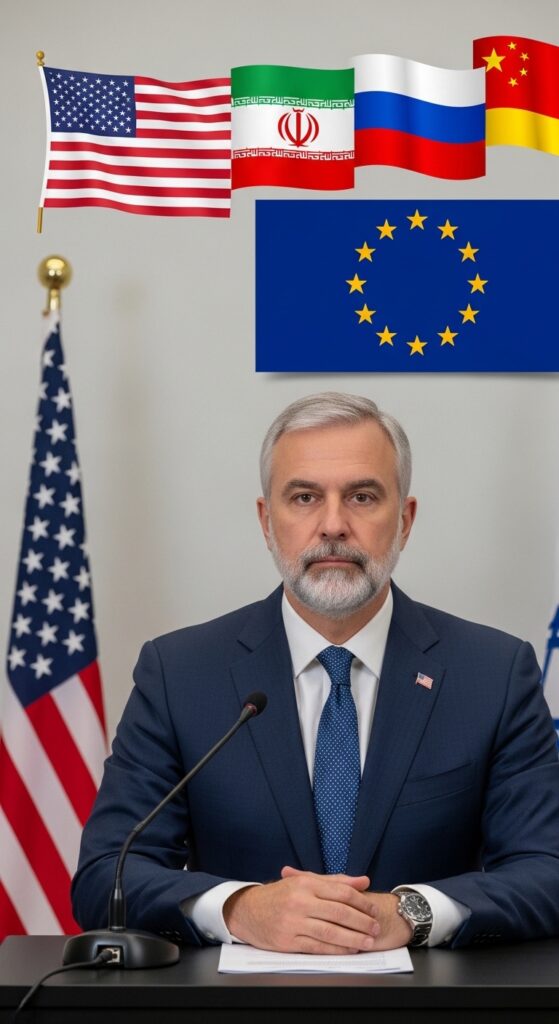
For much of the past year, the world has lived in a state of permanent alarm. Yet this week’s headlines feel different. They are not simply another set of crises stacked on top of old crises. They point to a possible turning point: a fragile moment in which diplomacy, war, markets, and political power are all moving at once, and in which a single miscalculation could either pull the international system back from the brink or push it into a deeper period of disorder. From the first direct U.S.-Iran talks in Islamabad to the sudden prospect of Israel-Lebanon negotiations, from renewed tariff escalation between Washington and Beijing to a shaky Easter truce in Ukraine, the story of the week is not that the world is calming down. It is that the world is testing whether calm is still possible.
The most dramatic development is in Pakistan, where American and Iranian officials have begun direct negotiations under the shadow of a ceasefire that remains deeply unstable. According to AP reporting, the talks in Islamabad are historic not only because of their visibility, but because they come after a war that has already killed more than 5,000 people across Iran, Lebanon, Israel and neighboring Gulf states. The U.S. delegation is led by Vice President JD Vance, while Iran is represented by Parliament Speaker Mohammad Bagher Qalibaf, with Pakistan playing host and countries such as China, Egypt, Saudi Arabia and Qatar involved as observers or facilitators. That diplomatic lineup alone tells us something important: this is no longer a regional dispute with global implications. It is already a global crisis being managed through a regional table.
What makes the Islamabad talks especially significant is that both sides appear to be negotiating from positions of mutual distrust rather than mutual confidence. Iran is reportedly pressing for compensation for war damage, access to frozen assets, sanctions relief, and guarantees connected to Israeli military activity and the Strait of Hormuz. The United States, meanwhile, is seeking restrictions tied to Iran’s nuclear and ballistic missile capabilities, as well as the reopening and stabilization of the waterway that remains one of the world’s most important energy chokepoints. These are not technical disagreements. They are competing definitions of what “peace” would even mean. Washington wants de-escalation without empowering Tehran; Tehran wants de-escalation without accepting a surrender narrative. That gap explains why even the fact of direct talks is historic, while the prospect of a durable settlement remains uncertain.
The central contradiction of the week is that diplomacy is advancing at the same time violence continues. AP reports that Israel has kept striking Hezbollah-linked targets in Lebanon even as negotiations over a broader regional ceasefire move forward. On Friday, at least 13 members of Lebanon’s State Security forces were killed in an Israeli strike in southern Lebanon, including in a government building in Nabatieh. Hezbollah responded with attacks of its own, including one targeting a naval base in Ashdod. Since the conflict reignited on March 2, at least 1,953 people in Lebanon have been killed in Israeli strikes, many during this week’s massive bombardment of Beirut. Those numbers matter because they reveal the political reality confronting negotiators: every new round of diplomacy is being shaped, and sometimes undermined, by military action on the ground.
That is why the possibility of direct Israel-Lebanon talks is such a remarkable, if still highly uncertain, subplot. AP and other coverage indicate that Prime Minister Benjamin Netanyahu has authorized direct negotiations with Lebanon focused on disarming Hezbollah and potentially establishing relations between the two neighbors. Even describing that possibility would have sounded unrealistic not long ago. Yet the proposal arrives amid continuing airstrikes, Lebanese demands for a ceasefire before meaningful talks, and open public anger inside Lebanon over any process seen as capitulation. In other words, the mere opening of talks is not evidence of peace. It is evidence that battlefield pressure, U.S. mediation, and regional exhaustion have combined to create a narrow diplomatic opening that none of the parties fully trust but none can afford to ignore.
The global economic reaction shows why the Middle East story is bigger than the region itself. Earlier this week, after President Donald Trump stepped back from threats of devastating strikes on Iran, oil prices fell below $95 a barrel and stock markets rallied sharply worldwide, with the Dow surging 1,300 points in one session. That was the market’s relief trade: investors briefly priced in the idea that the worst-case scenario—prolonged war around the Strait of Hormuz—might be avoided. But the relief is incomplete and probably temporary. AP also reports that the war’s earlier energy shock has already fed into inflation, with U.S. consumer prices rising 3.3% year-over-year in March, up from 2.4% in February, while monthly inflation hit 0.9%, the largest increase in nearly four years. In other words, even if diplomacy succeeds now, the economic cost of the crisis has already entered households, central-bank calculations and voter psychology.
This is what makes the current moment feel so volatile: geopolitics is no longer sitting outside the economy; it is driving it directly. Energy insecurity, shipping disruption and war risk are moving through inflation data almost in real time. When a ceasefire headline appears, markets jump. When a strike resumes, traders and governments immediately recalculate. The old separation between “hard security” and “economic news” has become almost meaningless. Whether one is looking at oil, freight, aviation fuel, monetary policy or consumer sentiment, the same conclusion emerges: military instability is now one of the world economy’s fastest transmission mechanisms.
At the same time, another destabilizing force is intensifying far from the battlefields: the trade confrontation between the United States and China. Recent reporting indicates that China has raised tariffs on U.S. goods to 125% in response to U.S. tariffs that now total 145% on many Chinese goods. Beijing has denounced the U.S. moves as economic bullying, vowed to continue retaliation, and signaled further legal and administrative responses, including complaints at the World Trade Organization and tighter controls around strategic trade items. This is no longer a standard tariff dispute about leverage at the negotiating table. At these levels, tariffs become a structural barrier, signaling that both powers are preparing for a longer era of managed economic hostility.
The consequences reach far beyond Washington and Beijing. A U.S.-China tariff spiral at these levels threatens to harden supply-chain fragmentation just as the world is already coping with war-driven energy shocks. Importers, manufacturers and consumers now face a double burden: security risk in key transport corridors and renewed costs in the world’s most important trading relationship. Even organizations tracking global trade more broadly have warned that protectionism and geoeconomic fragmentation are shaping commerce in 2026, with electronics helping sustain some growth even as uncertainty rises across sectors. That combination—war risk plus trade decoupling—may become the defining macroeconomic story of the year.
Europe, meanwhile, is again being reminded that its own security crisis is unresolved. AP reports that an Orthodox Easter ceasefire in Ukraine, declared for 32 hours, began this weekend but almost immediately came under strain. Ukrainian officials said Russian drone strikes continued after the truce took effect, even though artillery fire reportedly stopped in some sectors. Hours before the ceasefire, drone attacks killed civilians in Odesa and Kherson, and Ukraine said it intercepted 133 of 160 Russian drones overnight. The truce therefore carried two meanings at once: symbolically, it was notable because large-scale official pauses in the war have been so rare; operationally, it showed how fragile even a temporary halt remains after years of attritional fighting.
Still, the Easter ceasefire matters because it suggests that even the most entrenched wars can generate limited political openings when exhaustion and symbolism align. AP noted that a prisoner exchange also took place, with 182 Ukrainians returned, including 175 troops and seven civilians, while 175 Russian soldiers and several Russian civilians were also released. These exchanges do not prove that peace is near. But they do remind the world that even amid brutal conflict, communication channels survive where strategic trust does not. In that sense, the Ukraine truce and the Islamabad talks belong to the same global pattern: diplomacy is not replacing war, but threading itself through war in increasingly urgent ways.
Taken together, these stories reveal a world system that is trying to stabilize itself without having solved any of the underlying disputes. The U.S. and Iran are talking, but they are divided on the terms of peace. Israel and Lebanon may talk, but the battlefield remains active. Russia and Ukraine observed the outline of a truce, but not its full substance. The United States and China are not moving toward détente but toward more explicit economic confrontation. What links all these theaters is not resolution. It is brinkmanship with negotiation layered on top. Leaders increasingly appear to understand the cost of uncontrolled escalation, yet remain unwilling—or politically unable—to make the concessions required for a lasting settlement.
There is also a deeper political lesson in this week’s news: domestic calculations are shaping international choices more than ever. In Washington, inflation and fuel prices turn distant conflicts into immediate political risks. In Tehran, demands over sanctions and frozen assets reflect regime survival as much as national strategy. In Israel and Lebanon, negotiations are constrained by public trauma, military logic and questions of legitimacy. In Kyiv and Moscow, even a religious holiday truce becomes a test of narrative control as much as humanitarian relief. The age of cleanly separated foreign and domestic policy is over. Every international move is now made with one eye on the front line and the other on the home front.
So what should the world watch next? First, whether the U.S.-Iran channel produces a framework strong enough to hold beyond symbolism. Second, whether Israel-Lebanon contacts can progress without being overwhelmed by fresh strikes. Third, whether energy markets continue to stabilize or snap back upward at the first sign of collapse. Fourth, whether the U.S.-China tariff war spreads into broader restrictions on technology and critical materials. And fifth, whether the Easter pause in Ukraine leads to any further humanitarian or negotiating mechanism, however limited. None of these questions has a comfortable answer today. But together they define the real breaking news of this moment: not just what happened this week, but whether the international system still possesses enough diplomatic muscle to prevent every crisis from becoming a global one.
For now, the world is living in an in-between hour. War has not ended. Trade conflict is not easing. Trust is scarce. Yet talks are happening, prisoners are being exchanged, and governments that only recently threatened catastrophic escalation are now experimenting with restraint. That is not peace. But it is more than paralysis. The danger, and the opportunity, is that history often turns in such narrow spaces. This week’s headlines show a world still balanced between escalation and accommodation. What happens next may determine not only the direction of the next news cycle, but the shape of global order for the rest of 2026.
