The splashdown may mark the end of a lunar flight, but for astronauts returning from deep space, one of the most closely watched phases begins only after they are back on Earth: the physical tests, medical checks and reconditioning work needed to prove that the body can readapt to gravity.
To the public, the return from a Moon mission tends to culminate in a single cinematic image: the capsule descending under parachutes, the recovery teams approaching through the ocean spray, and astronauts emerging to waves of applause after days in space. But for flight surgeons, physiologists and rehabilitation specialists, that moment is less a finale than a handoff. The mission may be over, yet the human body is only starting its most immediate negotiation with gravity.
That reality has come back into sharp focus with NASA’s Artemis II crew, whose successful return from a lunar flyby has reopened a chapter of human exploration that had been dormant for more than half a century. Their flight around the Moon was historic, but the period after splashdown is scientifically important in a different way. It is when doctors and performance specialists begin measuring how a crew that has spent days in microgravity responds to Earth’s pull again — and how quickly strength, balance, coordination and stamina can be restored.
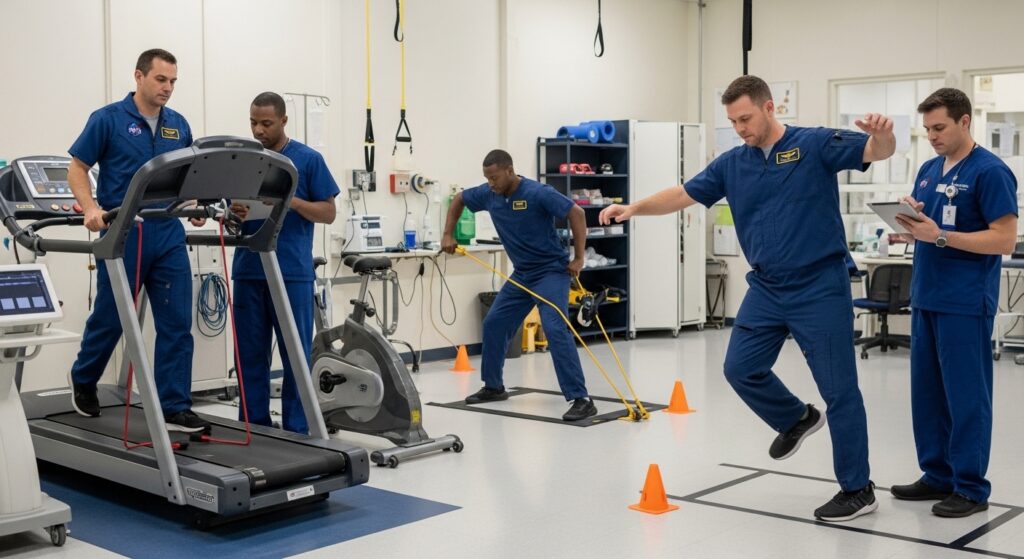
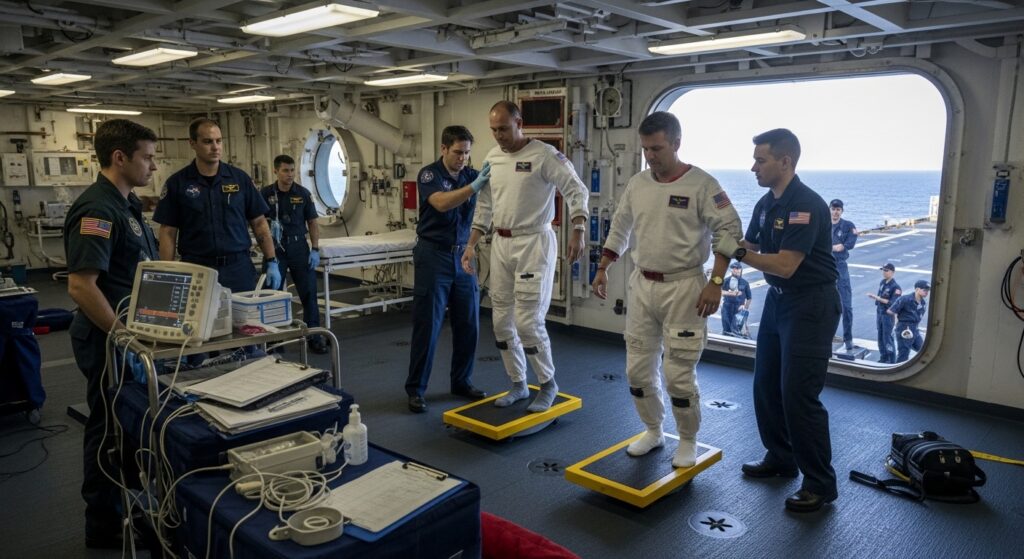
The phrase “fitness test” can sound almost casual, as if astronauts were simply heading into a gym after a long trip. In practice, the post-mission process is far more structured. NASA’s recovery sequence begins almost immediately after landing, with the crew extracted from Orion and transported to the USS John P. Murtha for medical evaluations before their return to Johnson Space Center in Houston. From there, the work shifts into a broader reconditioning framework: a mix of assessment, supervised exercise, monitoring and gradual retraining designed to restore full performance without pushing the body too hard, too fast.
That matters because even relatively short space missions can alter how the body functions. In weightlessness, the muscles used for standing and walking do not work in the same way they do on Earth. Fluids redistribute upward. The vestibular system — the network that helps control balance and spatial orientation — adapts to an environment where “up” and “down” lose much of their meaning. The cardiovascular system, too, adjusts to life without gravity pulling blood toward the legs. When astronauts return home, those adaptations can leave them feeling physically capable in one moment and unexpectedly unsteady in the next.
NASA’s own descriptions of post-flight reconditioning show how broad the challenge is. The early emphasis is not on heroic feats, but on fundamentals: basic ambulation, cardiovascular endurance, muscular strength, balance, flexibility and proprioception, the body’s sense of where it is in space. These are the building blocks of ordinary movement on Earth, and yet they become areas that must be measured with unusual care after spaceflight. Astronauts may have completed a technically flawless mission, but they still need to prove that the body is reacquiring old reflexes.
That does not mean the Artemis II crew are expected to face the same level of physical re-adaptation seen in astronauts returning from six months aboard the International Space Station. Duration matters. Long stays in orbit tend to produce more pronounced muscle and bone loss, deeper cardiovascular deconditioning and more persistent readjustment challenges. A roughly 10-day lunar mission is different. But “different” does not mean medically trivial. Artemis II flew humans farther from Earth than any mission since Apollo, and it still exposed the crew to days of microgravity, confinement, sleep disruption, demanding schedules and the stresses of deep-space travel.
What makes the post-mission phase especially important now is that Artemis is not a one-off symbolic program. NASA is trying to build a sustained pathway back to the Moon. That means the agency is not only interested in whether astronauts can survive the trip out and back. It needs detailed evidence about how quickly they recover, what systems show strain, how rehabilitation should be tailored, and what those lessons imply for future missions that could be longer, more operationally complex and eventually surface-based. Each balance test, strength assessment and cardiovascular check contributes to a larger database that future lunar planning will depend on.
The body’s readjustment is also more subtle than popular imagination often suggests. NASA astronauts who have described returning from orbit speak not only about weakness or fatigue, but about a strange reacquaintance with heaviness. Hard chairs feel harder. The head feels weightier. Simple movements can seem oddly deliberate. The brain, having adapted to microgravity, must relearn how to trust signals from the inner ear and muscles in a gravitational environment. That is why post-flight recovery is not just about fitness in the narrow athletic sense. It is about sensorimotor reintegration — teaching the body and brain to work together smoothly again under terrestrial conditions.
For specialists, those first hours and days are invaluable. They offer a rare look at what changes occurred despite in-flight exercise countermeasures and medical monitoring. They also reveal which systems recover quickly and which require more guided work. A crew member may appear outwardly well while still showing subtle deficits in coordination, postural control or orthostatic tolerance, the body’s ability to manage standing upright without dizziness or blood pressure problems. Post-mission testing is designed to catch those details before they become bigger issues.
There is also a practical reason the process is taken seriously. Astronauts are not ordinary travelers coming home from an exhausting itinerary. They are mission-critical personnel who may be needed for debriefings, technical reviews, public appearances and eventually future assignments. NASA’s rehabilitation framework therefore aims not only to restore comfort, but to return astronauts to a dependable level of function and fitness without risking injury during the transition back. The temptation to “feel normal” quickly can itself become a hazard if the body is pushed faster than it has readapted.
This is one reason post-flight reconditioning is described as individualized. Two astronauts can fly the same mission and still recover at different rates. Age, training history, physiology, prior flight experience and the small variations of how each body adapts to microgravity all matter. One astronaut may struggle more with balance, another with cardiovascular endurance, another with muscular stiffness or fatigue. The testing that follows a lunar mission is therefore not just pass-or-fail. It is diagnostic. It helps specialists decide what each astronaut needs and how fast that support should progress.
For Artemis II, the symbolism of that process is especially rich. These astronauts have just restored a human route around the Moon for the first time since 1972. Yet their first challenge back on Earth is profoundly ordinary: stand steadily, walk smoothly, recover strength, and readapt to the world’s gravity. In that contrast lies something essential about exploration. Spaceflight is often narrated through rockets, records and distances. But its success depends equally on the resilience of the human body and on the systems built to protect it before, during and after the mission.
It also underscores a truth that will matter even more as lunar exploration expands. The hardest part of a space mission is not always the launch or the re-entry. Sometimes it is the biological negotiation that follows, when the body must transition from one environment to another and prove it can do so repeatedly. If future crews are to orbit the Moon regularly, work on or near its surface, and eventually venture farther into deep space, the path will run through rehabilitation labs and recovery protocols as surely as it runs through launch pads.
So when astronauts prepare for fitness tests after a Moon mission, they are doing more than checking boxes on a medical chart. They are generating evidence for the next mission, and the one after that. They are helping NASA understand how deep-space travel reshapes human performance, and how that performance can be rebuilt safely on return. The public sees the splashdown. The agency sees what comes next: a measured return to gravity, step by tested step.
That is why the post-mission image matters almost as much as the launch image. One shows humanity leaving Earth. The other shows what it takes to come home and be ready to go again.