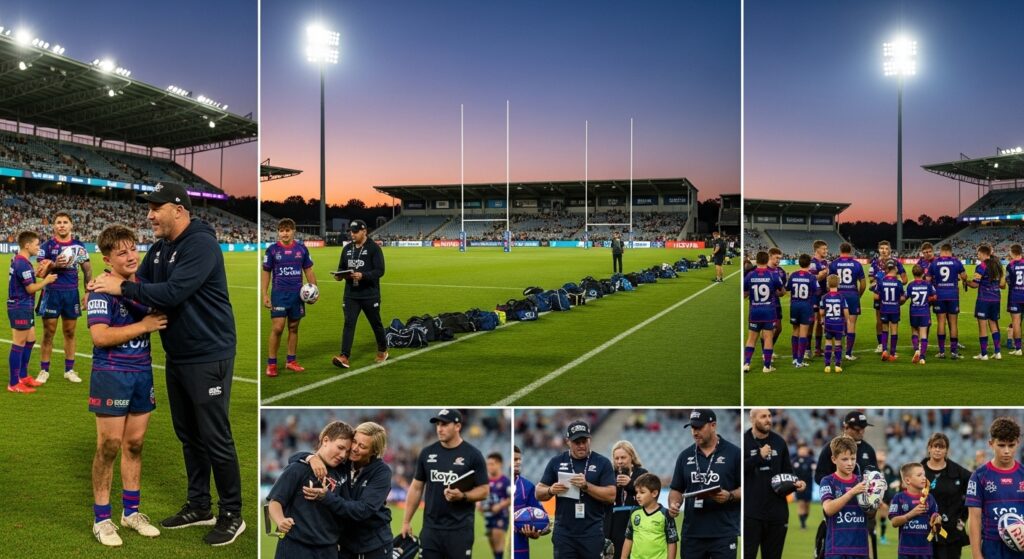
At Kayo Stadium in Redcliffe, a triple-header of Queensland junior representative deciders has turned Australia’s youth rugby league season into a showcase of rising talent, regional pride and the increasingly high-stakes business of elite player development.
Australian rugby league has long treated its junior pathways as more than a feeder system. They are scouting grounds, identity markers and, increasingly, public spectacles in their own right. This weekend’s Queensland Rugby League junior representative grand final day at Kayo Stadium in Redcliffe captured that shift in vivid form, with three title matches compressed into one high-intensity program and a growing sense that youth rugby league is no longer operating quietly in the shadow of the senior game.
The schedule alone explains why the occasion has drawn such attention. Queensland Rugby League confirmed that the Harvey Norman Under 17s grand final, the Cyril Connell Cup decider and the Harvey Norman Under 19s grand final would all be staged at Kayo Stadium on April 11, 2026, turning one suburban ground north of Brisbane into the center of a statewide finals day. The Under 17s final brought together Townsville Blackhawks and Burleigh Bears. The Cyril Connell Cup featured Wynnum Manly Seagulls against Norths Devils. The Under 19s grand final paired Souths Logan Magpies with Brisbane Tigers. It was not one championship match but a concentrated demonstration of the pathway system itself.
What makes these fixtures feel “explosive” is not simply the quality of the football. It is the density of ambition around them. Every player is trying to win a title, but many are also competing for something less visible and potentially more consequential: reputation. Queensland’s junior representative competitions are watched closely by clubs, recruiters and development staff because they offer one of the clearest views of which athletes are ready to move into deeper elite systems. A strong finals performance can reshape perception quickly. In youth sport, the grand final is not just a finish line. It is often an audition.
The matchups themselves underline how broad that talent base has become. In the Harvey Norman Under 17s decider, Townsville Blackhawks and Burleigh Bears arrived through different routes but with the same reward in view. In the Cyril Connell Cup, Wynnum Manly and Norths Devils advanced after semi-final victories that confirmed both clubs’ strength in the under-17 boys’ system. In the Under 19s competition, Souths Logan Magpies and Brisbane Tigers emerged as the last two teams standing in a female pathway competition that has become one of the clearest signs of rugby league’s continued expansion among young women.
That last point matters. The growth of female junior representative rugby league is one of the most important structural changes in the Australian game. The Harvey Norman Under 17s and Under 19s competitions are no longer peripheral additions to a male-dominated calendar. They are now central parts of the sport’s development architecture, creating earlier visibility for players who may later progress into state pathways, NRLW-linked systems and senior representative football. By placing these finals on the same marquee day as the Cyril Connell Cup, QRL is making an unmistakable statement about where the women’s and girls’ game now sits in the broader order of importance.
There is also a geographic story embedded in the grand final day. Rugby league in Queensland has always drawn strength from regional identity as much as metropolitan muscle, and the finalists reflected that tradition. Townsville’s presence in the Under 17s final brought North Queensland representation to the stage. Burleigh carried the Gold Coast banner. Wynnum Manly, Norths, Souths Logan and Brisbane Tigers ensured southeast Queensland’s major development corridors were heavily represented. The effect is one of layered rivalry: club against club, region against region, system against system.
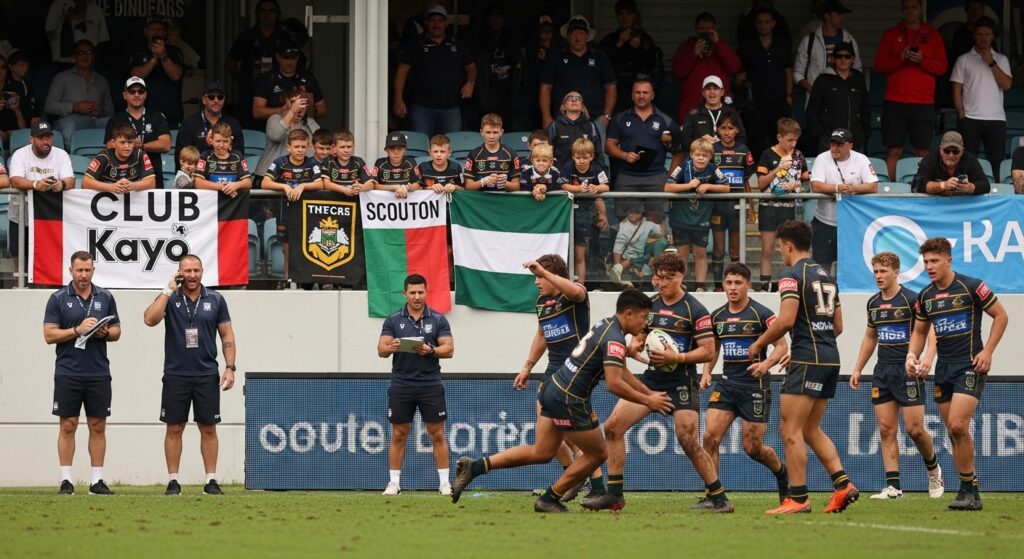
Kayo Stadium, though modest compared with the major venues of the NRL, is part of the story too. A junior finals day in a ground like this feels close to the sport’s developmental core. Families, academy staff, former players, local officials and talent scouts share the same space, and that proximity gives the matches a particular intensity. These are not anonymous youth games played behind closed fences. They are communal events in which every error is louder, every break more visible and every standout player harder to ignore.
The wider Australian youth rugby league calendar helps explain why the moment feels bigger than one afternoon in Redcliffe. In New South Wales, junior representative grand finals had already delivered decisive outcomes in late March, with Macarthur Wests Tigers beating Northern Rivers Titans 40-22 in the Laurie Daley Cup and defeating Newcastle-Maitland Region Knights 26-16 in the Andrew Johns Cup. Those results, published by NSWRL, reinforced the same message visible in Queensland: the junior rep system is producing its own narratives, its own fan interest and its own club prestige independent of the senior competitions they eventually feed.
That rise in attention reflects a broader shift in how the sport markets its pipeline. For years, junior development was treated primarily as internal business, important to clubs but largely invisible to the wider public. That is changing. Team-list announcements, dedicated match centers, finals scheduling and pathway coverage are now being packaged as part of rugby league’s public-facing product. The audience may still be smaller than for the NRL, but the logic is clear. If the professional game increasingly depends on homegrown talent and long-term retention, then the pathway system itself becomes worth showcasing.
There is an economic logic to that visibility as well. Developing players internally is cheaper and often more culturally sustainable than relying on external recruitment. Strong junior systems give clubs continuity, identity and leverage. They also reduce some of the uncertainty associated with late-stage talent acquisition. A finals day such as the one in Redcliffe therefore matters beyond sentiment. It is part of the sport’s long investment cycle, where junior competitions serve not only as community events but as infrastructure for future performance.
Still, what gives youth finals their distinctive power is not administration. It is atmosphere. Even when the crowd is smaller than at a professional match, the emotional temperature can be unusually high because so much is compressed into each moment. Parents have driven children across regions for years to reach this point. Coaches have spent months shaping combinations that may soon break apart as players age into new levels. Teammates know that some of them will stay together while others will drift into different systems, schools or clubs. Youth grand finals carry a particular tension because they are both arrival and departure.
That emotional mix is visible in the details: the urgency of warm-ups, the noise from benches, the long embraces after the final whistle, the scouts scribbling notes, the younger siblings watching from railings. It is one of the few levels of organized sport where the professional future and the community present sit so close together. The players are near enough to elite rugby league to sense what it might look like, but still close enough to grassroots life that the people who helped carry them there remain at the center of the occasion.
For Australian rugby league, that may be why these youth finals increasingly resonate. They represent the sport in miniature: intensely local, fiercely competitive, development-driven and emotionally legible. The players are not yet national stars, but the structures around them already resemble the larger game. What unfolds in Redcliffe is therefore not just a junior event. It is a glimpse of the next layer of the sport taking shape in public.
Calling the Australian youth rugby final scene “explosive” is not mere hype. The energy is real, but so is the significance. Finals day in Queensland, together with the junior representative title matches already completed in New South Wales, shows that the pathway system is no longer an afterthought. It has become one of the most dynamic parts of the rugby league calendar, where performance, identity and future opportunity collide under the brightest lights these young players have yet seen.