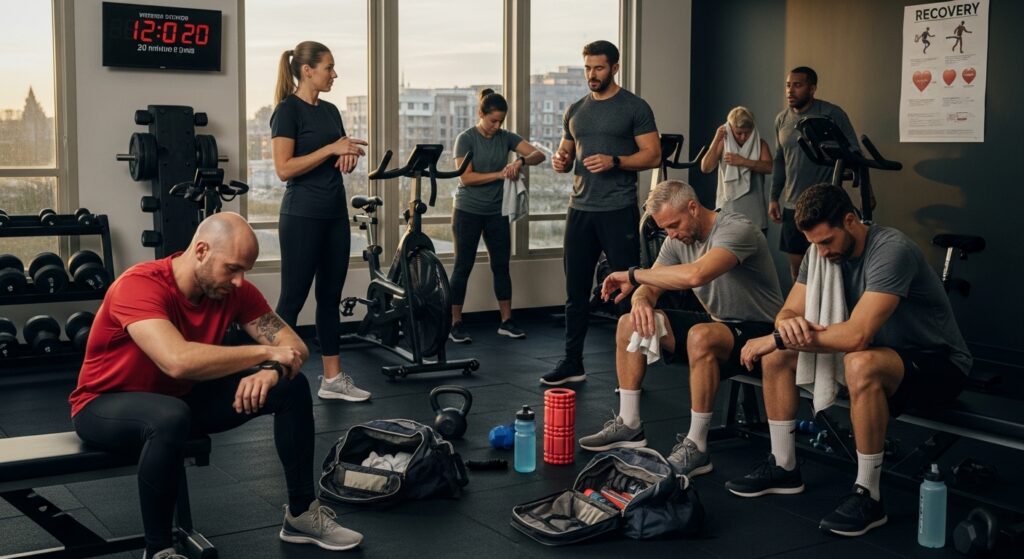
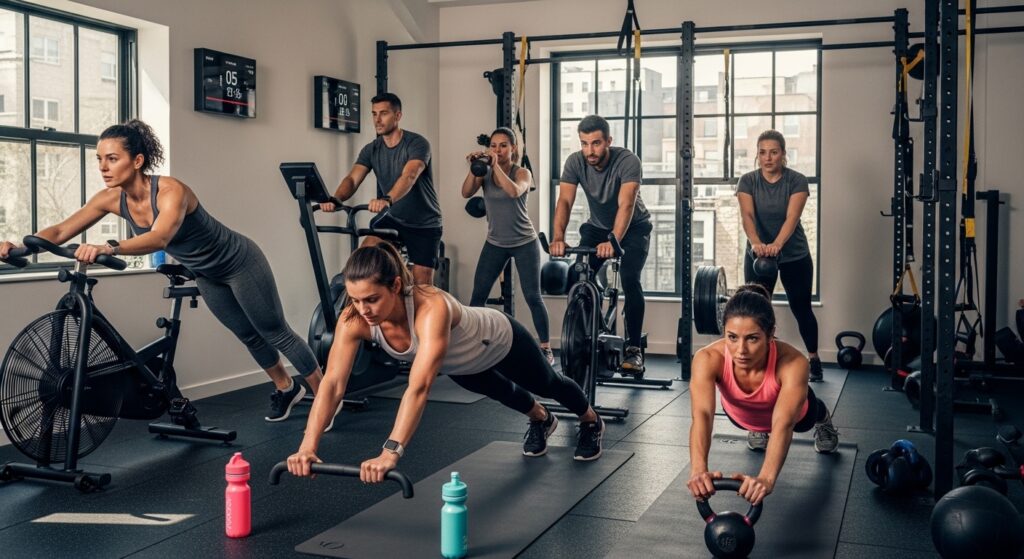
As busy schedules, wearable data and demand for efficient exercise reshape wellness culture, high-intensity interval training is returning to the center of the global fitness conversation.
For years, the promise of exercise was often sold in long blocks of time: an hour at the gym, a 10-kilometer run, a carefully scheduled class after work. But in a world increasingly shaped by crowded calendars, digital fatigue and a growing obsession with efficiency, the modern fitness ideal is being rewritten. The new aspiration is not necessarily to train longer. It is to train smarter, harder and in less time. That is one reason high-intensity interval training, better known as HIIT, is once again taking center stage.
The method is simple in theory and demanding in practice. HIIT alternates short bursts of vigorous effort with brief recovery periods. A workout might last 10, 15 or 20 minutes, but within that compressed window it asks the body to work near its upper limits. The appeal is immediate and obvious. For people who feel squeezed by work, family obligations and screen-heavy routines, HIIT offers a seductive proposition: meaningful fitness returns without surrendering an entire evening.
That proposition has helped keep HIIT firmly embedded in the global fitness industry. Even as wearable devices, health apps and data-driven coaching climb the rankings of professional trend reports, HIIT remains one of the most recognizable and durable training formats in the market. Its staying power says something important about the current moment. Consumers do not simply want exercise that works. They want exercise that fits. In an era when convenience can determine whether a healthy habit survives, time efficiency has become one of the most powerful selling points in fitness.
Yet the rise of HIIT is not only about convenience. It is also about psychology. Short workouts can feel more approachable than long ones, even when they are physically demanding. For many people, the barrier to exercise is not effort itself but the anticipation of a long commitment. A 15-minute session looks manageable. It can be inserted between meetings, before school pickup, during a lunch break or at the edge of a crowded morning. That practical flexibility has made HIIT especially attractive to urban professionals, parents, students and anyone trying to preserve health inside an overbooked life.
Technology has amplified the trend. Fitness watches, heart-rate monitors and smartphone apps have made interval training easier to structure, track and personalize. A user no longer needs a coach with a stopwatch to guide effort and recovery. Their wrist can do it. Real-time heart-rate zones, calorie estimates, readiness scores and recovery prompts have made the intensity legible, turning discomfort into measurable progress. For many users, that data provides motivation. The workout may be short, but the numbers make it feel tangible and serious.
This has helped HIIT migrate far beyond boutique studios and elite athletic circles. It now lives in hotel gyms, living rooms, app subscriptions, school training programs and corporate wellness packages. It is performed on treadmills, bikes, rowing machines and tracks. It is also built into bodyweight sessions requiring little more than floor space and determination. In an age of economic caution, that versatility matters. HIIT can be marketed as premium, but it can also be done cheaply, quickly and almost anywhere.
Science has played a central role in sustaining its popularity. Over the past decade, study after study has suggested that interval-based exercise can improve cardiorespiratory fitness, insulin sensitivity and other markers of health, often in less time than traditional steady-state exercise. That does not mean longer, moderate exercise has become obsolete. Far from it. Walking, cycling, swimming and strength training remain foundational for broad public health. But HIIT has benefited from a growing body of evidence suggesting that short, vigorous sessions can produce meaningful gains, particularly for people looking to improve cardiovascular fitness efficiently.
That efficiency matters because inactivity remains one of the world’s most stubborn health problems. Large shares of adults and an overwhelming proportion of adolescents still fail to meet recommended activity levels. Against that background, the appeal of HIIT becomes easier to understand. Public health messages have long struggled against the perception that exercise requires large amounts of time, money and access. HIIT disrupts that assumption. It tells people that exercise can be compressed. It lowers one psychological barrier, even if it raises the physical intensity of the work itself.
There is also a cultural element to HIIT’s revival. Fitness culture is moving away from a narrow fixation on aesthetics alone and toward a broader interest in performance, metabolic health and energy management. Many people are less interested in simply looking fit than in feeling capable: climbing stairs without fatigue, improving heart health, maintaining weight, reducing stress and aging with strength. HIIT fits comfortably into that shift because it is often framed not as appearance training but as functional conditioning. It promises stamina, resilience and measurable adaptation.
Social media has, predictably, accelerated the movement. Short-form video platforms are ideal for workout formats that can be demonstrated in under a minute and completed in under 20. Trainers can package HIIT into clean, repeatable routines with dramatic claims of efficiency. That visibility has helped normalize the idea that a serious workout does not need a long runtime to count. But it has also introduced a problem. Online HIIT is often sold at maximum intensity, stripped of context and tailored to attention spans rather than safety. In the hands of a skilled coach, interval training can be scaled intelligently. On the internet, it is often flattened into punishment.
That distinction matters. HIIT is effective, but it is not magical. Nor is it appropriate in the same way for everyone. Beginners, older adults, people returning after illness, and those with cardiovascular, musculoskeletal or metabolic conditions may need modified intervals, longer recovery periods or medical guidance before attempting vigorous sessions. The risk is not that HIIT is inherently dangerous, but that its branding encourages excess. When “harder” becomes the entire message, people may ignore the fundamentals of progression, technique and recovery that make exercise sustainable.
The most successful fitness professionals are responding by softening the edges of the concept without abandoning its core value. They are building interval workouts that are challenging but scalable, intense but not reckless. They use cycling, brisk incline walking, rowing, kettlebell circuits or low-impact movement patterns to adapt the format across ages and abilities. Some even avoid the HIIT label altogether, preferring language such as interval conditioning or cardio intervals to reduce the pressure associated with all-out effort. What remains constant is the structure: alternating challenge and recovery in a way that respects limited time.
The return of HIIT also says something about modern attention itself. Many people now organize daily life in compressed bursts of focus, fragmented by alerts, obligations and digital interruptions. In that environment, the appeal of concentrated exercise mirrors the logic of the broader culture. HIIT feels native to the age of optimization. It is efficient, measurable and intense. It offers the satisfaction of completion in a short span. For some, that is empowering. For others, it risks turning movement into yet another productivity contest.
That tension will shape the next phase of the trend. If HIIT continues to grow, it will likely do so not as a solitary fitness revolution but as part of a broader ecosystem that includes wearables, recovery tools, strength work and personalized programming. The future of interval training may be less about punishing boot camps and more about precision: the right dose of intensity, for the right person, at the right time. That approach is more nuanced than the old no-excuses slogans, but it may also be more durable.
In the end, HIIT is rising because it answers a question modern life keeps asking: how can people protect their health when they feel they have no time left to give? Its popularity reflects both a practical need and a cultural mood. People want results, but they also want efficiency. They want structure without long commitments, intensity without logistical friction, and workouts that fit into ordinary life rather than requiring life to be reorganized around them.
That does not make HIIT the only path to health, and it should not be treated as one. But its renewed momentum is no accident. In a crowded, accelerated world, short but effective training has become more than a method. It has become a philosophy of survival.