
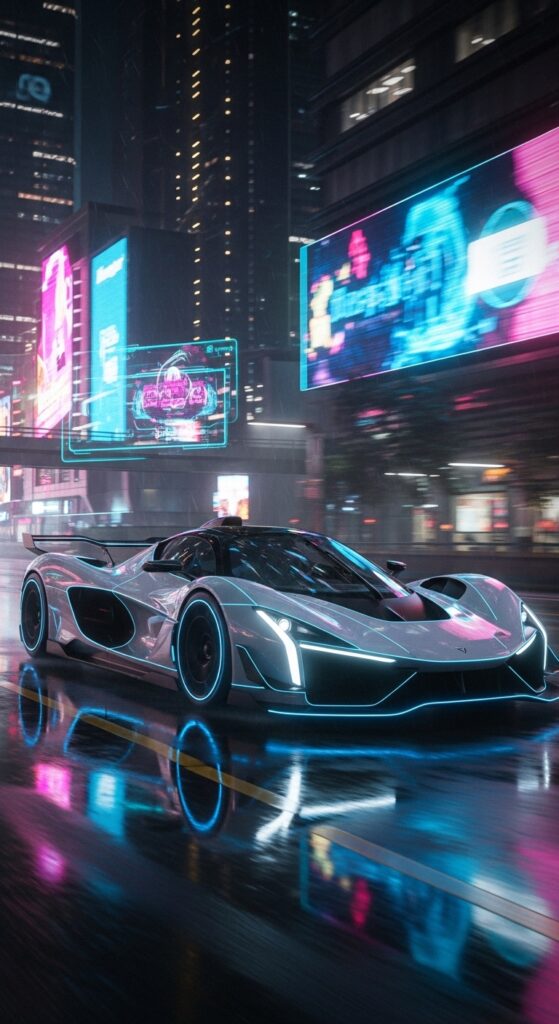
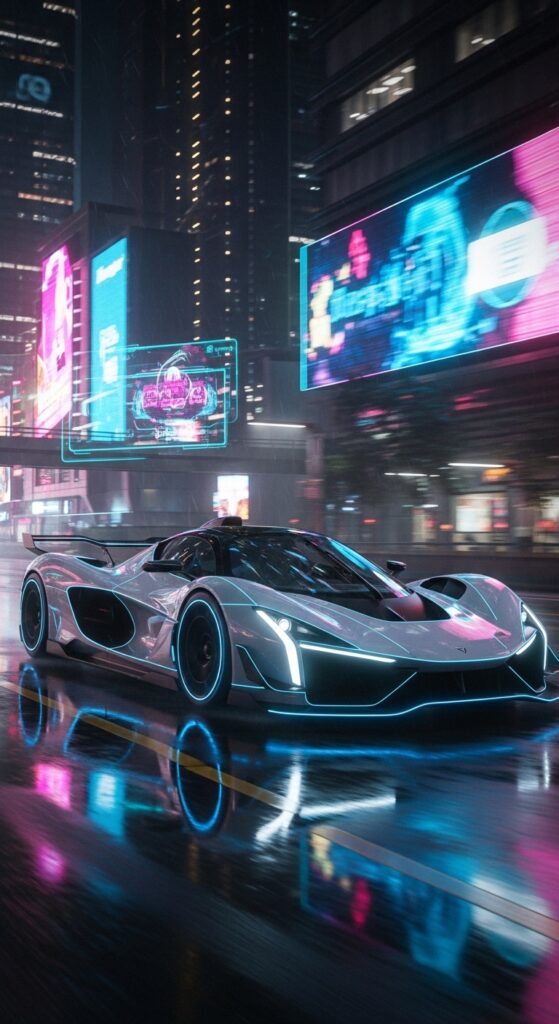
In the imagination of the modern world, few symbols are as powerful as the supercar. It represents freedom, wealth, engineering brilliance, and the eternal human hunger for speed. In the universe of cyberpunk, however, the supercar becomes something even more intense. It is no longer simply a machine built for performance. It is a statement of identity in a world ruled by neon lights, artificial intelligence, hyper-surveillance, corporate power, and the blurred boundary between man and machine. A cyberpunk supercar is not just a vehicle. It is a weapon, a fashion object, a mobile command center, and a mirror reflecting the anxieties and dreams of the future.
The idea of a cyberpunk supercar emerges naturally from the larger cyberpunk genre. Cyberpunk has always imagined societies where technology evolves faster than morality. Towering megacities glow under endless rain. Holographic advertisements fill the sky. Human bodies are enhanced with implants, data flows through every surface, and the gap between the rich and the poor grows wider than ever. In such a world, transportation must evolve as well. A normal car would feel too ordinary, too mechanical, too bound to the old world. The cyberpunk supercar must embody the chaos and glamour of its environment. It needs to look like it was designed in a secret laboratory, tested in illegal night races, and customized by someone who lives outside the law.
Visually, the cyberpunk supercar is unforgettable. Its silhouette is low, aggressive, and sculpted like a blade. Traditional curves are replaced by hard edges, aerodynamic channels, illuminated body panels, and surfaces that seem alive under artificial light. The paint is rarely simple. Matte black, reflective chrome, deep violet, electric blue, and glowing crimson dominate its palette. Neon strips run along the frame like circuits. Transparent panels reveal glimpses of machinery beneath the surface. Wheels may be partially enclosed for aerodynamic efficiency, while active spoilers shift automatically depending on speed, weather, or threat level. Every angle of the car suggests movement even when it is standing still.
Light plays a central role in the identity of this machine. In the cyberpunk city, light is language. It communicates status, danger, allegiance, and mood. A cyberpunk supercar uses programmable illumination not only for visibility but for self-expression. Its headlights can narrow into predatory slits. Its underglow can pulse with biometric rhythms. Emergency signals can transform the car into a flashing phantom in dark alleys or elevated highways. In more advanced versions, the body itself may contain reactive smart materials capable of changing color, texture, or reflectivity in response to environment and command input. The car becomes a digital skin stretched over mechanical muscle.
Yet aesthetics alone do not define the cyberpunk supercar. Its engineering must match its appearance. The powertrain of such a vehicle would likely move beyond the internal combustion engine, not only because of environmental pressure but because cyberpunk worlds tend to embrace radical, high-density energy technologies. One version might run on ultra-compact solid-state batteries delivering instant torque and near-silent acceleration. Another might use hydrogen cells or experimental synthetic fuels for long-range urban combat and highway pursuit. More extreme concepts could imagine micro-turbine hybrids or illegal black-market energy cores stolen from military supply chains. In every version, acceleration is savage, response is immediate, and the experience feels more like launching than driving.
Artificial intelligence would transform the cyberpunk supercar into something closer to a partner than a machine. Unlike today’s driver assistance systems, future onboard AI would not merely help with parking or lane keeping. It would monitor traffic flows, scan surveillance networks, identify threats, calculate escape routes, optimize energy usage, and even adapt the car’s handling to the psychology of its driver. A skilled operator might switch between multiple AI modes: stealth mode for avoiding detection, pursuit mode for high-speed chases, combat mode for hostile environments, and luxury mode for gliding through elite districts in silence and style. The car could speak, negotiate with traffic infrastructure, forge digital credentials, or hack hostile drones attempting to track it.
The cockpit of the cyberpunk supercar would also reflect the merger of human and machine. Instead of a dashboard filled with separate buttons and gauges, the interior would function as an immersive digital environment. Augmented reality displays project navigation, threat analysis, biometric feedback, and communication streams directly onto the windshield or contact-lens-linked interface. The steering wheel may retract when autonomous mode activates. Seats would contain adaptive materials that change shape for comfort or lateral support during high-speed maneuvering. Haptic controls built into the doors, console, and seat fabric would replace many conventional switches. For drivers with neural implants, the highest-end models might respond partly to thought commands, reducing the delay between intention and mechanical execution to almost nothing.
Comfort in a cyberpunk supercar would not resemble traditional luxury. It would be a different kind of luxury: immersive, intelligent, and deeply personalized. Climate systems would not simply cool or heat the cabin, but analyze stress, fatigue, and environmental toxins. Sound systems would create individualized acoustic zones, allowing the driver to hear tactical alerts while passengers listen to music or encrypted communications. Air filtration could defend against polluted city atmospheres. Security layers would include facial recognition, DNA verification, anti-tamper shells, and EMP-resistant shielding. In dangerous districts, the cabin would serve as a cocoon of technological privilege moving through urban decay.
Of course, the cyberpunk supercar is also shaped by the politics of the world around it. In classic cyberpunk fiction, the future is unequal. Massive corporations dominate public life, governments are compromised, and the streets belong to gangs, smugglers, mercenaries, and hackers. In such an environment, vehicles are social symbols. A corporate executive’s supercar would differ from a street racer’s machine not just in branding but in philosophy. Corporate models would be pristine, armored, networked to private security grids, and saturated with proprietary software. Street-built versions, by contrast, would be hacked, modified, stripped down, overclocked, and unpredictable. One is designed for control. The other is designed for survival and rebellion.
This contrast makes the cyberpunk supercar especially fascinating. It can belong equally to the elite and the outlaw. In the hands of the rich, it becomes a jewel of advanced capitalism, a rolling fortress that demonstrates absolute access to the best technology money can buy. In the hands of the underground, it becomes an act of resistance: stolen code, illegal modifications, counterfeit components, and custom AI stitched together to outperform official systems. This tension lies at the heart of cyberpunk itself. Technology is never neutral. It can liberate, oppress, entertain, seduce, or destroy depending on who controls it.
Popular culture has already given us many fragments of the cyberpunk supercar vision. Films, anime, video games, and concept art repeatedly return to the image of sleek, neon-drenched vehicles cutting through futuristic streets. These machines are often shown drifting through rain-soaked intersections, flying between skyscrapers, or waiting under flickering signage in forgotten industrial districts. Even when they are not central to the story, they enrich the atmosphere by suggesting a world in motion. They tell us that this society values speed, style, and technological intimidation. The vehicle becomes part of the world-building, as essential as the skyline or the soundtrack.
What makes the cyberpunk supercar so compelling is that it feels both fictional and strangely possible. Many of its features are already emerging in primitive form. Electric drivetrains now deliver astonishing acceleration. AI-based driver assistance grows more capable each year. Augmented reality interfaces, biometric systems, smart materials, and over-the-air software updates are no longer fantasy. Urban architecture increasingly resembles the dense, illuminated environments once imagined only in fiction. Designers across automotive, gaming, and fashion industries are drawn to sharp geometries, dramatic lighting, and machine-human fusion aesthetics. The cyberpunk supercar may not exist as a complete package yet, but the future is assembling its components piece by piece.
Still, the dream of such a machine raises questions beyond engineering. Would a cyberpunk supercar be a triumph of creativity or a symptom of excess? Would it represent freedom in a controlled world, or merely a luxury toy for those who profit from inequality? Could a car that is constantly connected, intelligent, and upgradeable ever truly belong to its driver, or would ownership be replaced by subscription, corporate lock-in, and remote control? Cyberpunk fiction warns us that the most advanced devices often come with invisible chains. The same AI that protects you could monitor you. The same network that guides your route could trap you. The same customization system that expresses your individuality could be monetized, restricted, or weaponized.
That paradox is why the cyberpunk supercar is more than an attractive design concept. It is a cultural object loaded with meaning. It captures our excitement about the future while exposing our fears about who gets to shape it. We imagine these vehicles racing through impossible cities because we are fascinated by power, but also because we sense the instability of a world driven by speed and innovation alone. The cyberpunk supercar is thrilling precisely because it exists on the edge between aspiration and warning.
There is also something deeply emotional about the idea. Cars have always carried symbolic weight. They are extensions of personality, expressions of taste, and private spaces in public landscapes. In a cyberpunk world, where identity itself may be fragmented by digital life, surveillance, and augmentation, a supercar becomes one of the few places where a person can still feel singular. It becomes a chosen shell, a moving room, a personal myth. Whether driven by a corporate heir, a renegade hacker, or a mercenary escaping the city before dawn, the vehicle tells a story about who that person is and how they survive.
From a design perspective, the cyberpunk supercar challenges creators to think beyond traditional automotive categories. It asks what happens when vehicle design merges with architecture, software, fashion, and speculative politics. It invites experiments with asymmetry, illuminated surfaces, active morphing components, and interfaces that treat the driver not as an operator but as part of the machine. It also encourages designers to imagine cities, roads, and social systems that justify such a vehicle. A true cyberpunk supercar cannot be fully understood in isolation. It belongs to a networked ecosystem of smart streets, surveillance drones, energy markets, criminal economies, and digital identities.
Looking ahead, the real-world automotive industry may never produce a pure cyberpunk supercar in the exact form imagined by fiction. Safety laws, infrastructure limits, cost, and public regulation will shape what becomes possible. Yet elements of the dream will continue to influence design language, performance engineering, and user experience. Future concept cars will grow more theatrical. Digital lighting will become more expressive. AI will become more integrated. Customization will become more software-driven. Cabins will evolve into intelligent environments rather than simple control spaces. The road to the cyberpunk supercar may not be direct, but it is already visible.
Ultimately, the cyberpunk supercar endures because it condenses a whole future into one object. It is beauty sharpened into aggression, luxury fused with code, mobility transformed into identity. It belongs to a world of contradictions: dazzling but unequal, advanced but unstable, connected but lonely. To imagine such a vehicle is to imagine ourselves in that world, gripping a wheel or thought-linked interface, neon reflecting across glass and steel, the city unfolding ahead like a circuit board at midnight.
In that moment, the cyberpunk supercar is not just transportation. It is a philosophy of motion. It says that the future will be fast, intelligent, and visually unforgettable. It also says that every machine carries the values of the society that creates it. Whether as an icon of rebellion or a monument to privilege, the cyberpunk supercar remains one of the most striking visions of tomorrow: a machine built not only to dominate the road, but to embody the beauty and danger of the age to come.
