
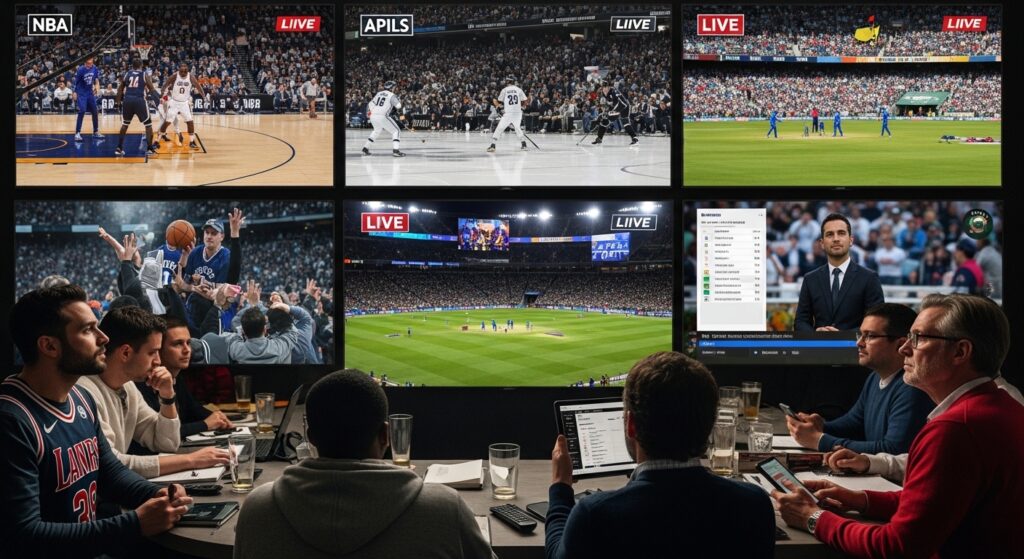
From playoff races in basketball and hockey to baseball’s opening weeks, Champions League knockouts, golf’s first major and cricket’s nonstop prime-time drama, April has again become one of the most crowded and compelling months in the global sports year.
April has long occupied a special place in the sports calendar, but in 2026 the month again feels unusually dense, with multiple seasons colliding rather than taking turns. In North America, professional basketball and ice hockey are moving into the final stretch of the regular season, where every night can alter playoff matchups and postseason survival. Major League Baseball, by contrast, is only just settling into its daily rhythm, offering fans the first meaningful clues of the summer ahead. In Europe, the UEFA Champions League has reached the quarter-final stage, where the margins narrow and the global audience expands. In India and across the cricket world, the Indian Premier League is filling the month with near-nightly spectacle. On the golf side, the Masters has once again turned Augusta into the center of the sport’s attention. Even before the NFL Draft arrives later in the month, April already feels like a compressed festival of elite competition.
What makes this period so attractive is not simply the number of events, but the range of emotional stakes packed into the same few weeks. Some sports are in the phase of climax, when a season’s worth of work is about to be judged. Others are in a phase of anticipation, when contenders are only beginning to reveal themselves. That contrast produces a rare blend of urgency and possibility. One evening may feature a basketball team fighting for seeding, a baseball club trying to define its early identity, a Champions League heavyweight defending a first-leg deficit, and a golfer chasing a green jacket. Few months offer that kind of cross-sport simultaneity.
In the NBA, the calendar is particularly tense. With the regular season winding down, the standings show not just the expected powers but also a number of striking storylines. The Oklahoma City Thunder have surged to the top of the Western Conference at 64-17, while the San Antonio Spurs are close behind at 62-19, creating a top tier that has reshaped expectations in the West. In the East, the Detroit Pistons lead at 59-22 ahead of the Boston Celtics and New York Knicks, a reminder that April is often when surprising teams stop being treated as curiosities and start being viewed as legitimate postseason forces. At this stage of the season, every result can influence home-court advantage, play-in positioning and the psychological tone entering the playoffs.
The NHL is operating in a similar key, but with its own distinctive edge. The league’s official standings note that they are current as of April 10 and that 16 teams will qualify for the Stanley Cup Playoffs. That alone is enough to explain the intensity surrounding April hockey. This is the month when tiebreakers, road points, late equalizers and back-to-back fatigue all begin to matter more. Hockey fans know that the difference between finishing comfortably in a playoff spot and stumbling into a wild-card fight can be just a few games, which is why April carries a pressure that even the most crowded winter schedule cannot reproduce.
If basketball and hockey are about tightening pressure, baseball in April is about breadth and ritual. MLB opened the 2026 season on March 25 with the Yankees facing the Giants, followed by a full Opening Day slate on March 26. By the second week of April, the league has already slipped into the everyday cadence that makes baseball unique among major sports. Clubhouse moods are still fluid. Hot starts are either the first sign of something real or the beginning of an illusion. Pitching rotations are settling. Star players are trying to find timing. Fans are reacquainting themselves with the long-haul nature of the sport. What makes April baseball feel lively is not playoff pressure but abundance: nearly every day offers another slate, another story, another chance for a contender to announce itself or a favorite to look unexpectedly vulnerable.
The international football calendar adds a different kind of drama because April is where reputations are tested in public and at the highest level. UEFA confirmed the 2025-26 Champions League quarter-final ties and dates in March, with heavyweight matchups including Real Madrid against Bayern Munich and Paris Saint-Germain against Liverpool. By early April, the first legs were already underway, turning the competition from broad continental narrative into a series of high-stakes, detail-heavy battles. At this point in the tournament, every tactical shift feels magnified. A one-goal swing can recast an entire tie. April therefore becomes the month in which elite clubs are measured not by domestic consistency alone, but by their capacity to survive the most pressurized nights in Europe.
Cricket’s contribution to the month is no less significant. The official IPL schedule shows the 2026 tournament running through April with a relentless sequence of fixtures after beginning on March 28. That rhythm is part of the league’s appeal. The competition rarely leaves space for the story to cool. Teams can rise or fall within a week, emerging players can become headline names almost overnight, and the table can change shape before fans fully absorb the previous result. For broadcasters and digital audiences, April now means IPL as much as spring once meant any one domestic tradition. It supplies color, pace, celebrity and continuity, all at once.
Golf, meanwhile, claims one of the month’s most iconic windows. The Masters is being staged from April 6-12, with tournament rounds from April 9-12 at Augusta National. Because it is the first men’s major of the year, the event always carries more than ordinary tournament weight. It is about form, legacy and symbolism. The Masters marks the moment when a golf season begins to feel serious to a global audience. Its place in April is part of its power: while other sports are hurtling toward playoffs or just beginning long campaigns, Augusta offers a concentrated stage where tradition and current form meet in a single, highly recognizable frame.
The wider appeal of April sports also lies in its narrative layering. Fans no longer consume one sport at a time in neatly separated seasons. Streaming, highlight culture, social media and global rights distribution have trained audiences to move between competitions quickly. A supporter can watch Champions League football in Europe, shift to the IPL in India, catch NBA score updates from the United States, and still wake up to baseball results or Masters highlights. April rewards that style of consumption because it rarely asks viewers to choose one storyline only. Instead, it invites them into a running conversation across time zones.
That global overlap is commercially valuable as well. Leagues and broadcasters benefit from the fact that April offers both appointment viewing and constant background competition. There are tentpole events like the Masters and the Champions League quarter-finals, but there is also the steady hum of daily sport: baseball schedules, playoff races, league tables and prime-time cricket. For sponsors, platforms and media companies, this is the kind of month that sustains audience attention over weeks rather than just hours.
Still, the packed calendar comes with its own strain. Athletes face compressed pressure, especially in sports where April determines postseason access or title survival. Fans confront a glut of choice. Broadcasters juggle overlapping rights and start times. But those are, in a sense, signs of abundance rather than weakness. The difficulty of keeping up is part of what makes the month feel alive.
For now, April 2026 stands as a reminder of why this period is so prized in the sports world. It offers the sharp edges of elimination, the freshness of new beginnings and the grandeur of established tradition, all within the same stretch of weeks. In one month, sport becomes louder, faster and more consequential almost everywhere at once. That is why April does not merely host games. It creates a season of momentum in its own right.