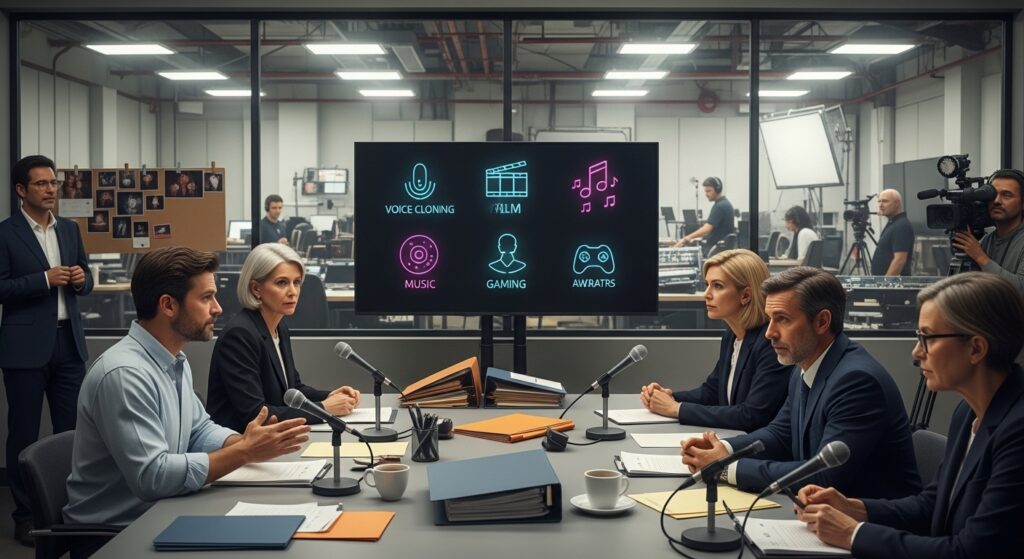
From script development and visual effects to music licensing, game voice work and creator-driven video production, artificial intelligence is moving from the margins of entertainment into the center of how content is made, sold and contested.
Artificial intelligence is no longer a speculative side story in global entertainment. It is becoming part of the industry’s daily operating reality. In film and television, executives and creative teams are testing AI tools for pre-visualization, editing support, dubbing, localization and digital production workflows. In music, labels and startups are moving from open conflict toward selected licensing deals that could turn AI into a new commercial layer of fan engagement. In gaming, the fight has moved beyond theory into labor contracts, where performers and publishers are trying to define how digital replicas of voices and performances may be created, used and paid for. Across the sector, the same pattern is taking shape: AI is entering the business not in one dramatic takeover, but through a series of practical openings that are beginning to reshape creative work.
That shift matters because entertainment has always been unusually sensitive to technological disruption. Every major change in distribution or production — sound, television, cable, digital editing, streaming, social video — has altered the balance between studios, artists, distributors and audiences. AI is proving more disruptive because it touches not only distribution and production, but the core of authorship itself. It can imitate style, synthesize voice, generate images, accelerate post-production and flood platforms with low-cost content. That makes it both a productivity tool and a direct challenge to traditional ideas of originality, consent and compensation.
In Hollywood, AI’s presence is now too visible to dismiss as experimental. Industry panels, executive discussions and creator summits increasingly treat it as an unavoidable part of the next business cycle. That does not mean the resistance has disappeared. Quite the opposite. Writers, actors and other creative workers still see the technology as a possible threat to jobs, bargaining power and artistic control. But the conversation has changed. The question is no longer whether AI will enter the entertainment industry. The question is under what rules, with whose permission and for whose benefit.
For studios and platforms, the attraction is obvious. AI promises lower costs, faster turnaround and greater flexibility in a market already under pressure from weakened advertising, fierce competition in streaming and rising production budgets. Tools that can quickly generate concept art, propose alternate edits, assist with visual planning or streamline multilingual versions of a show are commercially appealing even before fully generative uses become mainstream. For executives, AI is increasingly framed not as a replacement for talent in every area, but as a way to compress time and increase output in a business that has become structurally more expensive.
Yet for creative workers, efficiency is not a neutral word. In film and television, many writers and performers fear that “assistive” tools can gradually become leverage against human labor. A producer may begin by using AI to generate rough concepts or temporary dialogue. Later, the same logic may be used to reduce headcount, push unpaid revisions or pressure artists to compete against machine-generated alternatives. That anxiety has already shaped labor negotiations. The industry learned during the 2023 Hollywood strikes that AI is not a side issue. It is a central workplace issue, tied directly to credit, residuals, employment length and control over creative identity.
The same tensions are now spreading into newer corners of entertainment. Video games, one of the world’s largest and fastest-moving media businesses, have become a particularly important battleground because voice, motion and character performance are already deeply digitized. AI fits naturally into game production, where vast volumes of dialogue, non-player character interactions and multilingual content create strong incentives for automation. But that very logic collides with performers’ concerns that their voices or mannerisms can be cloned, reused or extended without meaningful consent. As a result, gaming is becoming one of the first sectors where the industry is trying to codify detailed AI guardrails rather than merely debate them in public.
Music offers a slightly different picture. Here, the conflict is increasingly taking a dual-track form. On one side, artists, labels and publishers continue to warn that unauthorized training on copyrighted songs threatens both artistic value and commercial rights. On the other, major music companies are beginning to experiment with licensed AI models and new products that could turn the technology into a controlled revenue stream. That marks an important change. The music business is not embracing unrestricted AI. It is trying to build a version of AI that can be monetized without surrendering ownership. The distinction may define how the wider entertainment industry proceeds: fight unlicensed systems, but partner with companies willing to pay for access and respect contractual boundaries.
That approach reflects a larger strategic calculation. Entertainment companies know they cannot simply halt AI’s advance through protest alone. The technology is spreading through creator platforms, consumer apps and production software too quickly for that. Instead, the industry is increasingly trying to split the market into acceptable and unacceptable uses. Licensed voice clones, negotiated replica rights and consent-based model training may become part of the formal economy. Unauthorized scraping of performances, characters, scripts and songs may remain the red line. In effect, entertainment is building a permissions architecture around AI while acknowledging that the underlying tools are here to stay.
This is also why the creator economy has become part of the story. AI is not only affecting major studios and global labels. It is also lowering barriers for small producers, influencers and internet-native storytellers who can now create polished material with fewer staff and lower budgets. That is exciting for many in the business because it expands who gets to make entertainment. It also unsettles traditional gatekeepers because it shifts creative power outward, toward smaller teams and individuals who can move faster than legacy companies. The result is a blurring of lines between amateur and professional, platform content and studio content, assistance and authorship.
Still, the industry’s concerns are not only economic. They are cultural. Entertainment depends on audience trust in the emotional reality of performance. If viewers become unsure whether a face, voice or musical phrase is real, licensed or synthetic, the industry risks a credibility problem as much as a legal one. That is particularly true in an age when audiences are already wary of manipulated media, deepfakes and synthetic celebrity likenesses. AI may help create spectacular new forms of entertainment, but it can also cheapen the sense of authenticity on which stars, brands and franchises depend.
For regulators and unions, this means the next few years will be less about banning AI outright than about setting terms for its use. Consent, disclosure, compensation and control are emerging as the core principles. Who owns a digital likeness? Can a voice be licensed for one project but not another? Does an AI-assisted script change authorship or credit? Can a studio train internal tools on past work products? These are not abstract questions anymore. They are contract questions, policy questions and court questions.
The likely future is therefore neither a total machine takeover nor a simple return to old creative norms. AI is entering entertainment as a layered force. In some areas it will remain mostly invisible, quietly speeding up workflows behind the scenes. In others, especially music, gaming and synthetic video, it will become a visible commercial product in its own right. The winners may not be the companies that automate the most aggressively, but the ones that persuade artists and audiences that AI is being used responsibly, transparently and with real value added.
For now, the industry stands in an uneasy middle ground. AI has moved beyond hype and into contracts, licensing deals, labor protections and production pipelines. That is what makes this moment significant. Entertainment is no longer asking whether AI can enter the business. It is discovering that the technology has already arrived — and that the harder task now is deciding what kind of industry will exist after the entrance is complete.