
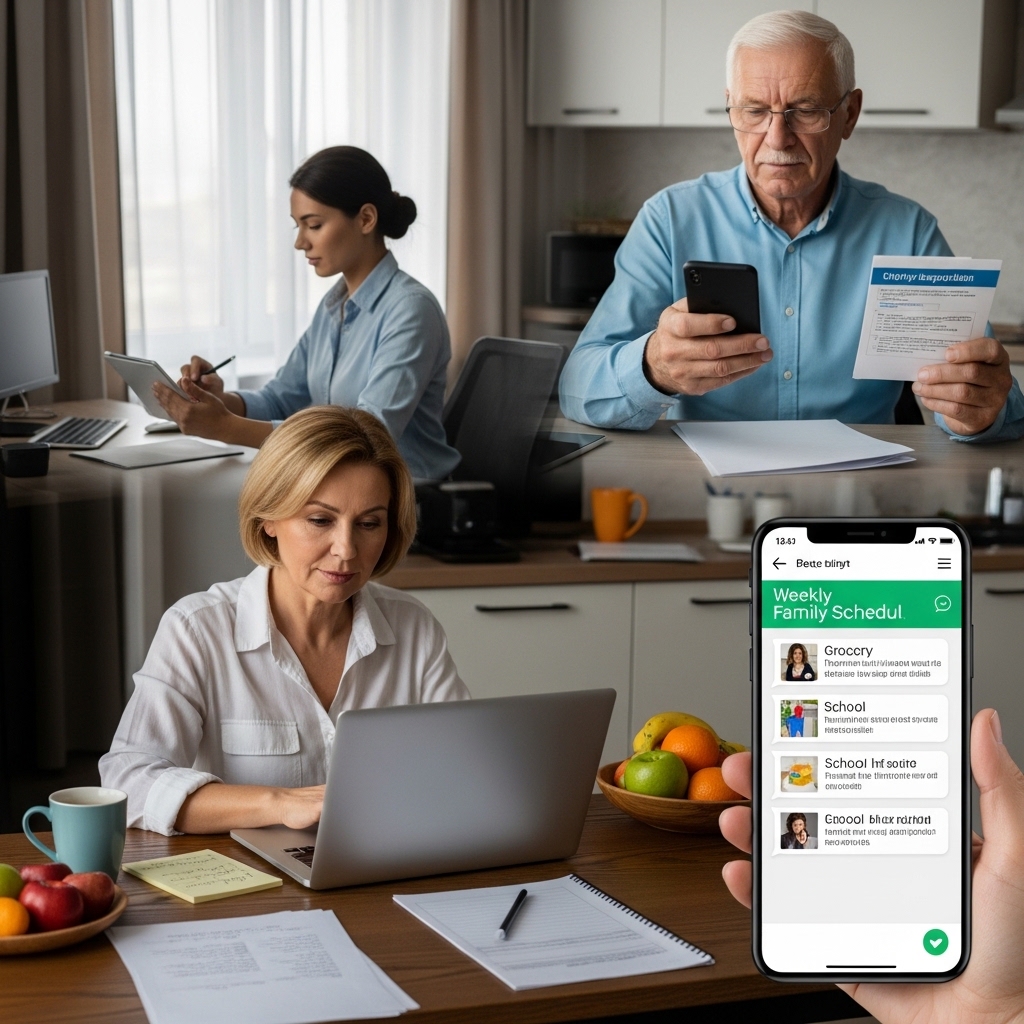
From planning dinner to managing money and learning new skills, artificial intelligence has moved quietly from novelty to routine.
Artificial intelligence once entered popular imagination as a tool for asking questions: a chatbot in a browser window, waiting for a prompt. In 2026, that view already feels narrow. For millions of ordinary users, AI is becoming less like a search box and more like an invisible layer across daily life — helping organize work, translate conversations, summarize information, draft messages, plan meals, edit images, coach learning and manage small decisions that used to consume time.
The shift is not happening evenly, and it is not without concern. Surveys show that many people remain cautious about privacy, accuracy, bias and the possibility that AI could replace human judgment. Yet the technology has moved far beyond early adopters. Pew Research Center reported that a large majority of Americans are aware of AI, and many say they would be willing to let it assist at least somewhat with day-to-day activities. Stanford’s 2025 AI Index described AI as increasingly embedded in society, business and public life. McKinsey has found that companies are investing heavily in AI, even as most are still learning how to turn experiments into mature systems.
What is most striking, however, is not the corporate race. It is the ordinary rhythm of use. AI is now showing up in kitchens, classrooms, commutes, offices, bedrooms and small businesses. The most common uses are not futuristic. They are practical.
The first everyday use is personal administration. People are asking AI to turn messy obligations into manageable plans. A parent with three children can paste a week’s school notices into a chatbot and ask for a calendar. A freelance worker can ask for a checklist before filing an invoice. A retiree can request a plain-language explanation of a confusing letter from a utility company. These uses do not require technical knowledge. They depend on the ability of AI systems to summarize, prioritize and reformat information.
This is why AI has become popular among people who do not consider themselves “tech users.” The value is not in the machine sounding clever. The value is in reducing friction. A long email becomes three bullet points. A confusing policy becomes a list of next steps. A scattered set of tasks becomes a schedule. For many users, that is enough.
The second use is writing and communication. AI is now a daily editor for emails, applications, customer replies, school notes and social media captions. Office workers ask it to make a message more diplomatic. Job seekers use it to tailor cover letters. Small-business owners use it to draft product descriptions. Non-native speakers use it to polish grammar without losing meaning.
This use has become especially important because modern life is text-heavy. People are expected to write constantly: to landlords, teachers, employers, clients, banks and government offices. AI helps people sound clearer and more confident. But it also raises questions about authenticity. Some employers and teachers worry that AI-generated writing can hide a person’s real ability. Users, meanwhile, often treat AI as a first draft rather than a final author. The most effective use is usually collaborative: the human provides the facts and judgment; the machine improves structure and tone.
The third use is learning. Students use AI to explain algebra, summarize historical events, quiz them before exams or translate difficult passages into simpler language. Adults use it to learn coding, cooking, photography, investing basics or a foreign language. Unlike a traditional search engine, AI can respond to follow-up questions and adjust explanations to the learner’s level.
This has made AI a kind of always-available tutor. A teenager can ask why a physics formula works, not just what the formula is. A worker changing careers can request a 30-day learning plan. A language learner can practice a conversation without embarrassment. Used carefully, AI can support curiosity and persistence. Used carelessly, it can provide wrong answers with confidence. That is why educators increasingly emphasize verification, source checking and the difference between assistance and substitution.
The fourth use is shopping and household decision-making. Consumers now use AI to compare phone plans, choose a washing machine, plan a grocery list, find substitutions for ingredients or decide whether a product review pattern looks suspicious. Instead of scrolling through dozens of tabs, users ask for a comparison table or a recommendation based on budget, space and personal needs.
This kind of use shows how AI is changing search behavior. People are not only looking for information; they are asking for judgment. That can be helpful when the task is low-risk, such as choosing a vacuum cleaner or planning a dinner menu. It can be more dangerous when the advice concerns health, debt, legal disputes or major financial decisions. AI can organize information, but it should not replace qualified professionals where stakes are high.
The fifth use is health and wellness organization. Many people use AI to prepare questions for a doctor, understand medical terms, track symptoms, design a basic exercise routine or plan meals around dietary goals. For someone facing a rushed appointment, an AI-generated list of questions can make the conversation with a clinician more productive. For someone trying to build healthier habits, AI can help create realistic routines.
The boundary is important. AI should not diagnose serious conditions or encourage users to ignore professional care. Its safer role is preparation and organization: explaining terms in plain language, helping users describe symptoms clearly, or reminding them what to ask a licensed provider. The promise is not that AI becomes a doctor. The promise is that people arrive better informed.
The sixth use is creative production. Ordinary users are generating birthday invitations, podcast outlines, music concepts, short videos, interior design ideas and photo edits. A restaurant owner can mock up a poster. A teacher can create a classroom activity. A couple planning a wedding can test color palettes. Someone redecorating a small apartment can ask for layout suggestions before buying furniture.
This use has expanded because generative AI can turn vague ideas into visible drafts. It lowers the barrier between imagination and prototype. But it has also intensified debates over copyright, artistic labor and disclosure. Professional artists worry that their work has been used to train systems without consent. Newsrooms, publishers and brands are developing rules about when AI-generated images must be labeled. For everyday users, the practical lesson is simple: AI can help brainstorm and mock up ideas, but transparency matters when images or text could be mistaken for real events or human-made work.
The seventh use is translation and cross-cultural communication. AI translation is helping travelers, migrants, international families and small exporters communicate across languages. A worker can translate safety instructions. A tourist can understand a menu. A family can write to relatives abroad. A small seller can answer a customer in another country.
Machine translation has existed for years, but newer AI systems are more conversational. They can explain tone, cultural context and alternative phrasings. Still, mistakes remain possible, especially in legal, medical or emotionally sensitive contexts. A mistranslated phrase can cause confusion or offense. For casual communication, AI is often useful. For official documents, human review remains essential.
The eighth use is workplace productivity. Even employees who are not programmers are using AI to summarize meetings, draft presentations, analyze spreadsheets, prepare reports and generate ideas. In many offices, AI has become a quiet assistant. It does not replace the meeting, the manager or the specialist, but it reduces the time spent turning raw information into usable form.
Companies are still struggling with governance. Some workers use public AI tools without knowing whether they are allowed to upload internal documents. Others worry that automation will be used to monitor or reduce staff. The strongest workplace uses tend to happen when organizations set clear rules: what data can be entered, what outputs must be reviewed, and which decisions require human accountability.
Across all eight uses, the pattern is consistent. AI is most helpful when it handles the first version, the summary, the translation, the comparison or the routine structure. It is least reliable when users treat it as an unquestioned authority. The difference matters because AI systems can produce errors, invent details and reflect biases in their training data. They can sound certain even when they are wrong.
The everyday AI era is therefore not defined by people surrendering decisions to machines. It is defined by people learning when to delegate small tasks and when to keep judgment firmly human. The best users are not those who ask the most complicated prompts. They are those who know what they want, check what they receive and understand the limits of the tool.
The deeper story is cultural. AI is becoming ordinary not because people fully trust it, but because it is useful enough to try. It saves minutes, reduces anxiety, improves drafts and opens possibilities for people who lack time, confidence or specialized training. That is how technologies become part of life: not all at once, and not only through grand breakthroughs, but through repeated small conveniences.
The question is no longer whether AI can answer questions. It can. The more important question is how societies will shape its presence in the ordinary routines where people work, learn, shop, care for families and make decisions. For now, the answer is being written every day — in grocery lists, emails, homework sessions, meeting notes and translated conversations — by users who may never call themselves early adopters, but who are already living with AI.