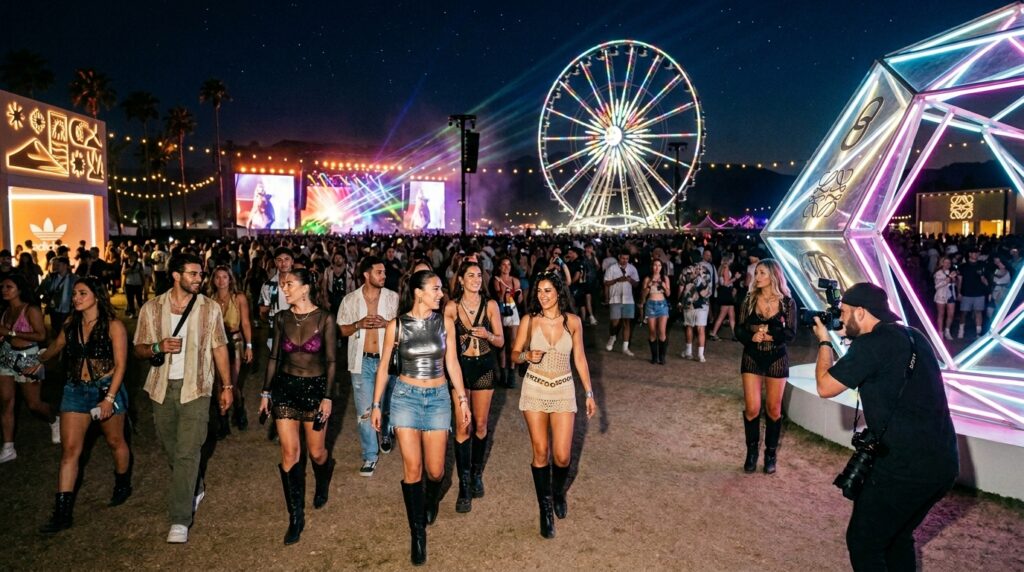
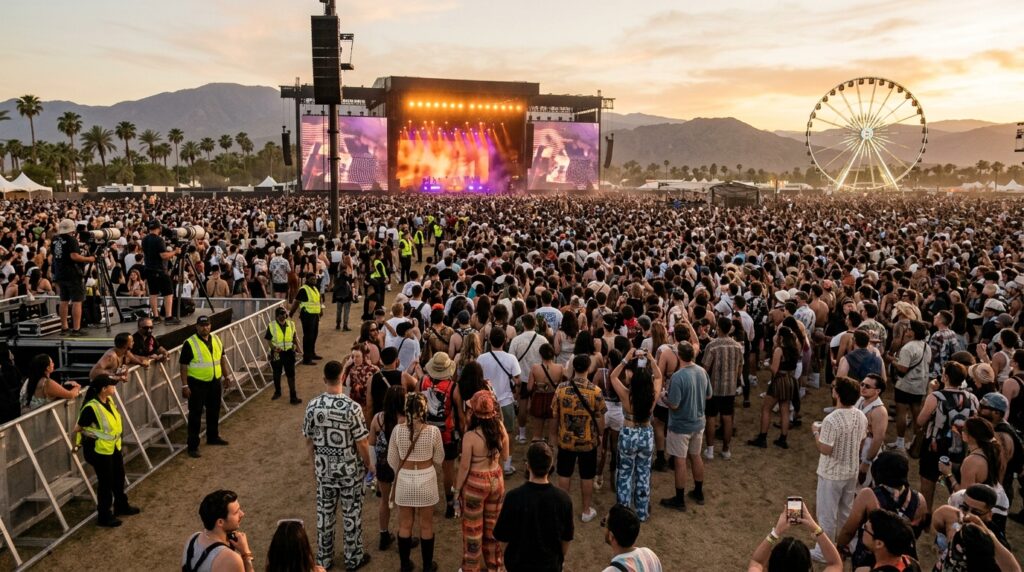
Coachella returned to the California desert this April with the kind of gravitational pull few festivals in the world can still command, bringing together blockbuster headliners, fashion spectacle, brand activations and the annual scramble to define what popular culture looks like in real time.
The 2026 Coachella Valley Music and Arts Festival took place across two weekends, April 10–12 and April 17–19, at the Empire Polo Club in Indio, California, with Sabrina Carpenter, Justin Bieber and Karol G topping the bill. The official festival lineup confirmed all three as headliners, anchoring a roster that also included major crossover names such as The Strokes, the xx, Turnstile, Young Thug, FKA twigs, Addison Rae, Laufey and many more. :contentReference[oaicite:1]{index=1}
That alone would have been enough to make Coachella one of the biggest entertainment events of April. But the festival’s importance in 2026, as in many recent years, reached well beyond the nightly sets. Coachella has become an annual pressure point for the wider culture: a place where artists test live narratives, celebrities and brands stage visibility, and fashion trends are accelerated through a feedback loop of performance, social media and commerce. By the time the second weekend ended, the desert had once again served as both concert venue and cultural amplifier. :contentReference[oaicite:2]{index=2}
The headliner mix helped explain the scale of attention. Sabrina Carpenter arrived as one of pop’s most commercially potent names, representing the kind of artist Coachella increasingly values: chart-proven, visually fluent, highly online and broad enough in appeal to draw both devoted fans and general-interest spectators. Justin Bieber, meanwhile, brought a different kind of gravity. His presence linked the festival to more than a decade of pop celebrity history, and coverage of the event quickly centered not only on his performances but also on the broader branding ecosystem around him and Hailey Bieber. Karol G’s headlining slot carried equal importance, underscoring the continued centrality of Latin music to the global mainstream and reinforcing Coachella’s role as a site where international audience power is reflected back into American pop infrastructure. :contentReference[oaicite:3]{index=3}
Festival coverage in the second weekend underscored how quickly Coachella can generate moments that spill into broader entertainment news. People reported on Madonna’s surprise appearance during Carpenter’s set, while separate coverage highlighted Bieber’s behind-the-scenes festival presence and additional guest moments involving artists such as Billie Eilish and SZA. These kinds of appearances matter because they extend Coachella’s relevance beyond ticket-holders. The event is watched as much through clips, recap culture and celebrity sightings as through the experience on the ground. :contentReference[oaicite:4]{index=4}
That dynamic has helped keep Coachella unusually central even as the live-music market has become more crowded. In purely musical terms, the festival no longer stands alone; there are more global festivals, more streaming-era stars, and more artists capable of building direct audiences outside traditional gatekeepers. Yet Coachella retains an outsized symbolic role because it compresses several industries into one weekend format. Music drives the event, but fashion, beauty, sponsorship, lifestyle media and social content increasingly shape how it is understood. :contentReference[oaicite:5]{index=5}
Fashion remains one of the clearest examples. Vogue recently asked what “Coachella style” should look like in 2026, a sign that the festival still functions as a seasonal reference point for how spring and festival dressing are imagined. Vanity Fair wrote this month that Coachella performances now rival high-profile world tours in scale and that festival costuming is closer to runway logic than ever before. Those observations point to a broader change in the event’s identity. Coachella style is no longer just shorthand for bohemian desertwear. It has become a more layered zone where celebrity styling, archival references, luxury branding and street-level experimentation mix together under the pressure of instant visibility. :contentReference[oaicite:6]{index=6}
Brands understand that visibility well. Fashionista reported this month that fashion and beauty companies once again poured heavily into Coachella-side activations in 2026, building pop-ups, photo moments and hospitality-driven experiences around the festival crowd. Forbes, in a separate piece, described the festival’s roadside billboards as some of the year’s most anticipated physical-media campaigns, arguing that Coachella has become a rare event where outdoor advertising itself turns into part of the spectacle. Together, those signals show why the festival still commands disproportionate commercial interest: it offers not just attendance, but concentration. Consumers, creators, celebrities and press all gather in a narrow time window, making the desert unusually efficient as a stage for influence. :contentReference[oaicite:7]{index=7}
This year’s editions also reinforced Coachella’s value as a trend laboratory. Fashion coverage tracked everything from celebrity festival looks to the reworking of old “festival fashion” codes, while broader cultural commentary treated the event as a snapshot of where youth and pop culture are moving. The most telling part is that these conversations often continue even when detached from any one performance. A festival outfit, a surprise guest, an artist billboard or a branded offsite lounge can circulate nearly as widely as a headline set. That diffusion is part of Coachella’s modern power. It does not merely host cultural moments; it produces assets that travel. :contentReference[oaicite:8]{index=8}
The 2026 lineup itself supported that broader role. Carpenter, Bieber and Karol G are not interchangeable stars. Together they reflect several major currents in the contemporary music business: pop’s renewed emphasis on personality and performance-world building, the enduring commercial value of legacy millennial stardom, and the rise of Spanish-language music as a permanent rather than peripheral force in the festival mainstream. Coachella’s booking can therefore be read not just as entertainment scheduling, but as a statement about where organizers believe audience energy is concentrated right now. :contentReference[oaicite:9]{index=9}
There is also a reason Coachella continues to matter to artists themselves. A strong set in Indio can function as a career marker, a reputational reset or a trailer for a broader touring cycle. A surprise appearance can revive older catalog interest. A wardrobe choice can become its own mini-news event. A weak showing, conversely, is often judged at scale and in public. Few festivals combine that level of opportunity and exposure in a setting so closely watched by both fans and industry peers. That is why headlining Coachella still carries prestige even in an era when artists can reach global audiences directly online. :contentReference[oaicite:10]{index=10}
By the end of April, Coachella 2026 had once again done what the festival does best: turn a run of concerts into a broader cultural referendum. It supplied major headliners, viral moments, celebrity cameos, fashion narratives and marketing theater, all while reinforcing the idea that one desert festival can still shape the month’s entertainment conversation. In a fragmented attention economy, that may be Coachella’s most durable achievement. It is no longer just a music festival people attend. It is a cultural event people track, decode and respond to — whether they are in Indio or not. :contentReference[oaicite:11]{index=11}”””